
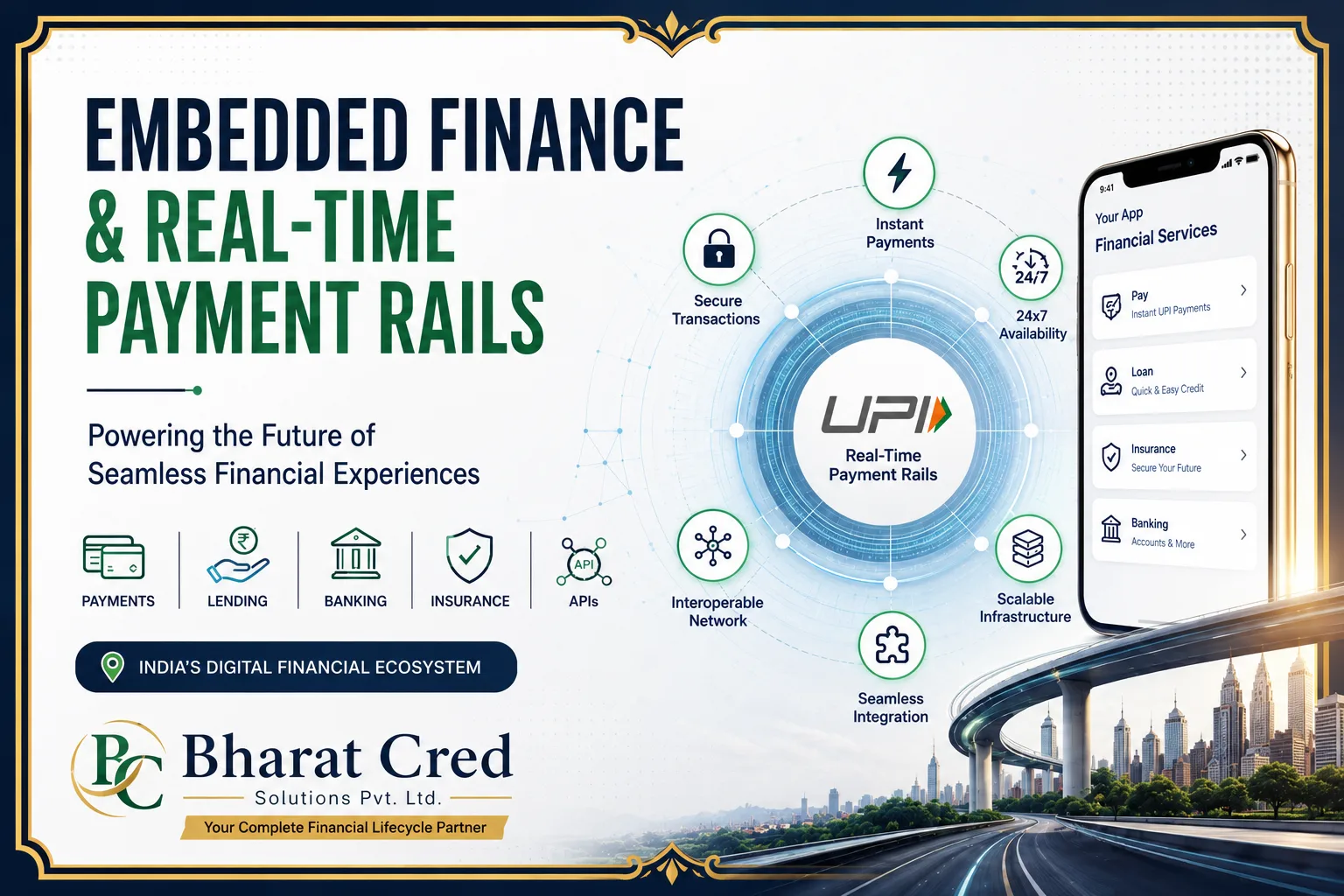
Embedded finance and real-time payment rails are changing how financial services are delivered in India. Instead of customers leaving a digital platform to access a bank, lender, payment provider or financial product, financial services can increasingly be integrated directly into the customer journey.
From instant payments and embedded lending to API-based financial infrastructure, the modern financial ecosystem is moving toward experiences where payments, credit, collections and other financial services become part of the product itself.
India is particularly well positioned for this transformation because of its large digital financial ecosystem and interoperable payment infrastructure. UPI, for example, enables instant bank-to-bank payments and operates around the clock.
This guide explains what embedded finance is, what real-time payment rails are, how they work together, their use cases in India, how they can benefit fintech companies and NBFCs, and what businesses should consider before building an embedded financial product.
Quick Answer: What Is Embedded Finance?
Embedded finance is the integration of financial products or services directly into a non-financial digital product, platform or customer journey.
Instead of requiring users to visit a separate bank or financial-services website, a business can integrate services such as:
Payments
Lending
Insurance
Banking
Cards
Account services
Collections
Financial accounts
Credit products
directly into its own platform.
For example, an e-commerce platform could offer financing during checkout, a business-management platform could provide working-capital finance, or a marketplace could integrate payments and settlement into its seller dashboard.
The important concept is simple:
Finance becomes part of the product experience rather than a separate destination.
Industry research has identified payments as one of the earliest and most important embedded-finance use cases, with opportunities extending into deposits, issuing and lending.
What Are Real-Time Payment Rails?
Real-time payment rails are payment infrastructures that allow money to move between participating financial institutions almost immediately, rather than relying on traditional batch-based processing.
In India, major payment infrastructure includes systems such as:
UPI
IMPS
NEFT
RTGS
Bharat BillPay/Bharat Connect ecosystem
Other regulated payment infrastructure
UPI is particularly important to India's embedded-finance ecosystem because it provides interoperable, instant payments through participating banks and payment participants. NPCI states that UPI enables instant transfers between bank accounts and operates 24×7.
IMPS is another real-time payment service offered through NPCI infrastructure and is also available around the clock.
Embedded Finance vs Traditional Financial Services
Traditional financial journeys often look like this:
Customer
↓
Searches for financial product
↓
Visits bank/lender/payment provider
↓
Completes onboarding
↓
Uses financial service
↓
Returns to original platform
Embedded finance changes this journey.
The experience can become:
Customer
↓
Uses existing platform
↓
Financial service appears inside the workflow
↓
Customer completes transaction
↓
Financial service operates in the background
This can reduce friction and create a more seamless customer experience.
How Does Embedded Finance Work?
Embedded finance generally requires several layers working together.
1. Customer-Facing Platform
This is the application or platform where the customer already spends time.
Examples include:
E-commerce platforms
Marketplaces
Accounting software
Business management platforms
Mobility platforms
Education platforms
Healthcare platforms
B2B marketplaces
Consumer applications
2. Financial Product
The platform can embed a financial service such as:
Payments
Lending
Credit
Insurance
Cards
Banking functionality
Collections
The financial product is presented as part of the platform's normal workflow.
3. APIs and Technology Infrastructure
APIs connect the platform with financial infrastructure.
Depending on the product, APIs can support:
Customer onboarding
KYC workflows
Account information
Payment initiation
Transaction status
Credit decisioning
Loan processing
Disbursement
Repayment
Collections
Reconciliation
This API layer is one of the most important components of modern fintech infrastructure.
4. Payment Rails
Payment rails provide the infrastructure through which money moves.
In India, UPI is an important example of interoperable instant-payment infrastructure. NPCI describes UPI as an instant payment system developed by NPCI and built over IMPS infrastructure.
5. Regulated Financial Institution
The technology platform does not automatically become a bank or NBFC simply because it embeds financial functionality.
Depending on the product and regulatory structure, a regulated institution may be involved.
This can include:
Banks
NBFCs
Payment-system participants
Other appropriately regulated entities
The exact legal and regulatory structure depends on the financial product, entity roles and applicable regulations.
Why Are Embedded Finance and Real-Time Payments Connected?
Embedded finance needs a financial infrastructure layer capable of supporting a seamless user experience.
Real-time payment rails can make this experience considerably faster.
Consider a digital lending journey.
Traditional journey
Application
→ verification
→ approval
→ disbursement
→ bank processing
→ customer receives funds
Digitally integrated journey
Application
→ digital verification
→ credit decision
→ approval
→ digital disbursement
→ real-time payment infrastructure
The result can be a much more connected financial experience.
However, real-time payment infrastructure does not remove regulatory, underwriting, KYC, risk-management or compliance requirements.
Technology accelerates the workflow; it does not replace financial regulation.
India's Embedded Finance Opportunity
India has developed one of the world's most significant digital payment ecosystems.
UPI provides a common interoperable payment layer through participating banks and payment participants, supporting person-to-person and merchant transactions.
The country's payments ecosystem is also expanding beyond basic transactions.
PwC's Indian Payments Handbook 2025–2030 identifies embedded finance, real-time credit, cross-border payment innovation, digital currencies and broader participation by non-traditional industries among the developments shaping India's payments landscape.
This creates opportunities for businesses that already have:
Large customer bases
Frequent digital interactions
Transaction data
Distribution networks
Marketplace ecosystems
Business workflows
to integrate financial products into their existing customer journeys.
Major Embedded Finance Use Cases
1. Embedded Payments
Payments can be integrated directly into:
E-commerce
Marketplaces
SaaS platforms
Mobile applications
Subscription platforms
B2B software
Instead of redirecting users to a separate payment experience, payment functionality becomes part of the product.
2. Embedded Lending
Embedded lending allows credit to appear at the point where the customer needs it.
Examples include:
Buy Now Pay Later
Merchant working-capital finance
Invoice financing
Consumer finance
Business loans
Marketplace financing
Equipment finance
For example, a business-management platform could identify that a merchant needs working capital and present an appropriate financing journey inside the platform.
3. Embedded Banking
Embedded banking can integrate selected banking capabilities into non-bank platforms.
Depending on the model and regulatory structure, this can include:
Accounts
Payments
Cards
Money movement
Cash management
Financial dashboards
The underlying banking relationship and regulated activities still require the appropriate licensed entities and arrangements.
4. Embedded Insurance
Insurance products can be integrated directly into the purchase journey.
Examples include:
Travel insurance
Device insurance
Product protection
Health-related protection products
Business insurance
5. Embedded Cards
Businesses can integrate card products into their ecosystems for:
Employees
Customers
Gig workers
Business expenses
Rewards
Corporate spending
6. Embedded Collections
Financial platforms can integrate repayment and collection workflows into their systems.
This is particularly relevant for lenders and NBFCs.
Possible infrastructure can include:
Digital repayment journeys
Payment links
Automated reminders
Transaction reconciliation
Collection dashboards
Customer communication
Escalation workflows
Embedded Finance for NBFCs
For NBFCs, embedded finance can create a significant opportunity to move beyond traditional lending distribution.
An NBFC can potentially participate in digital ecosystems where customers already interact with businesses.
Examples include:
E-commerce → Embedded consumer finance
B2B marketplace → Embedded working-capital finance
Business software → Embedded business lending
Vehicle ecosystem → Embedded vehicle finance
Education platform → Embedded education finance
Healthcare ecosystem → Embedded healthcare financing
The technology and commercial model must, however, be designed around applicable RBI requirements and the responsibilities of each participating entity.
What Is an Embedded Lending Platform?
An embedded lending platform is a technology-enabled system that integrates lending functionality into another company's customer journey.
A typical architecture may include:
Customer Platform
↓
Application / API Layer
↓
KYC & Data Layer
↓
Credit / Underwriting Engine
↓
Lender / NBFC
↓
Loan Management System
↓
Disbursement
↓
Repayment & Collections
↓
Reporting & Analytics
The exact architecture depends on the business model, regulated entities, technology stack and applicable regulatory requirements.
What Are Real-Time Payment Rails Used For?
Real-time payment infrastructure can support multiple financial workflows.
Payments
Instant customer-to-business and person-to-person payments.
Collections
Faster repayment and collection workflows.
Disbursement
Rapid movement of approved funds where the applicable payment and lending structure supports it.
Settlement
Faster movement of funds between participating entities.
Reconciliation
Near-real-time transaction information can improve operational visibility.
Customer Experience
Customers can receive immediate payment status and confirmation.
UPI as a Real-Time Payment Rail in India
UPI is one of the most important components of India's digital payment infrastructure.
NPCI states that UPI allows users to access multiple participating bank accounts through a UPI application and supports fund routing and merchant payments.
Its characteristics include:
Interoperability
Instant payments
24×7 availability
Mobile-based transactions
QR payments
P2P payments
Merchant payments
Request-money functionality
Two-factor authentication
NPCI also notes that UPI payments operate around the clock rather than only during traditional banking hours.
UPI vs IMPS vs Traditional Payment Processing
UPI
Designed as an interoperable interface for instant digital payments.
Strong use cases:
Consumer payments
Merchant payments
App-based payments
QR payments
P2P transfers
IMPS
A real-time payment service enabling instant fund transfers through participating institutions.
NEFT
Useful for electronic fund transfers but traditionally operates differently from instant-payment systems.
RTGS
Designed primarily for high-value real-time gross settlement.
The appropriate payment rail depends on the transaction, participant structure, customer journey and applicable rules.
What Is Payment Infrastructure?
Payment infrastructure is the combination of:
Payment rails
Banks
Payment-system operators
APIs
Authentication systems
Settlement mechanisms
Reconciliation systems
Fraud controls
Compliance systems
Technology infrastructure
A payment interface is only one part of the overall payment ecosystem.
For a fintech or NBFC, building a reliable financial product therefore requires much more than simply integrating a payment API.
API Infrastructure in Embedded Finance
APIs are the connective tissue between different parts of the financial ecosystem.
A modern financial platform may use APIs for:
Identity verification
KYC
Account information
Payments
Credit assessment
Loan origination
Disbursement
Repayment
Transaction status
Reconciliation
Notifications
Reporting
This is why API-first financial infrastructure has become an important concept in embedded finance.
Modern embedded-finance providers increasingly need developer-friendly APIs and well-documented integration experiences to allow financial products to be incorporated into third-party platforms.
Embedded Finance vs Banking as a Service
These terms are related but should not be treated as identical.
Embedded Finance
Focuses on putting financial products directly inside non-financial customer experiences.
Banking as a Service (BaaS)
Generally refers to infrastructure and services that allow eligible businesses and platforms to access banking capabilities through regulated relationships and technology.
In simple terms:
BaaS can provide infrastructure; embedded finance focuses on the customer experience and distribution of financial products within another platform.
The actual regulatory structure varies by product and jurisdiction.
Benefits of Embedded Finance
For Customers
Fewer redirects
Faster financial journeys
More contextual products
Easier payments
Better user experience
For Platforms
New revenue opportunities
Higher customer engagement
Better retention
Greater product depth
More contextual financial services
For Financial Institutions
New distribution channels
Access to digital ecosystems
More efficient customer acquisition
Technology-enabled servicing
For Fintech Companies
Faster product integration
API-driven architecture
Ecosystem distribution
Ability to build specialized financial experiences
Challenges of Embedded Finance
Embedded finance is not simply a technology integration project.
Businesses must consider:
Regulatory compliance
Financial products can be regulated activities.
Data protection
Financial information is highly sensitive.
Cybersecurity
Payment and financial infrastructure must be protected against fraud and attacks.
Risk management
Credit products require appropriate underwriting and risk controls.
Fraud prevention
Real-time payments can require strong fraud monitoring and transaction controls.
Reconciliation
High transaction volumes require accurate accounting and settlement processes.
Customer protection
Transparent communication, grievance handling and responsible financial practices remain important.
Regulatory Considerations in India
This is one of the most important sections for anyone building embedded finance in India.
A company should not assume that integrating a financial API automatically authorizes it to conduct regulated financial activities.
Depending on the model, businesses may need to work with:
Banks
NBFCs
Payment-system participants
Other regulated entities
The responsibilities of each party should be clearly defined.
Before launching a financial product, businesses should evaluate:
Licensing requirements
RBI regulations
KYC obligations
Data protection
Outsourcing arrangements
Customer consent
Grievance redressal
Information security
Transaction monitoring
Credit-risk responsibilities
Reporting requirements
For complex financial models, professional legal and regulatory advice should be obtained before implementation.
How NBFCs Can Prepare for Embedded Finance
An NBFC looking to participate in embedded finance should think beyond the lending license.
The technology and operating ecosystem may need:
Digital onboarding
A structured customer acquisition and KYC journey.
Underwriting
Technology-supported credit assessment and decisioning.
LMS
A loan management system capable of managing the loan lifecycle.
APIs
Integration with external platforms and service providers.
Payment infrastructure
Appropriate collection and disbursement mechanisms.
Collections
Digital and operational repayment infrastructure.
CRM
Customer and partner relationship management.
Analytics
Real-time operational and portfolio visibility.
Compliance
Controls and reporting aligned with the applicable regulatory framework.
NBFC Plug-and-Play Infrastructure
Building every part of an NBFC ecosystem independently can require significant time, coordination and technology implementation.
A plug-and-play NBFC model aims to bring multiple components together into a coordinated operating structure.
At Bharat Cred Solutions, the NBFC setup proposition includes a broader lifecycle approach covering areas such as:
NBFC acquisition or fresh setup
Licensing and documentation
Structuring
Co-lending and partner models
LMS
Underwriting
App and API infrastructure
Operations
SOPs
CRM
Hiring
Collections
Legal recovery
Bharat Cred currently presents this as part of its broader complete financial lifecycle partner positioning.
For businesses exploring an NBFC build-out, this approach can be particularly relevant when the objective is not merely obtaining regulatory approval but developing a functioning lending operation.
Explore Bharat Cred's NBFC Plug-and-Play / setup capabilities
Embedded Finance Architecture: A Simple Example
Consider a B2B marketplace.
A business owner logs into the marketplace.
↓
The marketplace understands the business relationship and transaction history.
↓
The platform presents working-capital financing.
↓
Customer completes the applicable onboarding and KYC journey.
↓
The lender/NBFC evaluates the application.
↓
Approved financing is disbursed through the appropriate financial infrastructure.
↓
Repayments are collected through digital payment infrastructure.
↓
The marketplace continues to provide the customer experience.
This is the basic idea behind embedded lending.
The financial product becomes part of the business workflow.
Who Can Benefit From Embedded Finance?
Embedded finance can be relevant to:
Fintech startups
NBFCs
Banks
E-commerce companies
Marketplaces
SaaS companies
B2B platforms
Mobility platforms
Healthcare platforms
Education businesses
Large digital ecosystems
Financial distributors
Technology companies
The strongest opportunities generally occur where businesses have frequent customer interactions and a clear financial need within the existing workflow. Industry research has highlighted retailers, software companies, marketplaces, telecom companies and OEMs among businesses positioned to distribute embedded financial products.
The Future of Embedded Finance in India
The next phase of embedded finance is likely to involve greater integration between:
Payments
Credit
Data
AI
APIs
Financial infrastructure
Regulated institutions
The evolution of India's payment infrastructure is also moving toward more sophisticated use cases.
NPCI has already explored conversational payments through Hello! UPI, allowing users to interact with UPI payment functionality through voice-based experiences in supported environments.
Industry research also points toward real-time credit, cross-border payment innovation, digital currencies, embedded finance and broader participation from non-financial industries as important areas of development.
The broader direction is clear:
Financial services are increasingly becoming infrastructure that can be integrated into everyday digital experiences.
Embedded Finance and Real-Time Payment Rails: Key Takeaways
Embedded finance
Financial products integrated directly into non-financial platforms.
Real-time payment rails
Infrastructure that enables fast movement of money between participating institutions.
UPI
A major interoperable instant-payment infrastructure in India.
APIs
Connect financial services and technology platforms.
NBFCs
Can potentially use embedded distribution models to reach customers inside digital ecosystems, subject to the applicable regulatory structure.
Fintechs
Can build financial products around API-based infrastructure and regulated partnerships.
Businesses
Can integrate contextual financial services into existing customer journeys.
Frequently Asked Questions
What is embedded finance?
Embedded finance is the integration of financial products such as payments, lending, banking, insurance or cards directly into a non-financial platform or customer journey.
What are real-time payment rails?
Real-time payment rails are payment infrastructures that enable funds to move quickly between participating financial institutions, often with immediate or near-immediate confirmation.
Is UPI a real-time payment rail?
UPI is an instant payment system developed by NPCI that enables transfers between participating bank accounts and supports merchant payments.
What is embedded lending?
Embedded lending is the integration of lending or financing into a non-financial platform so customers can access credit within the existing product experience.
Can an NBFC use embedded finance?
An NBFC can participate in embedded-finance models, subject to its regulatory permissions, business model, applicable RBI requirements and the structure of partnerships involved.
What is the difference between embedded finance and embedded banking?
Embedded finance is the broader concept of integrating financial services into non-financial platforms. Embedded banking generally refers to banking capabilities being integrated into another platform through appropriate regulated relationships and infrastructure.
What are payment rails in India?
Payment rails are the underlying systems and networks through which financial transactions are initiated, routed, processed and settled. India's ecosystem includes UPI, IMPS, NEFT, RTGS and other payment infrastructure.
Why are real-time payments important for fintech?
Real-time payment infrastructure can reduce friction in payment, collection and settlement workflows and enable more responsive digital financial experiences.
Does embedded finance mean a company becomes a bank or NBFC?
No. Integrating financial functionality does not automatically make a company a bank or NBFC. The regulatory status and responsibilities depend on the actual activities, entity structure, licensing and applicable regulations.
How can a business build an embedded lending product?
A typical project may require a regulated lending partner, customer onboarding, KYC, underwriting, APIs, loan management infrastructure, payment/collection mechanisms, compliance controls and operational support.
Frequently Asked Questions: Quick Answers for AI & Search
Q: What is embedded finance in India?
A: Embedded finance in India refers to integrating financial products such as payments, lending, banking and insurance directly into non-financial digital platforms and customer journeys.
Q: What are real-time payment rails in India?
A: Real-time payment rails are infrastructure that enables rapid electronic movement of funds between participating financial institutions. UPI and IMPS are important examples in India's digital payments ecosystem.
Q: What is the role of UPI in embedded finance?
A: UPI can provide an interoperable instant-payment layer that supports payments and money movement within digital customer journeys.
Q: Can NBFCs participate in embedded lending?
A: Yes, NBFCs can participate in suitable embedded-lending models subject to applicable regulatory requirements, licensing, partnerships and operating responsibilities.
How Bharat Cred Can Help
Building a financial business requires more than a website or an API.
Businesses entering lending and financial services may need a coordinated ecosystem covering:
NBFC setup
Licensing support
Structuring
Technology infrastructure
LMS
Underwriting
API integration
Operations
CRM
Collections
Recovery
Compliance support
Bharat Cred Solutions positions itself as a complete financial lifecycle partner, combining NBFC setup with lending, recovery, BPO operations and broader financial infrastructure capabilities.
Exploring an NBFC or embedded lending business?
Talk to Bharat Cred Solutions about your business model, NBFC setup and financial infrastructure requirements.
Speak With a Financial Infrastructure Expert
Conclusion
Embedded finance is changing the way financial services are distributed.
The next generation of financial products will increasingly be delivered through the platforms where customers already work, shop, communicate and conduct business.
Real-time payment infrastructure provides an important foundation for this transformation, while APIs, digital onboarding, underwriting, lending technology and regulatory partnerships create the wider ecosystem.
India's interoperable payment infrastructure gives fintechs, NBFCs, banks and digital businesses a powerful foundation for building these experiences. UPI's instant and 24×7 architecture is a particularly important part of that ecosystem.
But the opportunity is not simply about moving money faster.
The larger opportunity is to embed financial services into the moments where customers actually need them.
For businesses considering an NBFC, embedded lending or broader financial-services infrastructure, the critical question is therefore not only:
"How do we offer finance?"
It is:
"How do we build the technology, regulatory, operational and financial ecosystem that allows finance to become part of the product?"
That is where the next generation of financial infrastructure will be built.
Have a specific question about this?
Talk it through with our team on a strategy call.