
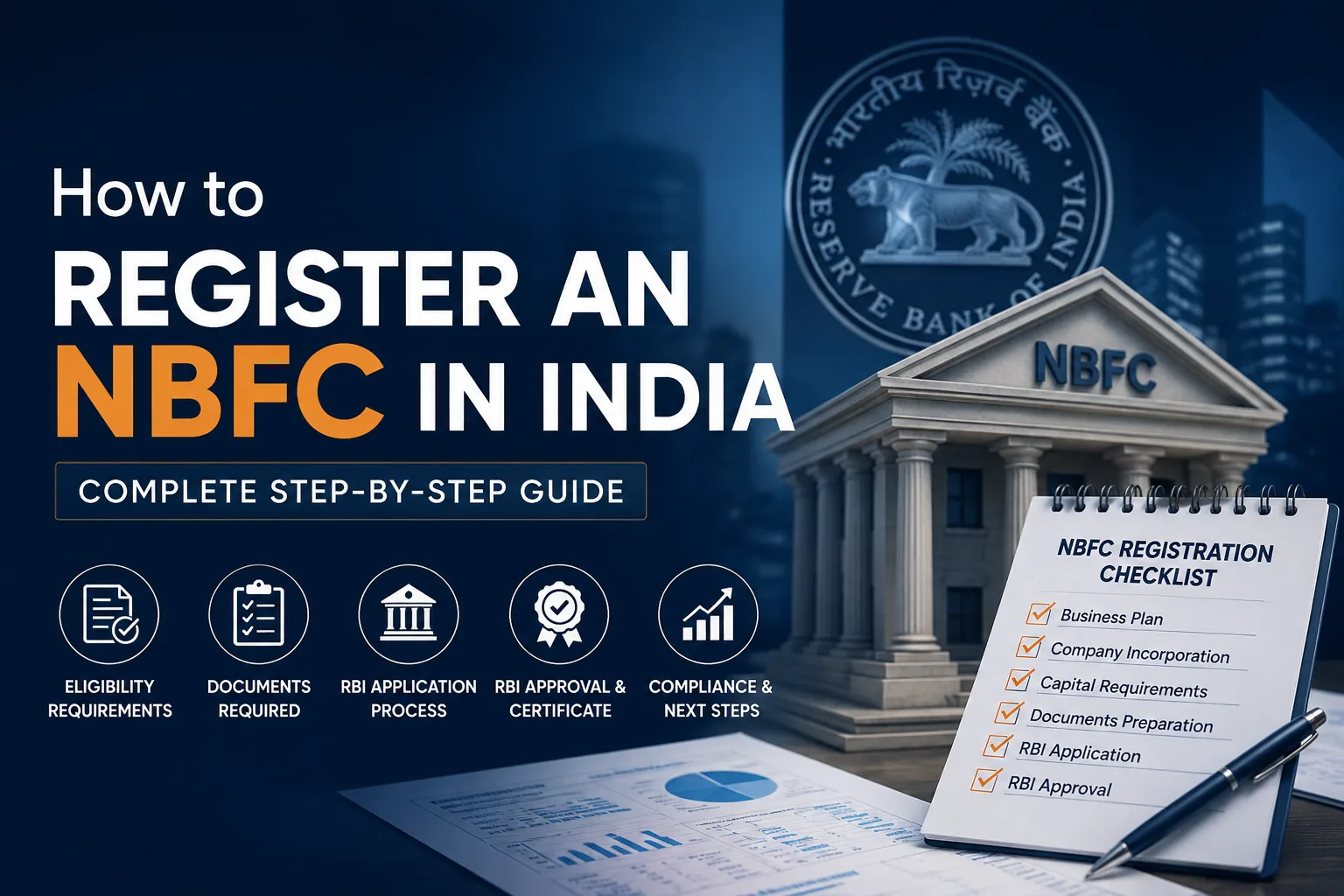
How to Register an NBFC in India: Complete Step-by-Step Guide
Starting a lending or financial services business in India requires careful planning, regulatory compliance, and approval from the appropriate authorities. For businesses looking to operate as a Non-Banking Financial Company (NBFC), registration with the Reserve Bank of India (RBI) is a critical regulatory requirement.
The NBFC registration process involves establishing a suitable company structure, meeting regulatory requirements, preparing the required documents, submitting an application to the RBI, and obtaining a Certificate of Registration (CoR).
In this guide, we explain the NBFC registration process in India step by step, including eligibility requirements, documents, capital requirements, RBI application procedures, expected timelines, and important compliance considerations.
Important: NBFC regulations and RBI requirements may change over time. Businesses should verify the latest applicable RBI directions and requirements before starting the registration process.
What Is an NBFC?
An NBFC (Non-Banking Financial Company) is a company registered under the Companies Act that carries out specified financial activities such as lending, financing, investment, or other permitted financial services.
Unlike traditional banks, NBFCs do not operate as full-service banks. However, they play an important role in India's financial ecosystem by providing credit and financial services to individuals, businesses, and specific sectors.
Depending on the business model and regulatory classification, NBFCs may operate in areas such as:
Lending and credit
Consumer finance
Business finance
Microfinance
Peer-to-peer lending
Factoring
Infrastructure finance
Investment activities
Asset finance
The exact regulatory framework applicable to an NBFC depends on its business activities and classification.
Who Can Register an NBFC in India?
Generally, an NBFC must be established as a company incorporated under the Companies Act and must meet the applicable regulatory requirements prescribed by the RBI.
Before beginning the registration process, promoters should determine:
The proposed business model
The type of financial activities the company will undertake
The applicable NBFC category
Capital requirements
Ownership and management structure
Regulatory and compliance obligations
Source of funds
Technology and operational infrastructure
This initial planning is important because choosing the wrong structure or business model can lead to delays during the regulatory approval process.
Step-by-Step NBFC Registration Process in India
Step 1: Determine the NBFC Business Model
The first step is to clearly define what the proposed company intends to do.
For example, the business may focus on:
Business loans
Consumer lending
Microfinance
Vehicle or asset finance
Investment activities
Peer-to-peer lending
Factoring
Other permitted financial services
The proposed activities will help determine the appropriate regulatory category and compliance requirements.
Why This Step Matters
Different NBFC categories can have different regulatory requirements. Therefore, promoters should identify the correct structure before preparing the application.
A well-defined business model also helps with:
Capital planning
Business projections
Management structure
Risk management
Technology requirements
Compliance planning
Step 2: Incorporate a Company
The proposed NBFC must be incorporated as a company under the applicable provisions of the Companies Act.
The incorporation process generally involves:
Selecting a suitable company name
Obtaining the required digital signatures
Obtaining Director Identification Numbers where applicable
Preparing incorporation documents
Filing the required forms
Obtaining the Certificate of Incorporation
The company's constitutional documents and business objects should appropriately reflect the proposed financial activities.
At this stage, it is important to ensure that the company's structure and objects are aligned with the proposed NBFC business model.
Step 3: Meet the Applicable Capital Requirements
The company must meet the applicable regulatory capital requirements for the proposed NBFC category.
The required capital level can depend on factors such as:
NBFC category
Type of financial activity
Regulatory framework
Business model
Applicable RBI requirements
The capital requirement should be assessed based on the latest RBI regulations applicable to the proposed category.
Important Consideration
Capital is only one part of the registration process.
The RBI may also assess factors such as:
Promoter background
Management experience
Financial strength
Source of funds
Business plan
Governance framework
Risk management systems
Compliance arrangements
Therefore, meeting the capital requirement alone does not guarantee registration.
Step 4: Prepare the Business Plan
A strong and realistic business plan is an important part of preparing for NBFC registration.
The business plan should explain:
Business objectives
Target customers
Products and services
Lending strategy
Revenue model
Funding strategy
Risk management
Technology infrastructure
Operational model
Management structure
Financial projections
Compliance framework
The plan should demonstrate that the proposed NBFC has a clear and sustainable operating model.
Step 5: Establish the Management and Governance Structure
The RBI may consider the experience, reputation, and suitability of the company's promoters and management.
The company should have an appropriate governance structure that supports:
Regulatory compliance
Risk management
Internal controls
Financial reporting
Customer protection
Responsible lending practices
The management team should have relevant experience and the ability to operate the proposed financial business effectively.
Step 6: Prepare the Required Documents
The exact documentation requirements depend on the company's structure, business model, and applicable NBFC category.
Commonly required documents may include:
Certificate of Incorporation
Memorandum of Association
Articles of Association
Company PAN
Company registration documents
Details of directors
KYC documents
Promoter details
Shareholding structure
Proof of registered office
Financial statements, where applicable
Bank statements
Source of funds documentation
Business plan
Financial projections
Board resolutions
Management profiles
Details of proposed financial activities
Compliance and risk management framework
Additional documents may be required depending on the specific circumstances of the applicant.
A complete and accurate documentation package can help reduce unnecessary delays.
Step 7: Apply for NBFC Registration With RBI
Once the company has been incorporated and the required documents and information have been prepared, the application for registration can be submitted through the applicable RBI process.
The application should contain accurate information regarding:
Company details
Directors
Promoters
Shareholding
Capital
Business activities
Financial projections
Management
Compliance systems
Source of funds
The applicant should ensure that the information provided across different documents is consistent and accurate.
Step 8: RBI Review and Due Diligence
After submission, the application may undergo regulatory scrutiny and due diligence.
The RBI may examine aspects including:
Promoter background
Directors and management
Financial position
Source of funds
Business model
Capital adequacy
Governance structure
Compliance framework
Risk management
Proposed operations
The regulator may request additional information or clarification during the review process.
The applicant should respond to such requests accurately and within the required timeframe.
Step 9: Address RBI Queries or Clarifications
During the review process, the RBI may raise questions or request additional documentation.
These queries may relate to:
Business activities
Promoter background
Source of capital
Shareholding
Financial projections
Management experience
Compliance systems
Operational arrangements
A well-prepared applicant should be able to respond with clear and properly documented information.
This stage can be critical because incomplete or inconsistent responses may delay the application process.
Step 10: Obtain the Certificate of Registration
If the RBI is satisfied that the applicant meets the applicable regulatory requirements, the company may be granted a Certificate of Registration (CoR).
Once registered, the NBFC must operate within the scope of applicable laws, RBI directions, and regulatory requirements.
Obtaining the Certificate of Registration is not the end of the regulatory journey.
The NBFC must continue to comply with applicable requirements throughout its operations.
How Long Does NBFC Registration Take?
The timeline for NBFC registration can vary significantly depending on:
Completeness of the application
Complexity of the business model
NBFC category
Promoter background
RBI queries
Additional documentation requirements
Regulatory scrutiny
Therefore, businesses should avoid relying on a fixed timeline without assessing their specific circumstances.
A properly prepared application with complete documentation can help reduce avoidable delays.
What Are the Costs Involved in NBFC Registration?
The overall cost of setting up and registering an NBFC may include:
Company incorporation expenses
Professional consultancy fees
Legal and compliance costs
Documentation expenses
Capital requirements
Technology infrastructure
Office and operational expenses
Compliance and audit costs
The capital requirement should not be confused with registration fees.
Capital represents the financial resources required to establish and operate the business, while professional and government-related costs are separate expenses.
The exact cost depends on the business structure, regulatory category, and operational requirements.
NBFC Registration vs NBFC Plug & Play
Starting a new NBFC from the beginning is not the only route available to businesses exploring entry into the financial services sector.
Depending on the business objectives and regulatory circumstances, entrepreneurs may also explore an NBFC Plug & Play or existing NBFC acquisition model.
New NBFC Registration
This generally involves:
Incorporating a company
Developing the business structure
Meeting capital requirements
Preparing documentation
Applying for regulatory approval
Building operations and compliance systems
NBFC Plug & Play
A Plug & Play model may provide an alternative route for eligible businesses looking to establish or expand financial operations using an existing regulatory and operational framework.
However, the suitability of any acquisition or Plug & Play structure depends on:
Regulatory status
Due diligence
Business objectives
Ownership and control requirements
RBI approvals, where applicable
Compliance history
Financial position
Businesses should conduct appropriate legal, financial, and regulatory due diligence before proceeding with any such structure.
Explore Bharat Cred's NBFC Plug & Play solutions to understand whether this model may be suitable for your business.
Common Reasons for Delays in NBFC Registration
Businesses can experience delays when:
Documents are incomplete
Information is inconsistent
The business model is unclear
Promoter information requires clarification
Source of funds is not adequately documented
Financial projections are unrealistic
Compliance systems are insufficient
RBI queries are not answered properly
Proper preparation before submission can significantly improve the quality of the application.
Common Mistakes to Avoid
1. Treating NBFC Registration Like a Standard Company Registration
Incorporating a company does not automatically give the company permission to conduct regulated NBFC activities.
2. Choosing the Wrong Business Structure
The proposed business activities should be carefully evaluated before selecting the applicable NBFC category.
3. Ignoring Regulatory Compliance
NBFC operations are subject to ongoing regulatory obligations.
4. Providing Inconsistent Information
All documents, financial projections, ownership details, and application information should be consistent.
5. Focusing Only on Capital
Meeting capital requirements does not automatically guarantee regulatory approval.
6. Starting Operations Without Appropriate Authorization
Businesses should not begin regulated financial activities without ensuring that all required regulatory permissions and approvals are in place.
NBFC Registration Checklist
Before applying, businesses should review the following:
☐ Business model finalized
☐ Appropriate NBFC category identified
☐ Company incorporated
☐ Constitutional documents reviewed
☐ Applicable capital requirements assessed
☐ Promoter and director information prepared
☐ Source of funds documented
☐ Business plan prepared
☐ Financial projections prepared
☐ Compliance framework established
☐ Risk management framework prepared
☐ Required documents collected
☐ Application information verified
☐ RBI submission process reviewed
☐ Post-registration compliance plan prepared
What Happens After NBFC Registration?
Once an NBFC is registered, the company must continue to comply with applicable regulatory requirements.
Depending on the nature of its activities, this may include:
RBI regulatory reporting
Financial reporting
KYC and AML requirements
Risk management
Corporate governance
Customer protection
Fair practices
Statutory audits
Regulatory returns
Record keeping
Compliance monitoring
The exact obligations depend on the applicable NBFC category and business activities.
Frequently Asked Questions About NBFC Registration
1. Can a private limited company register as an NBFC?
A company may be eligible to apply for NBFC registration if it meets the applicable legal and regulatory requirements prescribed by the RBI.
2. Is RBI approval required to operate as an NBFC?
Yes. Businesses conducting activities that fall within the regulatory framework applicable to NBFCs must comply with the relevant RBI requirements and obtain the necessary authorization.
3. How much capital is required for NBFC registration?
The applicable capital requirement depends on the type of NBFC and current RBI regulations. Applicants should verify the latest requirements for their proposed category.
4. How long does NBFC registration take?
The timeline varies depending on the application, documentation, regulatory review, and any queries raised during the process.
5. What documents are required for NBFC registration?
Documents may include incorporation records, constitutional documents, promoter and director details, financial information, source of funds, business plans, and other information required by the RBI.
6. Can an NBFC be acquired instead of starting a new one?
Depending on the circumstances, businesses may explore acquiring an existing NBFC or using an NBFC Plug & Play structure. Such transactions require careful legal, financial, and regulatory due diligence and may require regulatory approvals.
7. Can an NBFC start lending immediately after incorporation?
No. Incorporating a company alone does not authorize a business to conduct regulated NBFC activities. The company must obtain the required regulatory authorization before commencing activities that require such approval.
Conclusion
Registering an NBFC in India is a detailed regulatory process that requires careful planning, appropriate corporate structuring, adequate capital, complete documentation, and compliance with RBI requirements.
The process generally involves:
Business Planning → Company Incorporation → Capital Planning → Documentation → RBI Application → Regulatory Review → Clarifications → Certificate of Registration → Ongoing Compliance
For businesses considering entering India's lending and financial services ecosystem, the right preparation can make the registration journey more structured and efficient.
If you are evaluating NBFC registration, RBI licensing, NBFC compliance, or an NBFC Plug & Play solution, professional guidance can help you understand the appropriate route for your specific business objectives.
Looking to Start or Expand an NBFC Business?
Bharat Cred Solutions helps businesses navigate financial and regulatory requirements with solutions covering NBFC registration, compliance support, lending solutions, and NBFC Plug & Play opportunities.
Speak with our experts to discuss your requirements and explore the right path for your business.
Related Resources
NBFC Registration Fees: Complete Cost Breakdown
Documents Required for NBFC Registration
RBI Guidelines for NBFC Registration
NBFC Compliance Checklist
How to Check the RBI Registered NBFC List
NBFC Plug & Play: Complete Guide
NBFC Registration vs Plug & Play NBFC
How to Acquire an Existing NBFC in India
Disclaimer: This article is intended for general informational purposes only and should not be considered legal, financial, or regulatory advice. RBI regulations and applicable requirements may change. Businesses should verify the latest applicable regulations and seek qualified professional advice before taking regulatory or financial decisions.
Have a specific question about this?
Talk it through with our team on a strategy call.