

The Short Answer
Most foreign companies set up in India as a wholly-owned subsidiary — a private limited company incorporated under the Companies Act, 2013, with the foreign parent holding up to 100% of the shares. In most sectors this requires no prior government approval at all (the "automatic route"), and incorporation through India's SPICe+ system typically takes 7–15 working days once documents are ready.
The part almost no domestic-founder guide mentions: for a foreign company specifically, the real bottleneck usually isn't the Indian process — it's getting your home-country documents (board resolutions, director declarations, the parent company's incorporation certificate) apostilled or legalized before Indian authorities will accept them. That step alone can add anywhere from five working days to several weeks, and it happens entirely outside India's control. Start it first, not last.
Table of Contents
Why foreign companies are entering India right now
Choosing your entity structure
Which FDI route you're actually on
The real incorporation timeline, step by step
What it actually costs
Mistakes that delay foreign incorporations
A different path: setting up a Global Capability Center
Frequently asked questions
1. Why Foreign Companies Are Entering India Right Now
This isn't a trend building slowly — it's accelerating. India now hosts 2,117 Global Capability Centres, employing 2.36 million people and generating $98.4 billion in revenue in FY26 alone, according to the Nasscom-Zinnov India GCC Landscape Report 2026 — a figure already closing in on what the government had projected for 2030. More than 506 Forbes Global 2000 companies now run a GCC in India.
The reasons driving this are structural, not cyclical: global supply chain diversification away from single-country concentration, a deep and comparatively cost-effective technical talent pool, a large and growing domestic consumer market, and a genuinely faster regulatory path to market than existed even five years ago. India's SPICe+ system consolidated what used to be five separate government portals — company registration, PAN, TAN, GST, EPFO, and ESIC — into a single integrated filing.
None of this means entry is effortless. It means the door is wider than it used to be, and the companies moving fastest are the ones that understand the actual mechanics — not just the headline statistics.
2. Choosing Your Entity Structure
This is the first real decision, and it shapes everything downstream — tax treatment, compliance burden, and how much operational independence your India operation has.
Wholly-Owned Subsidiary (Private Limited Company) The default choice for most foreign companies planning genuine operations in India — hiring, selling, signing local contracts. Incorporated under the Companies Act, 2013, with the foreign parent holding up to 100% of shares in most sectors. Full operational and legal independence from the parent, which also means the subsidiary itself carries local liability, filing obligations, and tax residency.
Branch Office Allows an established foreign company to carry out permitted commercial activities in India without incorporating a separate legal entity. Requires RBI approval and generally suits companies wanting a direct extension of the parent rather than a distinct Indian company. Typical setup timeline runs 45–50 days — meaningfully longer than a subsidiary, since RBI approval sits in the critical path.
Liaison Office (Representative Office) Permitted only for non-commercial activities — market research, representing the parent, coordinating communications. Cannot invoice, generate revenue, or sign commercial contracts in India. Useful for companies still evaluating the market before committing capital. Setup typically takes 8–10 weeks given the RBI approval process.
Project Office A temporary structure for executing a specific contract in India, commonly used in infrastructure, EPC, and engineering projects. Exists only for the life of that project.
Joint Venture Structured as a private limited company with an Indian partner holding equity alongside the foreign investor. Makes sense where local partnership brings genuine value — regulatory relationships, distribution networks, sector-specific licensing — rather than being used purely to satisfy an ownership requirement, since most sectors no longer require one.
LLP (Limited Liability Partnership) Faster to register (7–10 working days) and lighter on ongoing compliance than a private limited company, but less familiar to Indian banks, government counterparties, and enterprise clients, which can matter for a foreign company trying to establish credibility quickly.
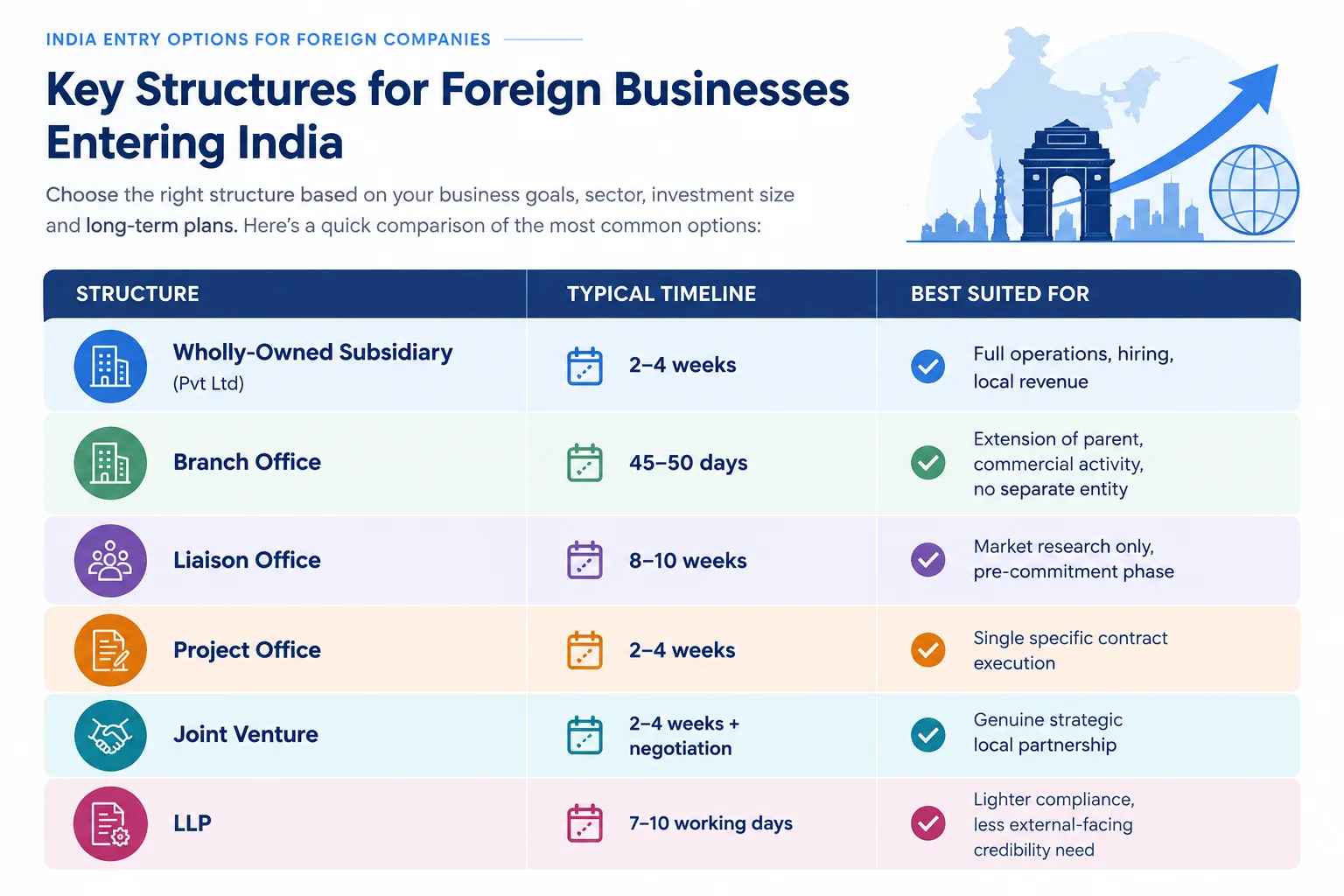
For most companies reading this — technology, services, manufacturing, GCC operations — the wholly-owned subsidiary is the right starting point, and it's what the rest of this guide focuses on.
3. Which FDI Route You're Actually On
India's FDI framework runs on two tracks, and knowing which one applies to you before you start is far cheaper than discovering it midway through.
The Automatic Route means no prior government approval is required — you invest, incorporate, and report the investment after the fact through an FC-GPR filing. Most sectors that matter to typical foreign entrants — IT and software, manufacturing, most professional services — allow up to 100% FDI under this route.
The Government Route applies to specific sensitive sectors and requires prior approval from the relevant ministry, the RBI, or both, before funds can move. This includes multi-brand retail (capped at 51%), print media (26%), defence and brownfield pharmaceuticals (above 74%), and telecom (49% automatic, 100% only via government approval). A small number of sectors — including lottery and tobacco manufacturing — are prohibited to foreign investment entirely. Government-route approval timelines generally run four to eight weeks.
One restriction worth knowing if it applies to you: under Press Note 3 of 2020, all investment from entities based in or beneficially owned by residents of countries sharing a land border with India — China, Pakistan, Bangladesh, Nepal, Bhutan, Myanmar, Afghanistan — requires government approval regardless of sector, though 2026 amendments now permit sub-10% non-controlling portfolio stakes under the automatic route.
A recent development worth knowing about: SEBI's SWAGAT-FI framework — a single-window system for onboarding trusted foreign portfolio and venture capital investors — went live on June 1, 2026, meaningfully simplifying entry for that specific investor category. If your India entry involves an FPI or FVCI structure rather than direct operational FDI, this changes your onboarding path.
Sector caps shift periodically — the insurance sector, for instance, was raised to 100% automatic-route FDI in the 2025-26 Union Budget cycle. Confirm your specific sector's current status against the DPIIT Consolidated FDI Policy before finalizing any structure, rather than relying on a general guide (including this one) for the final word.
4. The Real Incorporation Timeline, Step by Step
Domestic founders in India typically complete SPICe+ incorporation in 7–10 working days once documents are ready. For a foreign parent company, the honest timeline has an extra phase most guides skip entirely.
Phase 0 — Document Authentication (5 working days to several weeks, foreign companies only) Every document executed outside India — board resolutions authorizing the investment, the parent company's certificate of incorporation, director declarations, powers of attorney — must be notarized and apostilled (or, for non-Hague Convention countries, consularized through the Indian embassy) before Indian authorities will accept them. This step is governed entirely by your home country's process, not India's, and it's the single most common reason foreign incorporations run long. Start this before anything else, not in parallel with later steps.
Phase 1 — Name Reservation (1–2 working days) Filed through SPICe+ Part A. You can propose two names; if rejected, one resubmission is allowed. A trademark search on the IP India portal and a name search on the MCA portal beforehand meaningfully reduces rejection risk. Part A approval is valid for 20 days, so Part B needs to follow promptly.
Phase 2 — Digital Signature & Director Identification Every proposed director needs a Digital Signature Certificate from an MCA-recognized certifying authority, plus a Director Identification Number. Note: at least one director must be a resident of India — defined as someone who has stayed in India for 120+ days in the previous financial year. This surprises many foreign founders late in the process; plan for it from day one, not after a rejected filing.
Phase 3 — SPICe+ Part B Filing (the core incorporation form) This single filing bundles company incorporation, PAN, TAN, GSTIN, EPFO, ESIC, and profession tax enrollment — ten government registrations in one structured application, a major simplification versus the pre-2020 process, which required five separate portals.
Phase 4 — ROC Verification and Certificate of Incorporation Once verified, the Registrar of Companies issues the Certificate of Incorporation electronically, with PAN and TAN generated automatically.
Phase 5 — Post-Incorporation (within 30–180 days) Open a bank account, file the FC-GPR for your FDI within the required window, complete any sector-specific registrations, and hold your first board meeting within 30 days of incorporation under Section 173(1) of the Companies Act. A commonly missed deadline: you must file Form INC-20A confirming commencement of business within 180 days of incorporation — miss it, and the company cannot legally commence business or exercise borrowing powers, and the ROC can initiate strike-off proceedings.
Realistic total timeline for a foreign-parent subsidiary: 3–6 weeks from a standing start, once document authentication is accounted for — versus the 7–15 working days often quoted for domestic incorporations alone. Neither figure is wrong; they're answering different questions.
5. What It Actually Costs
Government filing fees are genuinely minimal — nil for companies with authorized capital up to ₹15 lakh, under current MCA rules. The real cost sits elsewhere:
Stamp duty — varies significantly by state, and by authorized capital amount. This is often the single largest line item founders don't anticipate.
Document apostille/legalization — cost varies by home country, but budget for it as a real line item, not an afterthought.
Professional fees — for a domestic incorporation alone, the realistic all-in range most founders report is roughly $70 – $250. For a foreign-parent subsidiary with cross-border document work, FDI structuring, and sector-cap verification, budget meaningfully above that baseline — the complexity, not the government fee, drives the cost.
Ongoing compliance — annual filings, statutory audit, FC-GPR and FLA return filings, and board governance requirements continue after incorporation and should be budgeted as a recurring cost, not a one-time event.
Treat any specific rupee figure you see quoted online — including in this guide — as a planning estimate, not a guarantee. Entity complexity and sector determine your actual cost more than any general benchmark can.
6. Mistakes That Delay Foreign Incorporations
These account for the overwhelming majority of delays we see in practice, and nearly all of them are avoidable with the right sequencing:
Starting document authentication too late. This is the single biggest one. If apostille takes three weeks and you only start it after your Indian filings are ready, you've added three weeks to your entire timeline for no reason.
Not identifying a resident director early. Discovering the resident-director requirement after your board and cap table are already decided creates real complications — sometimes solved with a nominee arrangement, sometimes requiring board restructuring. Address it in week one.
Assuming your sector is under the automatic route without checking. FDI caps and routes shift with policy updates. A sector that was 100% automatic eighteen months ago may carry different conditions now.
Choosing entity structure based on speed alone. A Liaison Office is faster to reject as an option than to correct after the fact — if you actually need to invoice customers or sign commercial contracts, a Liaison Office legally cannot do that, and discovering this after setup means starting over with a different structure.
Treating name approval as a formality. Rejected names cost real time. A basic MCA and trademark search before filing avoids most rejections entirely.
Missing the INC-20A deadline. A company that can't legally commence business 180 days post-incorporation because a routine compliance filing was missed is a self-inflicted, entirely preventable problem.
7. A Different Path: Setting Up a Global Capability Center
Not every foreign company entering India is opening a conventional operating subsidiary — a significant and fast-growing share are establishing Global Capability Centers: captive centers handling product engineering, operations, analytics, or increasingly AI development, for their global parent organization.
The entity-formation mechanics are largely the same as a wholly-owned subsidiary — the differences show up in scale, location strategy, and talent planning rather than legal structure. India's GCC base has grown 32% since FY2021, and more than half of existing GCCs have moved beyond basic cost-center functions into genuine transformation and ownership roles for their parent organizations. Bengaluru alone accounts for over 29% of all GCC units nationally, though Chennai, Mumbai, Delhi NCR, Hyderabad, and Pune all host substantial and maturing GCC ecosystems with meaningfully different cost and talent profiles.
If a GCC — rather than a conventional operating subsidiary — is the right entry model for your organization, the site-selection, talent-market, and real estate considerations deserve their own dedicated planning process, distinct from the incorporation mechanics covered here.
8. Frequently Asked Questions
Can a foreign company own 100% of an Indian company?
Yes, in most sectors, through the automatic route, with no prior government approval required. Certain sectors carry caps below 100% or require government approval — verify your specific sector before proceeding.
How long does it take to set up a company in India as a foreign business?
Domestic-only SPICe+ processing typically runs 7–15 working days. For a foreign parent, add document apostille/legalization time — realistically 3–6 weeks total from a standing start, depending on your home country's authentication process.
Do I need an Indian resident as a director?
Yes. At least one director must have stayed in India for 120 or more days in the previous financial year. This can be satisfied through a nominee director arrangement if no existing team member qualifies.
What is the automatic route versus the government route for FDI?
The automatic route requires no prior government approval — you invest and report after the fact. The government route requires prior approval from the relevant ministry and/or the RBI before funds transfer, and applies to specific sensitive sectors and to all investment from land-bordering countries under Press Note 3.
Can I open a branch office instead of a subsidiary?
Yes, subject to RBI approval, for permitted commercial activities. It doesn't create a separate legal entity from the parent, and typically takes 45–50 days to set up — longer than incorporating a subsidiary.
What's the difference between a liaison office and a branch office?
A liaison office cannot generate revenue or sign commercial contracts — it exists only for non-commercial representation and market research. A branch office can conduct permitted commercial activity. Choosing the wrong one is a common and costly mistake.
Does India allow 100% FDI in technology and IT services?
Yes, this is one of the sectors that permits up to 100% FDI under the automatic route, which is part of why it's the most common entry sector for foreign subsidiaries and GCCs.
What happens if I miss the INC-20A filing deadline?
The company cannot legally commence business or exercise borrowing powers, and the Registrar of Companies can initiate strike-off proceedings. This filing is due within 180 days of incorporation.
Is a Global Capability Center a different legal entity type from a subsidiary?
No — a GCC is typically structured as the same wholly-owned subsidiary described above. "GCC" describes the business function (a captive center serving the global parent), not a distinct legal category.
Planning to Set Up in India?
Every step above is genuinely manageable — but the sequencing matters more than most guides let on, and the mistakes that cost real time (starting apostille late, discovering the resident-director requirement mid-process, picking the wrong entity for what you actually need to do) are avoidable with the right guidance from day one.
Bharat Cred Solutions advises foreign companies, fintechs, and financial institutions on company registration, entity structuring, and regulatory compliance in India — including the RBI-specific licensing that applies if your India entry involves lending, NBFC registration, or other regulated financial activity.
📞 +91 92895 67208 | 🌐 bharatcredsolutions.com Financial • Regulatory • Trusted
Have a specific question about this?
Talk it through with our team on a strategy call.