
Introduction: Is Your NBFC's Compliance Function Ready for RBI's 2026 Directions?
An NBFC's compliance function is much more than a department responsible for filing returns and maintaining documents. It is an essential part of the company's corporate governance, regulatory risk management and operational control framework.
On 31 July 2026, the Reserve Bank of India (RBI) issued the Reserve Bank of India (Non-Banking Financial Companies – Compliance Function) Directions, 2026, under reference RBI/DoS/2026-27/460. The Directions came into effect upon issuance and apply to NBFCs in the Middle Layer (ML) and Upper Layer (UL), subject to the specified scope and applicable provisions.
The Directions establish minimum standards for compliance governance, the compliance function's structure and responsibilities, Board and senior management oversight, and the appointment and role of the Chief Compliance Officer (CCO). The framework follows the principle of proportionality, meaning the compliance structure should reflect the NBFC's governance arrangements, scale of operations, risk profile and organisational structure. Source: RBI Directions, 2026.
For NBFC promoters, directors, compliance professionals and fintech founders, this raises several practical questions:
What are the RBI compliance function requirements for NBFCs in 2026?
Which NBFCs need a Chief Compliance Officer?
What qualifications and reporting arrangements apply to a CCO?
What should a Board-approved NBFC compliance policy contain?
How should an NBFC conduct a compliance risk assessment?
Can an NBFC appoint an outsourced Chief Compliance Officer or virtual CCO?
What is the difference between outsourcing compliance support and outsourcing the compliance function itself?
How can an NBFC build an effective compliance framework without unnecessary operational complexity?
This guide answers these questions, explains the implementation process and provides a practical checklist for NBFCs reviewing their compliance arrangements.
Important distinction: Although searches such as “outsourced CCO for NBFC” and “virtual CCO for NBFC” reflect a genuine need for cost-effective expertise, an NBFC must not assume that outsourcing its compliance function is permitted. RBI's outsourcing framework identifies the compliance function as a core management function that should not be outsourced. External advisory support must therefore be distinguished from the NBFC's own compliance function and formally appointed CCO responsibilities.
1. What Are the RBI Compliance Function Directions, 2026?
The RBI Compliance Function Directions, 2026 establish minimum standards for the compliance framework of applicable Middle Layer and Upper Layer NBFCs.
The objective is to ensure that regulatory compliance is embedded into the company's governance and operating processes rather than treated as a task performed only before filing deadlines.
The framework addresses the following broad areas:
Board oversight and senior management responsibilities.
A Board-approved compliance policy.
Scope, structure, staffing and responsibilities of the compliance function.
Appointment and responsibilities of the Chief Compliance Officer.
Independence and appropriate reporting arrangements.
Compliance risk assessment, monitoring and testing.
Internal audit and oversight of regulatory compliance.
Compliance monitoring systems, workflows and reporting.
The exact requirements applicable to an NBFC should be assessed against the full text of the Directions, its regulatory classification and any other applicable RBI directions.
Why are these Directions important?
An NBFC can have a compliance calendar and still lack an effective compliance framework.
For example, a company might complete its periodic returns but fail to identify a regulatory change affecting a new lending product. Another might maintain policies that are not implemented in actual operations. A third might have a compliance officer whose reporting line makes independent escalation difficult.
A properly structured compliance function should help the NBFC identify obligations, assess compliance risks, monitor implementation, report deficiencies and follow up on corrective actions.
The objective is not simply to demonstrate that compliance activities occurred. It is to establish that regulatory risks are identified, monitored and addressed through an effective governance framework.
2. Which NBFCs Are Covered by the 2026 Compliance Function Directions?
The Directions apply to NBFCs in the Middle Layer and Upper Layer that hold registration under the Reserve Bank of India Act, 1934, or the Factoring Regulation Act, 2011, subject to the specified provisions.
The first step for any NBFC is to confirm its regulatory layer and identify the provisions applicable to its entity.
Middle Layer NBFC compliance requirements
A Middle Layer NBFC should review its compliance arrangements against the applicable RBI requirements, including the prescribed governance, policy, staffing, CCO and monitoring provisions.
The review should consider:
The NBFC's regulatory classification.
Its lending, financing or other permitted business activities.
Existing compliance policies and procedures.
The allocation of responsibilities between the Board, senior management and compliance personnel.
The independence and reporting arrangements of the compliance function.
The processes used to identify regulatory changes and compliance risks.
Monitoring, testing, reporting and corrective-action procedures.
Upper Layer NBFC compliance requirements
Upper Layer NBFCs should assess their compliance framework against the same Directions and any additional requirements arising from their applicable regulatory obligations.
Their assessment should consider the scale and complexity of their operations, risk profile, business activities, governance structure and the resources needed to monitor compliance effectively.
Do not assume that the same staffing model or compliance process will suit every NBFC. The required arrangement must be assessed against the applicable directions and the NBFC's circumstances.
What about Base Layer and other NBFCs?
The 2026 Compliance Function Directions described above specifically cover applicable Middle Layer and Upper Layer NBFCs. An NBFC outside this scope should not automatically assume that these particular Directions apply to it in the same way.
However, being outside the scope of this specific document does not mean that an NBFC has no compliance obligations. Other RBI directions, company law requirements, tax rules, anti-money-laundering obligations and sector-specific requirements may still apply.
Recommended action: Confirm the entity's regulatory layer and prepare an obligation-by-obligation applicability matrix before deciding what needs to change.
3. What Is a Chief Compliance Officer (CCO) in an NBFC?
A Chief Compliance Officer is a senior professional responsible for leading or overseeing the compliance function in accordance with the applicable regulatory framework and the NBFC's approved governance arrangements.
The CCO's role is not limited to maintaining a compliance calendar. It involves helping the NBFC establish a structured approach to identifying, monitoring, reporting and addressing compliance risks.
Depending on the applicable requirements, the compliance function may need to monitor regulatory obligations, assess compliance risks, evaluate the implementation of policies, report deficiencies and coordinate corrective actions.
What does an NBFC CCO do?
A CCO's responsibilities may include the following, subject to the exact requirements of the applicable RBI Directions and the role formally assigned:
1. Regulatory monitoring
Track relevant RBI directions, notifications, circulars and other regulatory requirements that affect the NBFC's activities.
2. Compliance risk assessment
Identify the company's key regulatory risks and assess where the probability or impact of non-compliance may be material.
3. Compliance policy and procedures
Support the development, implementation and periodic review of the NBFC's compliance policy, internal procedures and responsibility matrix.
4. Compliance monitoring and testing
Evaluate whether applicable requirements and internal controls are being implemented effectively. Record deficiencies and monitor remediation.
5. Reporting and escalation
Provide compliance reporting to the appropriate senior management, Board or committee in accordance with the prescribed governance arrangements.
6. New products and business activities
Assess the compliance implications of proposed products, processes and business changes, including applicable monitoring requirements.
7. Regulatory interactions
Support the NBFC's preparation for regulatory examinations, inspections, information requests and follow-up actions.
8. Corrective action
Monitor whether identified compliance gaps have been addressed and whether the corrective measures are effective.
These activities should be mapped against the actual CCO role and obligations specified in the 2026 Directions rather than treated as a substitute for reading the regulatory text.
4. What Are the CCO Requirements for NBFCs?
Searches such as “CCO requirements for NBFC,” “NBFC CCO eligibility criteria,” “RBI CCO guidelines for NBFC” and “NBFC CCO appointment” usually reflect a need to understand who can occupy the role and how the position should operate.
The applicable requirements should be checked against the Chief Compliance Officer provisions of the 2026 Directions.
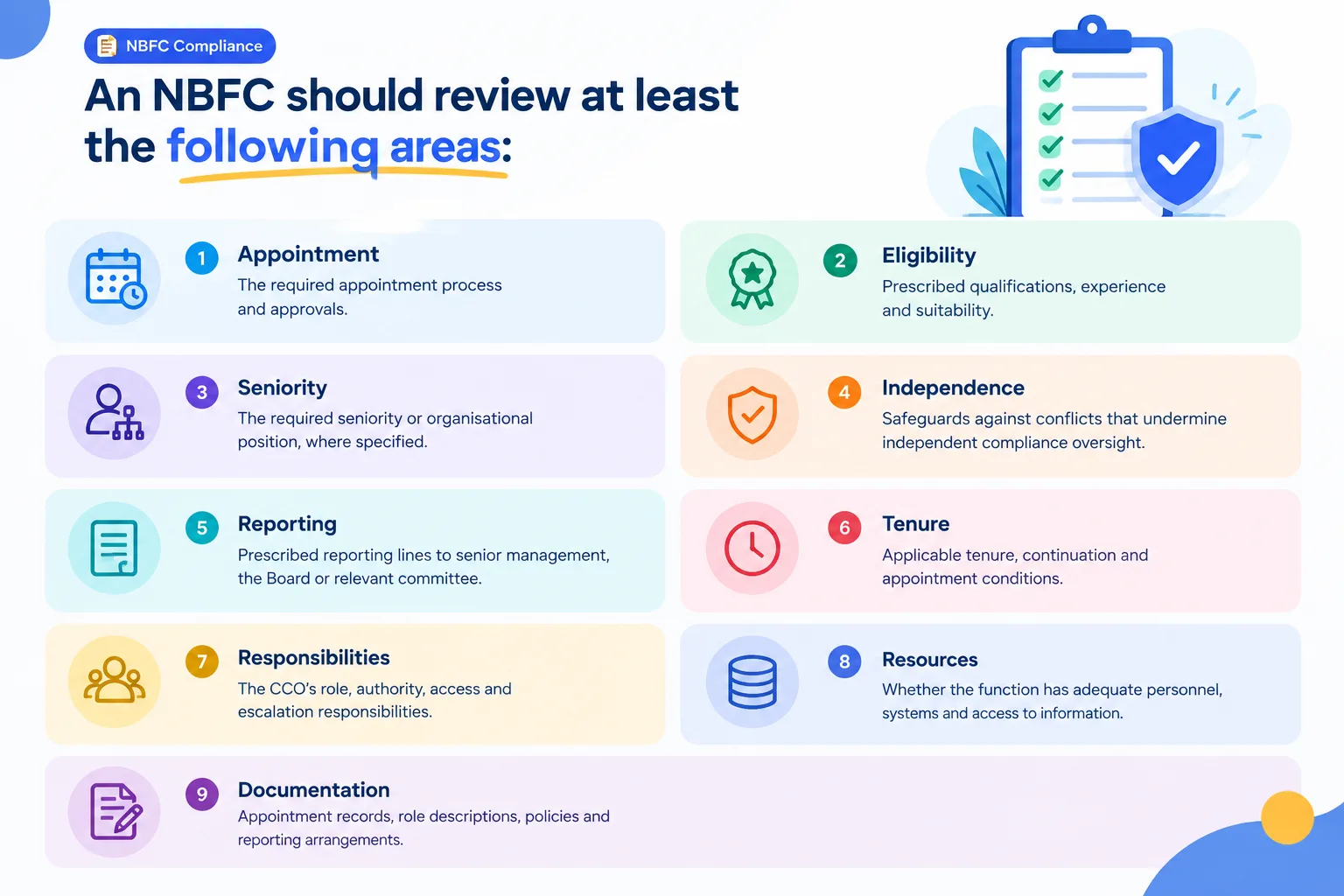
An NBFC should review at least the following areas:
Who is eligible to become an NBFC CCO?
Eligibility should not be determined by job title alone. The NBFC must verify the qualifications, relevant experience, seniority, independence and other criteria prescribed by the applicable Directions.
A professional with experience in banking, financial services, legal compliance, risk management or regulatory affairs may have relevant skills, but that experience alone does not establish eligibility.
The proposed appointment must be assessed against the exact regulatory requirements.
Can a director or senior executive automatically serve as the CCO?
No such assumption should be made. The role must satisfy the prescribed eligibility, independence, reporting and conflict-of-interest requirements. The NBFC should assess the proposed individual's existing responsibilities and the requirements of the applicable Directions before appointment.
What should be documented when appointing a CCO?
An implementation file should ordinarily address:
The applicable regulatory requirement.
The individual's eligibility and suitability assessment.
The appointment and approval records.
The CCO's formal role description.
Reporting and escalation arrangements.
Access to information and compliance resources.
Conflict-of-interest and independence considerations.
The compliance reporting calendar.
The precise documentation required should be verified against the current regulatory text.
5. Can an NBFC Outsource Its Chief Compliance Officer?
This is one of the most commercially important questions for NBFC promoters searching for an “outsourced chief compliance officer NBFC,” “outsourced CCO for NBFC,” “virtual CCO for NBFC” or “NBFC compliance outsourcing.”
The critical distinction is between outsourcing the compliance function and obtaining external compliance advisory support.
RBI's framework on managing risks and conduct in outsourcing of financial services identifies core management functions—including the compliance function—as activities that should not be outsourced. The NBFC also retains ultimate responsibility for outsourced activities that are otherwise permitted. Source: RBI Handbook on Regulations at a Glance.
Accordingly, an NBFC should not assume that engaging an outside consultant, compliance firm or virtual CCO automatically fulfils its obligation to maintain the required compliance function or appoint an eligible CCO.
What does “outsourced CCO for NBFC” mean in practice?
People use this search term to describe different arrangements, including:
Hiring an external compliance consultant.
Obtaining specialist regulatory advice.
Using external assistance to review policies and procedures.
Getting help with regulatory change monitoring.
Commissioning a compliance gap assessment.
Obtaining support with documentation and implementation planning.
Engaging independent specialists for particular compliance projects.
These arrangements must be distinguished from delegating the NBFC's core compliance function or substituting an external adviser for a CCO appointment required under RBI directions.
Is a virtual CCO for an NBFC permitted?
The phrase “virtual CCO” is a commercial description, not proof that a proposed arrangement meets RBI requirements.
A virtual arrangement should not be represented as a compliant replacement for the formally appointed CCO where the applicable Directions require one. The NBFC must assess the actual duties, authority, reporting arrangements, independence and regulatory requirements involved.
An external professional may be able to provide specialist advice or support on particular matters, subject to the applicable rules. That is different from claiming that the NBFC can outsource its compliance function.
Can a small NBFC use an external compliance consultant?
External consulting can help an NBFC understand its obligations, review its documentation, identify gaps and plan corrective actions. The permitted scope must be assessed carefully.
For example, an external adviser may be engaged to conduct a defined compliance gap assessment or review a policy. The NBFC should still establish who is accountable for its compliance function, how the required CCO role is fulfilled, and how compliance risks are monitored and escalated internally.
The correct question is not simply “Can we hire an outsourced CCO?” It is “Which activities may we obtain external support for, and how do we maintain the compliance function and appointments required by RBI?”
6. What Is an NBFC Compliance Function?
The compliance function is the organisational arrangement through which an NBFC identifies and manages its regulatory compliance obligations.
It should help the organisation understand which laws, directions, rules and standards apply to its activities; identify the risks of non-compliance; monitor whether requirements are implemented; report deficiencies; and ensure that corrective actions are followed up.
A compliance function may interact with several business areas, including:
Lending and underwriting.
KYC and customer onboarding.
Recovery and collections.
Product development.
Customer communications and grievance handling.
Financial reporting and regulatory returns.
Technology and information security.
Outsourcing arrangements.
Board governance and internal controls.
The exact scope depends on the NBFC's activities and the applicable regulatory requirements.
What makes a compliance function effective?
An effective compliance framework should have:
Clear accountability.
Appropriate independence.
A documented compliance policy.
A current inventory of applicable obligations.
A risk-based compliance monitoring plan.
Defined reporting and escalation procedures.
Documented testing and review.
Corrective-action tracking.
Adequate resources and access to relevant information.
Evidence that policies are implemented in actual operations.
A policy that exists only as a document is not enough. The organisation must be able to demonstrate how the framework operates.
7. What Should an NBFC Compliance Policy Contain?
The RBI Compliance Function Directions, 2026 address the compliance policy and governance responsibilities. The NBFC should consult the complete Directions to confirm the exact prescribed requirements.
As a practical starting point, the policy review should cover:
Governance and accountability
Identify the responsibilities of the Board, relevant committees, senior management, the CCO and business functions.
Compliance culture
Explain how regulatory compliance is embedded into decision-making and day-to-day operations.
Regulatory obligation management
Define how new and amended regulatory requirements are identified, assessed, assigned and implemented.
Compliance risk management
Establish how compliance risks are identified, assessed, prioritised, monitored and escalated.
Monitoring and testing
Set out the process for reviewing adherence to applicable requirements and recording deficiencies.
Reporting and escalation
Specify reporting responsibilities, frequency, escalation triggers and corrective-action follow-up in accordance with the applicable Directions.
Independence and conflicts
Describe the safeguards used to maintain appropriate independence and address conflicts of interest.
Documentation and evidence
Establish records of assessments, monitoring, testing, decisions, reports and remediation.
Review and updating
Define how the policy is reviewed when regulatory requirements, the business model, operations or risk profile change.
This is an implementation framework, not a substitute for the full requirements of the RBI Directions. Each NBFC should map the policy to the applicable regulatory clauses.
8. What Is an NBFC Compliance Risk Assessment?
An NBFC compliance risk assessment is a structured review of the regulatory risks that may arise from the company's business activities, operations, controls and external obligations.
The objective is to identify where non-compliance could occur, assess its potential impact and determine which areas require stronger controls or more frequent monitoring.
How to conduct an NBFC compliance risk assessment
Step 1: Identify applicable obligations
Create an inventory of relevant RBI directions, company law requirements and other rules applicable to the entity and its activities.
Step 2: Map obligations to business processes
Identify which department, product, system or person is responsible for implementing each requirement.
Step 3: Identify compliance risks
Determine where requirements may be misunderstood, missed, inconsistently applied or inadequately documented.
Step 4: Assess existing controls
Review the policies, system controls, approvals, reconciliations, monitoring procedures and reporting mechanisms already in place.
Step 5: Prioritise the gaps
Evaluate the significance of each identified gap using a documented and appropriate risk assessment method.
Step 6: Assign corrective actions
Define the action required, responsible owner, target date and evidence needed to demonstrate completion.
Step 7: Monitor and report
Track outstanding actions and escalate significant unresolved issues through the prescribed governance channels.
Step 8: Reassess when circumstances change
Update the assessment when the business model, regulatory requirements, products, systems or risk profile change.
The NBFC should follow the assessment, reporting and monitoring requirements specified in the applicable RBI Directions.
9. NBFC Compliance Checklist for 2026
The following checklist can help a Middle Layer or Upper Layer NBFC begin reviewing its compliance framework.
Compliance areaQuestions to reviewRegulatory applicabilityHas the NBFC confirmed its regulatory layer and applicable directions?Compliance policyIs the policy aligned with the applicable 2026 Directions?Board oversightAre Board and committee responsibilities appropriately documented?Senior managementAre responsibilities and escalation arrangements clear?CCO appointmentDoes the appointment satisfy applicable eligibility and governance requirements?IndependenceAre reporting arrangements and conflicts appropriately addressed?Obligation inventoryAre applicable regulatory requirements identified and assigned?Risk assessmentIs there a documented process for assessing compliance risks?MonitoringAre compliance activities monitored using a defined plan?TestingAre the applicable compliance testing requirements addressed?ReportingAre reports submitted to the appropriate governance bodies?Corrective actionsAre identified gaps assigned, tracked and closed?New productsAre compliance implications assessed before relevant changes are implemented?TechnologyAre monitoring, workflow, escalation and reporting systems suitable for the applicable requirements?Internal auditAre compliance-related audit responsibilities and follow-up processes clear?DocumentationIs evidence maintained for assessments, decisions, reviews and remediation?
This is a practical review checklist, not a complete legal checklist or a representation that every item has the same applicability to every NBFC. The full RBI Directions and other relevant requirements must be reviewed before declaring compliance.
10. How to Set Up an NBFC Compliance Function: Step-by-Step Procedure
A structured implementation process helps an NBFC move from reviewing regulatory requirements to establishing working controls.
Step 1: Confirm regulatory applicability
Identify the NBFC's regulatory layer, registration status, business activities and the specific provisions that apply.
Step 2: Conduct a compliance gap assessment
Compare the current governance structure, policies, appointments, monitoring processes and documentation against the applicable requirements.
Step 3: Review the existing CCO arrangement
Assess eligibility, appointment documentation, responsibilities, reporting lines, independence and access to information.
Step 4: Review the compliance policy
Identify required changes and establish a clear process for approving, implementing and maintaining the policy.
Step 5: Prepare the compliance obligation inventory
Map applicable regulatory requirements to business owners, processes, evidence and reporting obligations.
Step 6: Build the risk assessment and monitoring plan
Determine how compliance risks will be assessed, monitored, tested, reported and escalated.
Step 7: Define resources and technology
Evaluate staffing, skills, workflow systems, compliance registers, reporting dashboards and documentation tools against the actual requirements.
Step 8: Establish reporting and corrective-action tracking
Ensure that identified gaps are assigned to responsible owners and that significant issues are escalated appropriately.
Step 9: Coordinate internal audit and governance reviews
Review the applicable audit provisions and ensure that findings, management responses and corrective actions are documented.
Step 10: Review and improve continuously
Compliance is not a one-time implementation project. The NBFC should maintain an ongoing process for regulatory monitoring, periodic review and corrective action.
The timeline, staffing model and implementation sequence will vary according to the NBFC's existing arrangements, scale, risk profile and the regulatory provisions applicable to it.
11. How Much Does NBFC Compliance Support Cost?
There is no universal price for NBFC compliance support or CCO-related advisory.
The cost depends on the scope of work, the NBFC's regulatory requirements, its business activities, the complexity of its operations and the level of support required.
Cost considerations may include:
Initial compliance gap assessment.
Regulatory applicability review.
Compliance policy review and documentation.
CCO appointment and governance advisory.
Compliance risk assessment.
Monitoring and testing process design.
Regulatory change tracking.
Compliance reporting systems.
Staff training and implementation support.
Ongoing specialist advisory.
An NBFC should distinguish between the cost of establishing and maintaining its own required compliance function and the fees for external advisory services.
A low-cost external arrangement should not be selected solely on the assumption that it can replace required internal responsibilities or a formally appointed CCO.
How should an NBFC compare compliance service providers?
Before engaging a provider, assess:
Relevant NBFC and RBI regulatory experience.
Clear scope of work and deliverables.
Confidentiality and information-security arrangements.
Conflicts of interest.
Documentation and reporting standards.
The boundary between external advisory and the NBFC's own regulatory responsibilities.
How findings and recommendations will be implemented.
Whether the proposed arrangement is consistent with applicable outsourcing and compliance requirements.
For a meaningful cost estimate, begin with a review of the NBFC's current framework and the specific work it needs completed.
12. How Bharat Cred Can Help With NBFC Compliance Advisory
Bharat Cred Solutions Pvt. Ltd. provides professional consulting and advisory support to businesses operating in the NBFC and financial-services ecosystem.
For NBFCs reviewing their compliance framework, relevant advisory work may include:
Compliance gap assessment
Review existing policies, procedures and documentation against the requirements identified as applicable to the NBFC.
Regulatory applicability review
Help the NBFC organise its regulatory obligations and identify areas requiring further professional or legal review.
Compliance policy and documentation advisory
Assist with reviewing and developing policy documentation, responsibility matrices and implementation plans.
CCO and governance advisory
Help assess role descriptions, reporting arrangements, governance documentation and the requirements that must be verified before an appointment or structural change.
Compliance monitoring framework
Support the design of compliance registers, monitoring calendars, reporting workflows and corrective-action tracking processes.
Implementation planning
Help the NBFC prioritise identified gaps, assign actions and plan the work required to strengthen its framework.
External specialist coordination
Where appropriate, help coordinate with qualified legal, audit, technology or regulatory specialists for issues requiring their specific expertise.
These are advisory and implementation-support services. Bharat Cred does not represent that it can replace an NBFC's required compliance function or formally appointed CCO through an outsourced service, nor does it guarantee regulatory compliance or approval.
Why begin with an assessment?
Every NBFC has a different operating model, regulatory profile and existing control environment.
A gap assessment helps establish what is already in place, what needs improvement and which requirements need further verification. It also helps avoid paying for a generic service package that does not match the NBFC's actual needs.
CTA: Book a consultation with Bharat Cred's NBFC compliance advisory team.
Discuss your current compliance arrangements, identify the areas that need attention and develop an implementation plan appropriate to your organisation.
13. Frequently Asked Questions About NBFC Compliance and CCO Requirements
What are the RBI Compliance Function Directions, 2026?
The RBI Compliance Function Directions, 2026, issued on 31 July 2026, prescribe minimum standards for the compliance function of applicable Middle Layer and Upper Layer NBFCs. They address governance, the compliance policy, the structure and responsibilities of the compliance function, the CCO and related monitoring and oversight arrangements.
Which NBFCs are covered by the 2026 Compliance Function Directions?
The Directions apply to specified Middle Layer and Upper Layer NBFCs registered under the RBI Act, 1934, or the Factoring Regulation Act, 2011, subject to the provisions and applicability criteria in the Directions.
What are the NBFC CCO requirements?
The requirements must be assessed against the CCO provisions in the 2026 Directions. Relevant areas include appointment, eligibility, seniority, independence, reporting arrangements, tenure and responsibilities. An NBFC should verify the exact criteria before appointing a CCO.
Is a Chief Compliance Officer mandatory for every NBFC?
The answer depends on the applicable regulatory framework and the entity's classification. The 2026 Directions specifically cover applicable Middle Layer and Upper Layer NBFCs. An NBFC should not assume that identical CCO requirements apply to every entity.
Can an NBFC outsource its compliance function?
RBI's outsourcing framework identifies the compliance function as a core management function that should not be outsourced. An NBFC must distinguish between its own compliance function and external specialist advisory support.
Can I hire an outsourced Chief Compliance Officer for my NBFC?
An external provider should not be assumed to replace the CCO appointment or compliance function required by RBI. External advisory services may support specific projects, but the proposed arrangement must be assessed against the applicable Directions and outsourcing framework.
Is a virtual CCO for an NBFC permitted?
“Virtual CCO” is not, by itself, a regulatory status that demonstrates compliance. The NBFC must fulfil its applicable CCO and compliance-function requirements. External advisory support should not be marketed or relied on as an automatic substitute for those requirements.
Can a small NBFC hire a compliance consultant instead of a full-time CCO?
A compliance consultant may provide specialist advice or project-based support where permitted. However, the NBFC must independently determine how it will satisfy any CCO appointment and compliance-function requirements that apply to it.
What should an NBFC compliance policy include?
The policy should be reviewed against the full RBI Directions, including applicable governance responsibilities, compliance culture, risk management, independence, reporting and implementation arrangements. The exact required contents should be confirmed against the current regulatory text.
What is an NBFC compliance risk assessment?
It is a structured assessment of the risk that the NBFC may fail to comply with applicable laws, regulations, directions or internal requirements. It identifies regulatory exposures, evaluates existing controls and helps prioritise corrective actions.
What is the difference between an NBFC compliance officer and a CCO?
A compliance officer may perform assigned compliance activities, while a Chief Compliance Officer holds the designated senior role described by the applicable regulatory framework. Titles alone do not establish regulatory eligibility; the formal responsibilities and appointment requirements must be assessed.
How often should an NBFC review its compliance framework?
The NBFC should follow the review, assessment, monitoring and reporting requirements prescribed by the applicable Directions. It should also reassess its framework when material regulatory, operational, product or risk-profile changes occur.
What is the cost of NBFC compliance services?
Costs vary according to the work required, the NBFC's regulatory obligations, the complexity of its operations and the scope of external advisory. A gap assessment is a sensible starting point for defining the scope and obtaining a meaningful quotation.
Does Bharat Cred provide outsourced CCO services?
Bharat Cred provides professional NBFC compliance advisory and implementation support within the applicable regulatory framework. Any proposed support arrangement must preserve the NBFC's own responsibilities and must not be treated as an automatic replacement for a required CCO or compliance function.
How can I book an NBFC compliance consultation?
Contact Bharat Cred Solutions through its official website and explain your NBFC's regulatory layer, existing compliance structure and main concern. The initial discussion can help determine the scope of assessment and the next steps.
14. Related Resources and Internal Links
For readers who need more information about related NBFC and financial-services topics, Bharat Cred should link this article to relevant service and educational pages.
Suggested internal links:
NBFC Registration Assistance — for promoters evaluating NBFC registration requirements and the initial regulatory process.
NBFC Compliance Services — for businesses reviewing their compliance framework and ongoing obligations.
RBI Compliance Advisory — for businesses assessing specific regulatory requirements and implementation questions.
Plug & Play NBFC Solutions — for promoters planning the wider lending-business ecosystem beyond registration.
Lending Business Advisory — for lending models, operational readiness and business planning.
Recovery & Collections Advisory — for NBFCs reviewing collections and recovery operations.
NBFC Acquisition & Exit Advisory — for promoters exploring acquisition, sale or exit transactions.
Startup Advisory — for founders assessing business structures and setup requirements.
Use the actual published URLs for these pages when adding links. Anchor text should describe the destination accurately and should not imply that Bharat Cred issues RBI registrations or guarantees regulatory outcomes.
Strengthen Your NBFC's Compliance Framework
Is your NBFC's compliance function ready for the RBI Compliance Function Directions, 2026?
Whether you are reviewing CCO requirements, updating your compliance policy, assessing regulatory risks or building a structured monitoring framework, start by understanding the obligations that actually apply to your NBFC.
Bharat Cred Solutions can help you assess the current position, identify areas requiring attention and plan appropriate advisory and implementation support.
Book a consultation with Bharat Cred's NBFC compliance advisory team.
Discuss your requirements and the next steps for your organisation.
Bharat Cred Solutions Pvt. Ltd.
Complete Financial Lifecycle Partner
Regulatory disclaimer: Bharat Cred Solutions Pvt. Ltd. is a privately owned professional consulting firm. It is not affiliated with, endorsed by or acting on behalf of the Reserve Bank of India or any government authority. Bharat Cred provides professional consulting and advisory support; regulatory decisions and approvals remain with the competent authority. No regulatory outcome is guaranteed.
Have a specific question about this?
Talk it through with our team on a strategy call.