What Plug & Play Actually Means for an NBFC-Backed Business
At its core, a Plug & Play NBFC model means structuring your lending business to operate through an existing, already-licensed NBFC's regulatory framework — rather than building your own license, technology stack, and operations independently from a standing start.
This isn't one single arrangement. Depending on your goals, it can take a few different legal forms:
Operating under an established NBFC partner as a Business Correspondent or Lending Service Provider — sourcing and managing loans without needing to hold your own RBI license or raise Net Owned Fund capital
Acquiring an existing, already-registered NBFC rather than filing a fresh application — faster than starting from zero, though the capital requirement to hold that license still applies
Co-lending alongside an established NBFC partner, deploying your own capital jointly on a shared basis under RBI's co-lending framework
Each of these solves a different problem, and none of them is a way around regulation — they're different, RBI-recognized ways of structuring who holds the license and how the partnership works.
Why This Model Is Gaining Ground
Traditional registration asks a lot before you've proven anything. Meeting the current Net Owned Fund requirement, building a five-year business plan, and waiting through RBI's review process — typically several months — all happen before you've disbursed a single loan. For a founder who's confident in the business model but not ready to lock up that much capital and time upfront, that's a real barrier, not just a formality.
The operational build is often harder than the license itself. Even after a Certificate of Registration is issued, a founder still has to build lending technology, hire credit and collections staff, and stand up an operating office. The regulatory milestone and the operational readiness milestone are two separate projects — and most new entrants underestimate how much work sits in the second one.
Speed matters more in lending than in most businesses. Market timing, competitive positioning, and investor expectations all move faster than a multi-month registration process accommodates. A structure that gets a founder to their first loan sooner — without cutting any regulatory corners — is a genuine advantage, not just a convenience.
NBFC Plug & Play: A Faster Way to Build and Operate a Lending Business in India
Starting a lending business in India is much more complicated than simply incorporating a company and offering loans.
A serious lending business may require a regulatory structure, an appropriate NBFC relationship, lending technology, underwriting processes, compliance systems, manpower, customer servicing, collections, recovery infrastructure and operational controls.
For many entrepreneurs, fintech founders, investors and businesses, building every component independently can take significant time, capital and operational effort.
This is where an NBFC Plug & Play system can become an alternative route.
A Plug & Play model is designed to connect the business with an existing lending ecosystem so that the entrepreneur does not necessarily have to build every regulatory and operational component from zero.
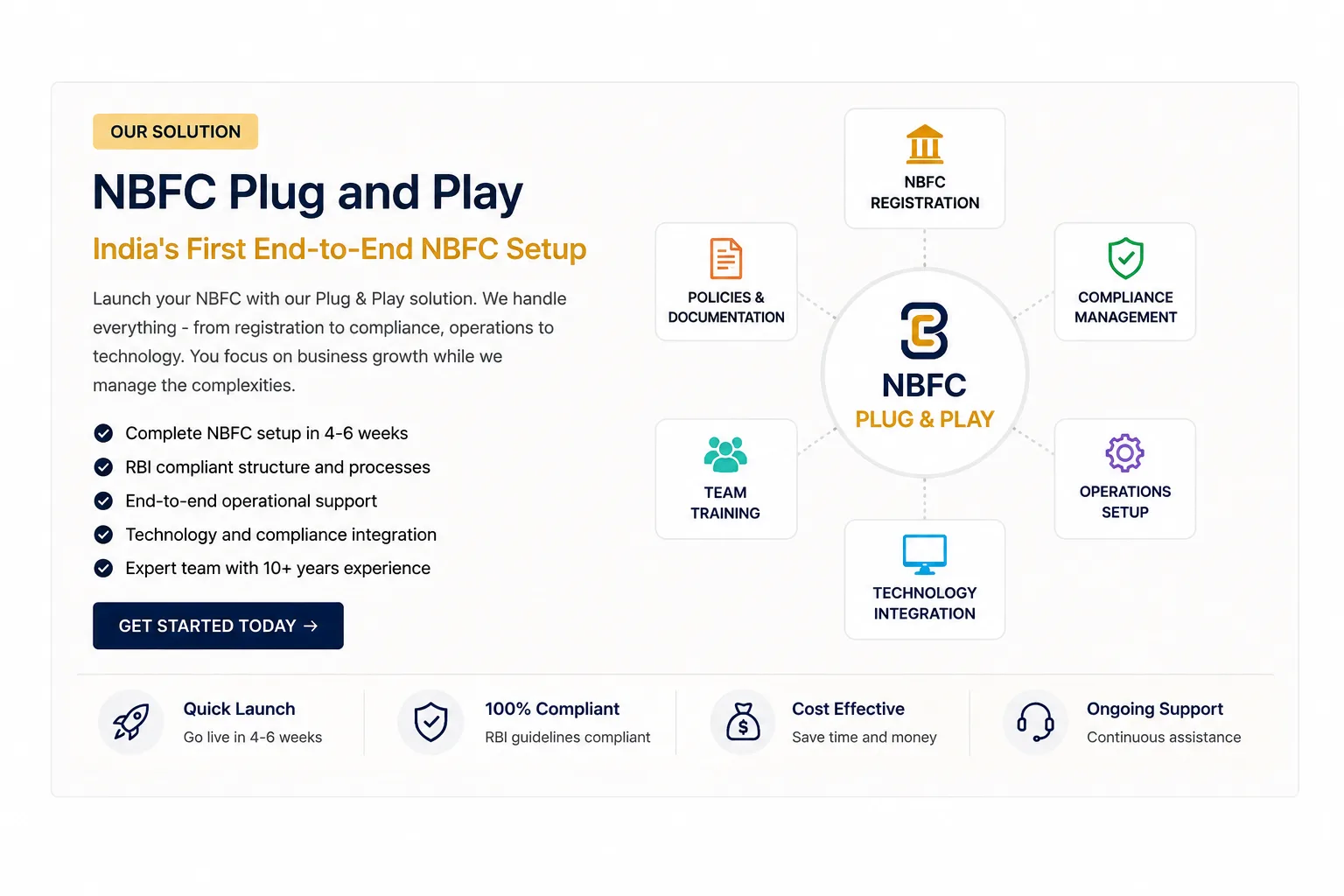
Bharat Cred Solutions describes its Plug & Play system as an integrated ecosystem covering areas such as an existing NBFC, strategic tie-up, lending technology, operational support, manpower, office infrastructure and recovery/collection support.
Important: An NBFC Plug & Play model should not be understood as a way to bypass RBI regulations. The appropriate structure depends on the business model, the parties involved and applicable regulatory requirements.
What Is an NBFC Plug & Play System?
An NBFC Plug & Play system is a structured approach that allows a business to enter the lending ecosystem by connecting with an existing NBFC or lending infrastructure instead of independently building every component from scratch.
Instead of separately arranging:
NBFC registration
regulatory advisory
lending technology
loan management software
underwriting systems
employees
office infrastructure
customer support
collection teams
recovery infrastructure
the business can potentially access several of these capabilities through an integrated operating model.
Bharat Cred's current Plug & Play offering identifies seven major components:
Existing NBFC
Strategic Tie-Up
Lending Technology
Operational Support
Manpower Support
Office & Infrastructure
Recovery & Collection
The objective is simple:
Connect → Build → Launch → Operate → Scale
Why Are Entrepreneurs Looking for NBFC Plug & Play Solutions?
Traditional lending-business setup can involve multiple independent activities.
An entrepreneur may need to coordinate:
Company → Regulatory Consultant → NBFC → Technology Vendor → Hiring → Office → Operations → Collections → Recovery
This can create:
Multiple vendors
Higher coordination costs
Longer implementation cycles
Technology integration problems
Hiring challenges
Compliance gaps
Operational delays
The Plug & Play approach attempts to bring these components into a more connected ecosystem.
The fundamental idea is not necessarily to eliminate regulatory requirements.
It is to avoid unnecessarily rebuilding infrastructure that already exists.
Can You Start an NBFC Without RBI Registration?
This is one of the most important questions.
The answer depends on what you mean by "start an NBFC."
If you want to operate your own independent NBFC, RBI registration requirements apply to the relevant business model.
The Reserve Bank of India states that companies intending to undertake NBFC activities generally need to meet applicable eligibility requirements and obtain the required Certificate of Registration. RBI also provides the relevant NBFC registration application and documentation framework.
However, a business may potentially enter lending through another legally structured model.
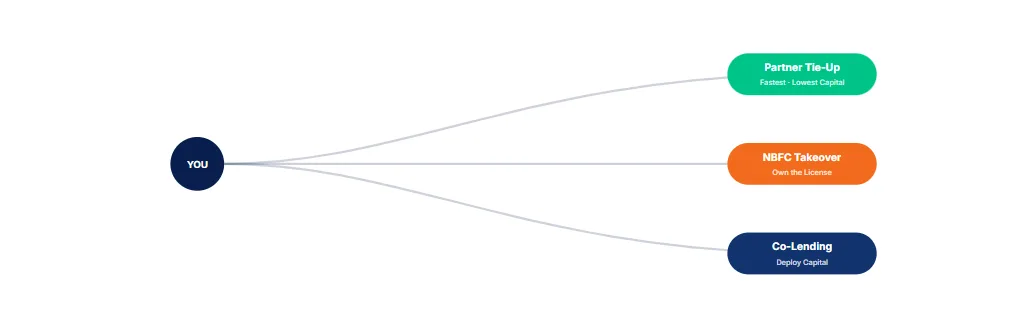
For example, the Plug & Play page identifies:
Partner Tie-Up / LSP model
NBFC Takeover / Acquisition
Co-Lending
as three different routes into NBFC-backed lending.
Therefore:
Plug & Play ≠ "No regulation."
Instead:
Plug & Play = A potentially faster and more integrated way to structure entry into the lending ecosystem.
Three Ways to Enter NBFC-Backed Lending
One of the strongest sections of the Bharat Cred model is that it doesn't present one solution as suitable for everyone.
There are different possible routes depending on:
Capital
Business model
Timeline
Desired ownership
Regulatory requirements
Lending category
Risk appetite
Long-term objectives
1. Partner Tie-Up / LSP Model
A business can potentially operate as a Lending Service Provider (LSP) under an appropriately structured relationship with an existing regulated NBFC.
Under the model described by Bharat Cred, the business can focus on areas such as sourcing, underwriting support and loan servicing while the regulated NBFC remains the relevant regulated entity.
Who is this suitable for?
This model can be attractive to:
Fintech startups
First-time founders
Entrepreneurs
Loan distribution businesses
Digital lending businesses
Businesses that want faster market entry
Businesses that don't initially need to own their own NBFC
Potential advantages
Lower initial infrastructure burden
Faster operational launch
Existing regulatory relationship
Access to lending technology
Operational support
Potentially lower capital requirements compared with owning a standalone NBFC
But the exact legal and commercial structure must be evaluated before launch.
2. NBFC Takeover or Acquisition
Another possible route is acquiring an existing registered NBFC rather than beginning the entire registration process from zero.
This can potentially reduce the time associated with starting a new application because the target entity already exists.
However, an NBFC acquisition is not simply buying an RBI licence.
The transaction requires careful due diligence.
You should examine:
Existing liabilities
Regulatory history
RBI correspondence
Compliance status
Financial statements
Net Owned Fund
Shareholding
Directors
Litigation
Outstanding regulatory issues
Business activities
Loan portfolio
Borrowings
Statutory filings
Existing contracts
Technology
Customer obligations
Bharat Cred specifically notes that acquisition can improve speed but does not eliminate the applicable Net Owned Fund requirement.
3. Co-Lending Partnership
Co-lending provides another route for businesses or institutions that have capital and want exposure to lending alongside an NBFC partner.
Instead of establishing a completely independent NBFC infrastructure, the parties participate according to the applicable co-lending framework.
This can be particularly relevant to:
Investors
Financial institutions
Fintech companies
Businesses with lending capital
Institutional lenders
However, co-lending is not the same as a low-capital lending model.
You need capital to participate in the lending arrangement.
Bharat Cred's Plug & Play page currently positions co-lending as a capital-deployment route rather than a low-investment entry model.
What Is Included in a Plug & Play NBFC System?
A proper Plug & Play ecosystem should go far beyond simply introducing an NBFC partner.
1. Existing NBFC
An established NBFC partner can provide the regulated lending infrastructure relevant to the chosen model.
The exact relationship and permitted activities depend on the structure.
2. Strategic NBFC Tie-Up
The partnership structure needs to be designed according to the business model.
Possible structures may include:
LSP arrangements
Co-lending arrangements
Strategic partnerships
Other permitted arrangements
Acquisition/takeover structures
The documentation and responsibilities should be clearly defined.
3. Lending Technology
Modern lending businesses need technology.
A complete lending technology stack may include:
Loan Management System
Loan Origination System
CRM
Underwriting tools
Customer portal
Partner portal
Payment integrations
Credit bureau integrations
KYC/eKYC integrations
OCR
Digital signatures
API integrations
Collection technology
Analytics
Reporting dashboards
WhatsApp automation
Bharat Cred's website currently highlights LMS, CRM, collection platforms, analytics, client dashboards, credit bureau/eKYC APIs, OCR, digital signatures and WhatsApp/AI automation as components of its broader lending technology stack.
4. Operational Support
Technology alone does not create a lending company.
You also need processes.
These can include:
Credit policy
Loan workflows
Documentation standards
Customer onboarding
Verification
Underwriting
Disbursement processes
Customer support
Grievance handling
Reporting
Compliance processes
Bharat Cred's Plug & Play model specifically describes operational support around credit policies, workflows and documentation standards.
5. Manpower Support
A lending business needs the right people.
Depending on the model, this may include:
Credit officers
Underwriters
Operations executives
Compliance professionals
Customer support
Collection executives
Recovery teams
Sales teams
Technology teams
Building an experienced financial-services team can be difficult for a first-time founder.
An integrated model can help reduce that operational burden.
6. Office & Infrastructure
Depending on the business structure and operational requirements, infrastructure can include:
Registered office
Operational office
Customer support infrastructure
Employee workstations
Communication systems
IT infrastructure
Data-security systems
Process documentation
7. Recovery & Collection Infrastructure
Collections are one of the most important parts of lending.
A lending business can have excellent acquisition and underwriting but still struggle if its collection system is weak.
A proper collection ecosystem can include:
Early-bucket collection
Tele-calling
Field collection
Payment reminders
DPD monitoring
Skip tracing
Legal recovery
Portfolio monitoring
Recovery analytics
Bharat Cred positions recovery and collection as a separate component of its Plug & Play ecosystem because it is a major operational requirement of lending businesses.
NBFC Plug & Play vs Traditional NBFC Registration
The two models should not be confused.
Traditional NBFC Registration
You generally build:
Company → Capital → RBI Application → Regulatory Review → Registration → Technology → Team → Operations → Lending
This route can make sense for entrepreneurs who ultimately want their own independent NBFC structure.
RBI provides specific registration documentation and application processes for NBFCs.
Plug & Play
The approach is more like:
Business Idea → Choose Structure → Existing NBFC / Partner → Technology → Operations → Launch → Scale
The exact timeline and requirements depend on the selected model.
Who Should Consider an NBFC Plug & Play Model?
The model can be particularly relevant to:
FinTech Founders
If you have a technology platform but don't want to build the entire lending infrastructure yourself.
Entrepreneurs
If you want to enter lending but are evaluating alternatives to building a standalone NBFC immediately.
Investors
If you want exposure to lending through structured partnerships.
Existing Businesses
Businesses with an established customer base may explore lending partnerships to add financial products.
Foreign Companies
International businesses exploring India's lending ecosystem may require a carefully structured regulatory and operating model.
Existing NBFCs
Existing NBFCs can also require:
Technology
Collections
BPO
Underwriting support
Operational support
Compliance
Recovery infrastructure
Which Industries Can Use an NBFC Plug & Play Model?
Depending on the business and regulatory structure, lending infrastructure may be relevant to segments such as:
Consumer lending
Personal lending
MSME finance
Business loans
Gold loans
Vehicle finance
Education finance
Housing finance
Loan Against Property
Digital lending
FinTech
Microfinance
Supply-chain finance
Bharat Cred currently identifies consumer lending, MSME finance, gold loans, housing finance, vehicle finance, education finance, microfinance, digital lending, fintech, banks, NBFCs and investors among the lending-market segments it serves.
Is NBFC Plug & Play Legal?
This is another critical question.
There is no legitimate model where a business can simply ignore RBI regulations because it is called "Plug & Play."
The legality depends on the actual activities, contractual structure, regulated entity, responsibilities and applicable RBI directions.
For example, RBI's framework recognizes outsourcing arrangements involving NBFCs but makes clear that the regulated NBFC retains responsibility and control over outsourced activities.
RBI also states that NBFCs must ensure outsourcing does not diminish their ability to meet regulatory and customer obligations.
Therefore, every Plug & Play arrangement should be structured and reviewed appropriately.
Does Plug & Play Mean You Get an NBFC Licence?
No.
This distinction is extremely important.
A Plug & Play arrangement may provide access to an existing NBFC ecosystem or structured partnership.
It does not automatically mean that the entrepreneur receives an independent RBI Certificate of Registration.
If your objective is to own and operate your own NBFC, you should evaluate the dedicated NBFC Registration route instead.
Bharat Cred itself makes this distinction on its Plug & Play page and directs businesses that require their own RBI Certificate of Registration toward its NBFC Registration service.
How Long Does an NBFC Plug & Play Setup Take?
There is no single universal timeline.
The timeline depends on:
Business model
Partner availability
Due diligence
Legal structure
Documentation
Technology requirements
Compliance requirements
Operational readiness
Funding
Product category
For the Partner Tie-Up model, Bharat Cred describes the route as potentially reaching operation in weeks rather than the months associated with a fresh registration review, while also emphasizing that the exact path must be selected according to the business.
Do not trust anyone promising an unconditional "NBFC licence in X days."
How Much Does an NBFC Plug & Play System Cost?
There is no responsible single price applicable to every business.
The cost can depend on:
Business model
Lending product
Partner arrangement
Technology
Capital requirements
Manpower
Geography
Loan volume
Operational requirements
Compliance scope
Collection requirements
For this reason, businesses should obtain a structure-specific commercial proposal rather than relying on generic online pricing.
What Is the Difference Between NBFC Registration and Plug & Play?
Think of it this way:
NBFC Registration
You want to build and own your own regulated NBFC.
Plug & Play
You want to enter the lending ecosystem through an appropriately structured existing infrastructure or partnership.
NBFC Takeover
You want control of an existing NBFC rather than starting from a fresh application.
Co-Lending
You have capital and want to participate in lending alongside an NBFC partner.
LSP
You want to provide specified lending-related services under a regulated NBFC relationship without necessarily becoming the regulated NBFC yourself.
Choosing the wrong model can create unnecessary costs and delays.
What Should You Check Before Choosing an NBFC Plug & Play Provider?
Do not select a provider merely because they advertise:
"Start NBFC in 7 Days."
Instead ask:
Regulatory
Who is the regulated NBFC?
What is its current status?
What is the proposed legal structure?
Who holds regulatory responsibility?
What activities can we actually perform?
Commercial
What are the setup costs?
What are the recurring costs?
Are there revenue-sharing arrangements?
Who pays technology costs?
Technology
Is LMS included?
Is LOS included?
Are APIs available?
Is CRM included?
Is reporting available?
Operations
Who manages underwriting?
Who handles customer support?
Who manages collections?
Who manages recovery?
Compliance
Who owns compliance responsibility?
Who handles KYC/AML?
Who manages regulatory reporting?
How is customer data protected?
Exit
What happens if the partnership ends?
How are customers handled?
What happens to the loan portfolio?
What happens to technology and data?
Why Bharat Cred's Plug & Play Model Is Different
Bharat Cred positions itself not simply as an NBFC consultant but as an operating partner.
The website describes its broader ecosystem as combining:
NBFC setup
RBI licensing
Compliance
Lending technology
Recovery
Financial BPO
Operations
rather than stopping at paperwork.
The Plug & Play offering specifically brings together:
Existing NBFC + Strategic Tie-Up + Lending Technology + Operational Support + Manpower + Office Infrastructure + Recovery & Collection.
That makes the proposition particularly relevant to founders who don't simply want an NBFC registration consultant—they want help building an operational lending business.
Plug & Play Is Not Just About Starting Faster
The biggest misconception is that Plug & Play is only about speed.
The bigger advantage can be integration.
A lending business has multiple connected systems:
Customer Acquisition
↓
Lead Qualification
↓
KYC
↓
Underwriting
↓
Loan Approval
↓
Disbursement
↓
Loan Servicing
↓
Collections
↓
Recovery
↓
Reporting & Compliance
When these systems are built independently by different vendors, integration becomes difficult.
An integrated ecosystem can potentially reduce that fragmentation.
Can You Start With Plug & Play and Later Build Your Own NBFC?
Potentially, yes—but the transition must be planned properly.
A founder may initially enter lending through an appropriate partnership structure and later evaluate establishing or acquiring their own NBFC.
The decision should depend on:
Business scale
Capital availability
Regulatory strategy
Portfolio size
Product expansion
Investor requirements
Desired control
This should be treated as a strategic roadmap rather than an automatic progression.
The Future of Lending Businesses in India
India's lending ecosystem is becoming increasingly technology-driven.
Modern lending businesses increasingly require:
Digital onboarding
Automated underwriting
API integrations
Credit data
eKYC
Loan management
Customer communication
Digital collections
Analytics
Compliance monitoring
At the same time, regulatory expectations remain important.
RBI's regulatory framework continues to evolve across areas including NBFC regulation, digital lending, outsourcing, governance and customer protection.
This means successful lending businesses need both:
Technology + Regulatory Discipline
Not one without the other.
Frequently Asked Questions About NBFC Plug & Play
What is an NBFC Plug & Play system?
It is a structured lending-business model that can connect entrepreneurs or businesses with existing NBFC infrastructure, partnerships, technology and operational support.
Can I start lending without registering my own NBFC?
Depending on the activity and structure, some businesses may operate through permitted arrangements such as an LSP or other partnership model. You should not assume that all lending activities can be performed without RBI registration.
Does Plug & Play mean I get an RBI licence?
No. A Plug & Play arrangement does not automatically give the entrepreneur an independent RBI Certificate of Registration.
What is an LSP?
An LSP, or Lending Service Provider, is an entity providing specified lending-related services to a regulated lender under an appropriate arrangement.
What is an NBFC takeover?
It involves acquiring control of an existing NBFC rather than beginning entirely from a fresh NBFC registration application.
Does NBFC takeover remove the capital requirement?
No. Acquisition does not automatically eliminate applicable Net Owned Fund requirements.
What is co-lending?
Co-lending is a structured lending arrangement involving eligible entities under the applicable regulatory framework.
Is Plug & Play suitable for fintech startups?
It can be, particularly where a fintech wants to build a lending product without independently developing every regulatory and operational layer.
Is Plug & Play suitable for first-time entrepreneurs?
It can be considered, but the correct structure depends on the founder's business model, capital, objectives and regulatory requirements.
Can an existing NBFC use Plug & Play services?
Yes. Existing NBFCs may also need technology, operations, manpower, BPO, collections, recovery and compliance support.
How quickly can I launch?
There is no universal timeline. Partner availability, structure, due diligence, documentation, technology and compliance requirements all affect implementation.
How much does it cost?
There is no universal cost. A proper proposal should be based on the selected business model and required infrastructure.
NBFC Plug & Play vs Building Everything Yourself
If you have:
Capital + Time + Regulatory Expertise + Technology Team + Operations Team
then building independently may be appropriate.
If you have:
Business Idea + Customer Acquisition Capability + Capital/Market Opportunity
but don't want to build every lending infrastructure component yourself, a Plug & Play structure may be worth evaluating.
The important question isn't:
"Which option is cheapest?"
The better question is:
"Which structure gives my business the right balance of control, capital, speed, compliance and scalability?"
Ready to Start Your Lending Business?
If you are planning to:
Start a lending business
Launch a fintech lending platform
Explore an NBFC partner
Become an LSP
Explore an NBFC takeover
Explore co-lending
Build a digital lending business
Set up lending technology
Build collection infrastructure
Register your own NBFC
Understand RBI licensing requirements
don't start by buying technology or hiring a large team.
Start by choosing the right structure.
Bharat Cred Solutions can evaluate where you are today and help map the appropriate route—whether that means NBFC registration, Plug & Play, strategic partnership, acquisition/takeover, co-lending, technology, compliance or operational support.
Talk to a Bharat Cred NBFC Expert
Book a consultation and discuss your lending business model.
Bharat Cred Solutions Private Limited
NBFC Setup | RBI Licensing | Compliance | Lending Technology | Recovery | Financial BPO
Call: +91 92895 67208
Email: Info@bharatcredsolutions.com
Have a specific question about this?
Talk it through with our team on a strategy call.