
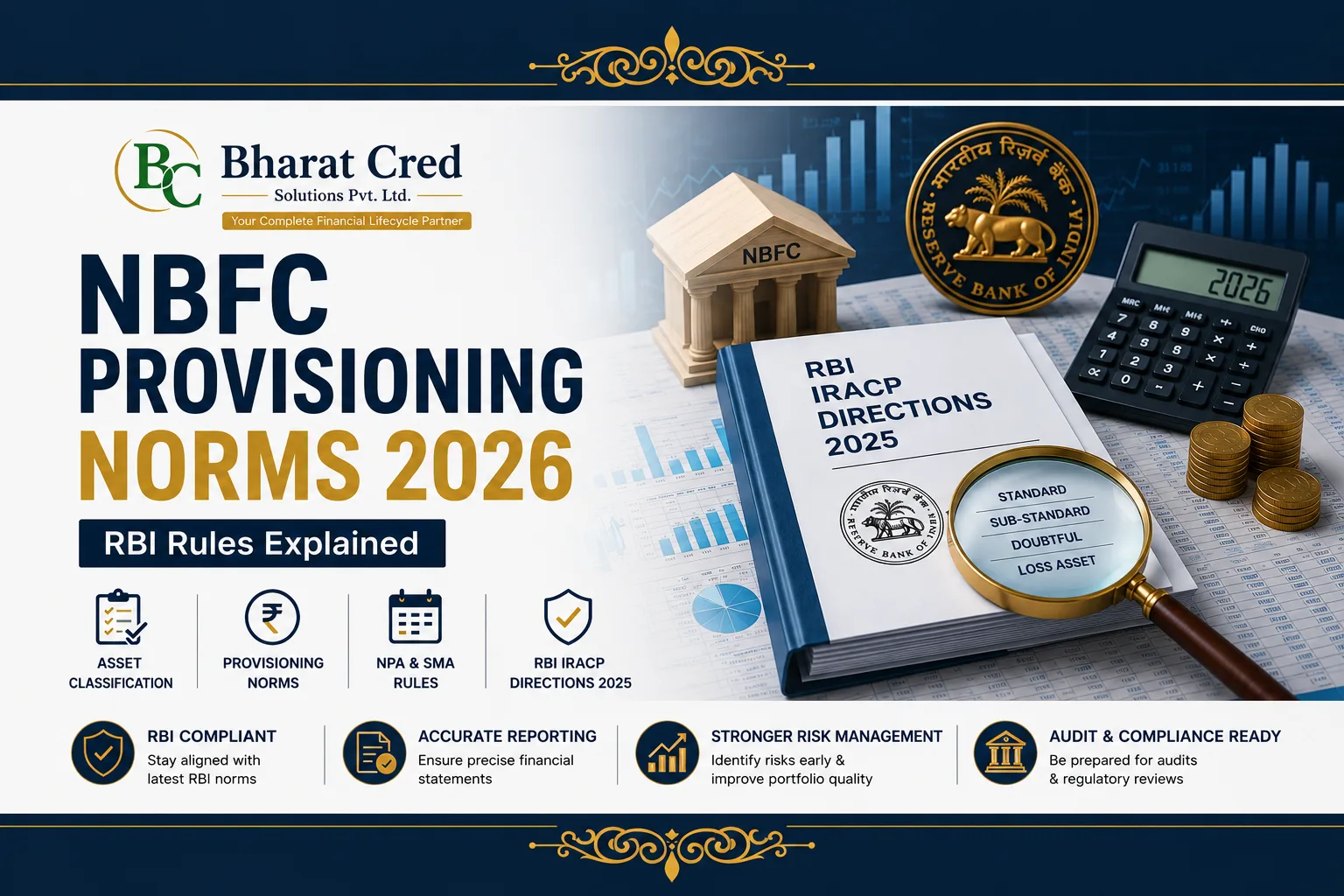
NBFC Provisioning Norms 2026 | RBI IRACP Directions | Asset Classification | NPA Rules | Standard, Sub-Standard, Doubtful & Loss Assets
Last Updated: August 2026
Reading Time: 15–20 minutes
Author: Bharat Cred Solutions — NBFC & RBI Regulatory Advisory Team
Quick Answer: What Are the NBFC Provisioning Norms in 2026?
NBFC provisioning norms are RBI-prescribed prudential requirements that determine how much provision an NBFC must maintain against loans and other credit exposures based on their asset classification and risk.
Under the Reserve Bank of India (Non-Banking Financial Companies – Income Recognition, Asset Classification and Provisioning) Directions, 2025, NBFCs generally classify credit exposures into:
Standard Assets
Sub-Standard Assets
Doubtful Assets
Loss Assets
The applicable provisioning requirement depends on the NBFC's regulatory layer, the type of exposure, the period for which an asset remains non-performing, the realisable value of security and other applicable RBI requirements.
The RBI's 2025 Directions also require NBFCs to perform overdue, SMA and NPA classification through their day-end processes. Asset classification is generally borrower-wise rather than merely facility-wise, and an NPA can be upgraded to standard only after the required arrears of principal and interest have been fully paid.
This guide explains the NBFC provisioning norms for 2026, including RBI asset classification, NPA recognition, SMA classification, standard asset provisioning, sub-standard provisioning, doubtful asset provisioning, loss asset provisioning, Ind AS implications, project-finance provisioning and practical compliance requirements.
Table of Contents
What Are NBFC Provisioning Norms?
What Are the RBI IRACP Directions 2025?
Who Do the NBFC IRACP Directions Apply To?
What Is Asset Classification for NBFCs?
What Is an Overdue Account?
What Are SMA-0, SMA-1 and SMA-2?
How Does the 90-Day NPA Rule Work in 2026?
Borrower-Wise NPA Classification
How Can an NPA Account Be Upgraded?
NBFC Standard Asset Provisioning Norms
NBFC Sub-Standard Asset Provisioning
NBFC Doubtful Asset Provisioning
NBFC Loss Asset Provisioning
Project Finance Provisioning Norms
Provisioning for Hire Purchase and Leased Assets
Ind AS 109 and Prudential Provisioning
Income Recognition on NPAs
NBFC Provisioning and Audit Readiness
Common NBFC Provisioning Mistakes
NBFC Provisioning Compliance Checklist 2026
Practical Example of NBFC Asset Classification
FAQs About NBFC Provisioning Norms
How Bharat Cred Solutions Can Help
1. What Are NBFC Provisioning Norms?
NBFC provisioning norms are regulatory requirements that require a Non-Banking Financial Company to recognise and provide for expected or identified losses arising from its lending and credit portfolio.
In simple terms:
Provisioning means setting aside an appropriate amount against a loan or asset when there is a risk that the amount may not be fully recovered.
Provisioning is important because an NBFC cannot treat every loan on its books as equally healthy.
For example:
A loan being repaid normally may remain a standard asset.
A loan that becomes non-performing may become a sub-standard asset.
If the weakness continues, it may become a doubtful asset.
If the asset is identified as effectively uncollectible, it may become a loss asset.
Each stage can carry different provisioning consequences.
The purpose is to ensure that the NBFC's financial statements do not present an unrealistically strong picture of its loan book.
2. What Are the RBI IRACP Directions 2025?
The RBI issued the:
Reserve Bank of India (Non-Banking Financial Companies – Income Recognition, Asset Classification and Provisioning) Directions, 2025
The Directions are dated November 28, 2025 and came into force with immediate effect.
They consolidate the RBI's prudential framework concerning:
Income recognition
Asset classification
NPA recognition
Provisioning
Standard asset provisioning
Borrower-wise classification
NPA upgradation
Project-finance provisioning
Disclosure requirements
Prudential provisioning for Ind AS NBFCs
The Directions were updated on February 13, 2026, and therefore should be treated as a primary reference when reviewing the 2026 framework.
Important RBI Reference
RBI Reference: RBI/DOR/2025-26/356
Circular: DOR.STR.REC.No.275/21.04.048/2025-26
Date: November 28, 2025
NBFCs should always verify the latest RBI version before making a regulatory decision because RBI directions and amendments can change the applicable requirements.
For Guidance On NBFC Asset Classification And Provisioning Compliance In 2026, Contact Us Today
3. Who Do the NBFC IRACP Directions Apply To?
The 2025 Directions apply to specified NBFC categories including:
NBFC-D
NBFC-ICC
NBFC-Factor
NBFC-IFC
IDF-NBFC
They also contain provisions applicable to HFCs, NBFC-MFIs, Mortgage Guarantee Companies and Core Investment Companies subject to their respective regulatory directions and any provisions that prevail in case of conflict.
However, the Directions specifically exclude certain entities and situations, including:
NBFC-P2P
NBFC-AA
Standalone Primary Dealers registered as NBFCs
NOFHCs registered as NBFCs
Certain NBFCs that do not avail public funds and do not have customer interface
Certain NBFC-BL entities having customer interface but not availing public funds
Therefore, you should not assume that one provisioning rule applies identically to every entity carrying the NBFC label.
The regulatory layer and category matter.
4. What Is Asset Classification for NBFCs?
Under the RBI framework, applicable NBFCs classify credit exposures into four broad categories:
1. Standard Asset
An asset where there is no perceived repayment default and no unusual credit weakness or risk.
2. Sub-Standard Asset
An asset that has become non-performing and remains within the prescribed sub-standard period applicable to that NBFC layer.
3. Doubtful Asset
An asset that remains in the sub-standard category beyond the applicable period.
4. Loss Asset
An asset identified as a loss because recovery is considered highly unlikely or because the asset has suffered an appropriate loss condition recognised under the RBI framework.
The RBI Directions require applicable NBFCs to classify assets after considering the degree of credit weakness and the extent to which recovery depends on collateral.
5. What Is an Overdue Account?
An amount due to an NBFC becomes overdue when it is not paid on the due date fixed by the NBFC.
This sounds simple, but the timing of classification is extremely important.
The RBI requires NBFCs to flag an account as overdue through their day-end process for the relevant due date.
Similarly, SMA and NPA classification must also be performed as part of the relevant day-end process.
Why Does Day-End Classification Matter?
An NBFC should not wait until:
month-end,
quarter-end,
audit time,
management review,
financial statement preparation,
to identify an account that has already crossed the applicable classification threshold.
The classification date should reflect the relevant calendar date determined through the day-end process.
6. What Are SMA-0, SMA-1 and SMA-2?
SMA means Special Mention Account.
SMA classification acts as an early-warning mechanism before an account becomes an NPA.
For applicable loan accounts, the general framework tracks overdue status before the NPA threshold is reached.
SMA-0
Typically refers to accounts where the payment is overdue up to 30 days.
SMA-1
Typically refers to accounts overdue for more than 30 days and up to 60 days.
SMA-2
Typically refers to accounts overdue for more than 60 days and up to 90 days.
Once the applicable NPA threshold is crossed, the account moves into NPA classification.
The critical point is that the NBFC's systems must identify these stages accurately and on time.
7. How Does the 90-Day NPA Rule Work in 2026?
This is one of the most important areas where NBFCs need to avoid oversimplification.
The RBI Directions provide a glide path for applicable NBFCs where the NPA classification period was being reduced.
The timeline was:
More than 150 days overdue → March 31, 2024
More than 120 days overdue → March 31, 2025
More than 90 days overdue → March 31, 2026
The RBI specifically states that this glide path does not apply to NBFCs that were already required to follow the 90-day NPA norm.
For NBFC-ML, the 2025 Directions prescribe NPA recognition based on more than 90 days overdue for the relevant categories of exposures.
Why This Matters
A common mistake is to publish a generic statement such as:
"Every NBFC in India follows exactly the same 90-day NPA rule."
That is not sufficiently precise.
The applicable:
NBFC category,
regulatory layer,
portfolio type,
transitional provision,
and specific RBI direction
must be considered.
This is why an NBFC should review its own classification framework rather than rely on a generic internet checklist.
8. Borrower-Wise NPA Classification
One of the most important principles under the RBI Directions is borrower-wise asset classification.
The RBI states that asset classification is borrower-wise and not merely facility-wise.
If one facility of a borrower becomes NPA, other facilities of the same borrower with the same NBFC may also need to be treated according to the borrower-wise classification requirements.
Example
Suppose an NBFC has given:
Business Loan — ₹20 lakh
Working Capital Facility — ₹10 lakh
Equipment Finance — ₹15 lakh
to the same borrower.
If one relevant facility becomes NPA, the NBFC cannot automatically assume that the remaining facilities can continue to be treated independently as standard assets.
The borrower-wise classification framework must be applied.
This is particularly important for NBFCs with multiple products and borrowers having multiple credit facilities.
9. How Can an NPA Account Be Upgraded?
The RBI framework is clear on the basic requirement.
An NPA account can be upgraded to standard only after the required entire arrears of interest and principal have been paid by the borrower.
For borrowers having multiple credit facilities, the applicable requirement also considers the arrears across those facilities.
What Does This Mean in Practice?
Suppose a borrower has ₹5 lakh of overdue principal and interest.
The borrower makes a partial payment of ₹2 lakh.
The account may still have outstanding arrears.
Therefore, the NBFC should not treat the account as standard merely because the immediate overdue amount has fallen below a threshold.
The actual RBI upgradation conditions must be satisfied.
Restructured accounts and other special cases can have additional requirements under the RBI Resolution of Stressed Assets Directions, 2025.
10. NBFC Standard Asset Provisioning Norms 2026
Standard assets are not necessarily provision-free.
The applicable NBFC layer determines the standard asset provisioning requirement.
NBFC Base Layer
An NBFC-BL is required to make provision for standard assets at:
0.25% of outstanding
This provision is not reckoned for arriving at net NPAs.
NBFC Middle Layer
An NBFC-ML is required to make provisions for standard assets at:
0.40% of outstanding
The RBI also states that this rate applies to microfinance loans in the relevant context.
NBFC Upper Layer
For NBFC-UL, standard asset provisioning is differentiated by exposure category.
The 2025 Directions prescribe, among other rates:
Individual housing loans and loans to small and micro enterprises — 0.25%
Housing loans at teaser rates — 2% initially, subject to the prescribed reduction after the reset period if the account remains standard
CRE-RH — 0.75%
CRE other than CRE-RH — 1%
Other loans and advances, including loans to medium enterprises — 0.40%
Restructured advances — as prescribed under the applicable stressed-assets framework
Key Takeaway
Do not apply one standard-asset provisioning percentage to every NBFC loan book.
The NBFC's regulatory layer and exposure category matter.
11. NBFC Sub-Standard Asset Provisioning
For applicable NBFC exposures covered by the general provisioning requirements, the RBI Directions prescribe:
10% general provision of total outstanding for sub-standard assets.
The exact treatment can differ where special categories, microfinance portfolios, restructuring provisions or other specific regulatory requirements apply.
What Is a Sub-Standard Asset?
For NBFC-BL, an asset may remain sub-standard while it has been classified as NPA for a period not exceeding 18 months.
For NBFC-ML, the corresponding period is not exceeding 12 months.
Restructured or renegotiated assets can also have specific classification treatment until the required period of satisfactory performance is completed.
12. NBFC Doubtful Asset Provisioning
Doubtful asset provisioning is particularly important because the requirement depends on:
how long the asset has remained doubtful,
the realisable value of security,
the unsecured portion,
the applicable NBFC layer,
and the specific regulatory provisions applicable to the portfolio.
For the general provisioning framework in the 2025 Directions, doubtful assets require:
Unsecured / Uncovered Portion
100% provision to the extent the advance is not covered by the realisable value of security to which the NBFC has valid recourse.
The realisable value must be estimated on a realistic basis.
Secured Portion
Additional provisioning is based on the period the asset has remained doubtful.
The general framework specifies:
Up to 1 year — 20%
1 to 3 years — 30%
More than 3 years — 50%
These rates apply to the secured portion under the specified general framework.
Important
Do not confuse these rates with provisioning frameworks applicable to banks or other regulated entities.
The correct provisioning matrix should always be mapped to the NBFC's applicable RBI Directions.
13. NBFC Loss Asset Provisioning
A loss asset represents an exposure where the loss has been identified by the NBFC, its internal or external auditor, or by RBI inspection, subject to the conditions prescribed by the Directions.
The RBI framework requires the entire asset to be written off.
If the asset is permitted to remain on the books, 100% of the outstanding amount must be provided for.
Simple Rule
Loss asset = write-off or 100% provision where it remains on the books.
This is why correct asset identification and timely escalation are critical for NBFC finance and compliance teams.
14. Project Finance Provisioning Norms for NBFCs
Project finance has its own provisioning requirements.
For specified project-finance exposures, the 2025 Directions prescribe general provisions based on whether the project is in the construction phase or operational phase.
Construction Phase
CRE: 1.25%
CRE-RH: 1.00%
All others: 1.00%
Operational Phase
After commencement of repayment of principal and interest:
CRE: 1.00%
CRE-RH: 0.75%
All others: 0.40%
There are also specific provisions concerning DCCO deferment and projects where financial closure was achieved before the relevant cutoff.
Therefore, project-finance provisioning should be reviewed separately rather than simply applying the standard-asset percentage.
15. Provisioning for Hire Purchase and Leased Assets
NBFCs involved in hire purchase and leasing should pay particular attention to the additional provisioning framework.
The RBI Directions prescribe additional provisioning based on how long hire charges or lease rentals remain overdue.
The additional provision schedule includes:
Up to 12 months overdue — Nil
More than 12 months up to 24 months — 10% of net book value
More than 24 months up to 36 months — 40%
More than 36 months up to 48 months — 70%
More than 48 months — 100%
The Directions also contain specific rules concerning depreciated asset value, security deposits, other security and the treatment of financial leases.
16. Ind AS 109 and Prudential Provisioning
This is one of the most important issues for NBFC finance teams.
An NBFC following Indian Accounting Standards must maintain impairment allowances under Ind AS.
However, the RBI Directions also require the NBFC to calculate provisions under the prudential framework.
The prudential calculation acts as a regulatory floor.
If the Ind AS 109 impairment allowance is lower than the applicable prudential floor, the difference must be appropriated from net profit or loss after tax into a separate Impairment Reserve, subject to RBI's prescribed conditions.
In Simple Terms
Ind AS accounting impairment and RBI prudential provisioning are related but are not the same calculation.
An NBFC should therefore maintain the appropriate reconciliation and documentation between:
Ind AS ECL
and
RBI Prudential Provisioning
This is an area where inadequate documentation can create significant audit and regulatory problems.
17. Income Recognition on NPAs
Provisioning is only one part of the RBI's prudential framework.
Income recognition is another.
Under the Directions, income such as:
interest,
discount,
hire charges,
lease rentals,
other charges
on an NPA should be recognised only when it is actually realised.
Income recognised before an asset became non-performing but remaining unrealised is required to be reversed in accordance with the applicable framework.
Why This Matters
An NBFC should not improve its reported profitability simply by continuing to recognise unrealised income on an NPA.
The classification and income-recognition systems must therefore work together.
18. NBFC Provisioning and Audit Readiness
NBFC provisioning should not be treated as an accounting exercise performed immediately before the audit.
A strong compliance framework should continuously track:
Loan-level DPD
Overdue dates
SMA classification
NPA classification
Borrower-level exposure
Security valuation
Realisable value
NPA ageing
Provisioning percentage
Restructured accounts
Upgradation eligibility
Write-offs
Ind AS ECL
Prudential provisioning
Impairment reserve
Regulatory disclosures
What Should an NBFC's System Be Able to Answer?
If an auditor or regulator asks:
"Why is this account still standard?"
the NBFC should be able to demonstrate the answer from its records.
If asked:
"Why is this account classified as doubtful?"
the classification history and provisioning calculation should be traceable.
If asked:
"Why was this NPA upgraded?"
the NBFC should be able to demonstrate that the prescribed conditions were satisfied.
This is why automated loan-management systems, accurate DPD tracking and documented provisioning policies are increasingly important.
19. Common NBFC Provisioning Mistakes
Here are some of the most common problems NBFCs should review.
1. Using an outdated provisioning matrix
RBI directions change. An old spreadsheet may no longer reflect the current framework.
2. Applying the same rule to every NBFC
NBFC-BL, NBFC-ML and NBFC-UL can have different requirements.
3. Ignoring day-end classification
Waiting for month-end can result in incorrect classification dates.
4. Classifying facility-wise instead of borrower-wise
The RBI framework requires borrower-wise classification in applicable circumstances.
5. Upgrading an NPA after partial payment
An account should not be upgraded merely because the overdue amount has been reduced.
6. Using original collateral value instead of realisable value
Provisioning against doubtful assets depends on the appropriate realisable value of security.
7. Confusing Ind AS ECL with RBI provisioning
The two frameworks need to be appropriately reconciled.
8. Ignoring project-finance provisions
Project finance has additional provisioning requirements.
9. Treating provisioning as an annual activity
Provisioning should be integrated into ongoing portfolio monitoring.
10. Failing to document the calculation
A correct number without an auditable calculation trail is still a compliance weakness.
20. NBFC Provisioning Compliance Checklist 2026
Use the following checklist for an initial internal review.
Asset Classification
☐ Current RBI IRACP framework identified
☐ NBFC regulatory layer confirmed
☐ Applicable NBFC category confirmed
☐ Overdue definition implemented correctly
☐ Day-end overdue process functioning
☐ SMA classification functioning
☐ NPA classification functioning
☐ Borrower-wise classification tested
☐ NPA ageing maintained
☐ Restructured accounts separately tracked
Provisioning
☐ Standard asset provisioning matrix updated
☐ Sub-standard provisioning correctly calculated
☐ Doubtful asset provisioning calculated by ageing
☐ Security realisable value documented
☐ Unsecured portion correctly identified
☐ Loss assets identified
☐ 100% provision/write-off treatment verified
☐ Project finance provisions reviewed
☐ Lease/hire-purchase provisions reviewed where applicable
Ind AS
☐ Ind AS 109 ECL calculation completed where applicable
☐ RBI prudential floor calculated
☐ ECL vs prudential provision reconciliation prepared
☐ Impairment Reserve requirement assessed
Income Recognition
☐ NPA income recognition reviewed
☐ Unrealised income reversals checked
☐ Interest accrual on standard accounts reviewed
☐ Moratorium cases reviewed
Governance & Audit
☐ Board-approved policies updated
☐ Provisioning policy reviewed
☐ Classification policy reviewed
☐ Loan-management system tested
☐ MIS reconciled with GL
☐ Provisioning calculations documented
☐ Audit trail maintained
☐ Regulatory disclosures reviewed
21. Practical Example of NBFC Asset Classification
Consider an NBFC that has provided a ₹50 lakh business loan.
The borrower initially pays according to the agreed schedule.
The account therefore remains a standard asset, subject to the applicable provisioning requirements.
Later, the borrower begins missing payments.
The NBFC's system should:
Step 1: Record the overdue amount on the relevant due date.
Step 2: Run the day-end classification process.
Step 3: Monitor the account through the appropriate SMA stage.
Step 4: Classify the account as NPA when the applicable NPA criteria are satisfied.
Step 5: Move the asset into the appropriate NPA category.
Step 6: Calculate the applicable provision.
Step 7: Continue monitoring NPA ageing.
Step 8: Reassess security and realisable value where relevant.
Step 9: Upgrade the account only after the applicable RBI conditions are satisfied.
This process should be system-driven wherever possible rather than dependent on manual spreadsheet reviews.
22. Frequently Asked Questions About NBFC Provisioning Norms
What are NBFC provisioning norms?
NBFC provisioning norms are RBI requirements that determine the amount an NBFC must provide against credit exposures based on asset classification, risk, ageing, security and applicable regulatory requirements.
What is the RBI IRACP Directions 2025?
The RBI IRACP Directions 2025 are the Reserve Bank of India's consolidated directions governing income recognition, asset classification and provisioning for specified NBFCs.
What are the four asset classifications for NBFCs?
The four broad categories are:
Standard
Sub-standard
Doubtful
Loss
What is the standard asset provisioning rate for an NBFC-BL?
The RBI Directions prescribe 0.25% of outstanding for standard assets for NBFC-BL, subject to the applicable framework.
What is the standard asset provisioning rate for an NBFC-ML?
The prescribed standard asset provision for NBFC-ML is 0.40% of outstanding, subject to the applicable provisions.
What is the standard asset provisioning rate for NBFC-UL?
NBFC-UL has differentiated standard-asset provisioning rates depending on the exposure category. These include 0.25%, 0.40%, 0.75%, 1% and 2% in specified circumstances.
What is the provisioning rate for sub-standard assets?
Under the general framework, sub-standard assets attract a 10% general provision on total outstanding, subject to the applicable category-specific requirements.
What is the provisioning requirement for loss assets?
A loss asset should generally be written off. If it remains on the books, the applicable RBI framework requires 100% provision of outstanding.
How is a doubtful asset provision calculated?
The provision depends on the unsecured/uncovered portion and the period the asset has remained doubtful. Under the general framework, the uncovered portion requires 100% provision, with additional provisioning on the secured portion based on doubtful-asset ageing.
Is the NPA rule 90 days for NBFCs in 2026?
The answer depends on the applicable NBFC category and regulatory layer. The RBI's glide path for applicable NBFCs reached the more-than-90-day stage by March 31, 2026, while NBFC-ML has a more-than-90-day NPA framework. NBFCs should therefore verify the rule applicable to their exact regulatory category rather than rely on a generic statement.
Can an NBFC upgrade an NPA after receiving a partial payment?
Generally, an NPA account may be upgraded to standard only after the required entire arrears of interest and principal have been paid. Borrowers with multiple facilities are subject to the applicable borrower-wise upgradation requirement.
Does collateral reduce NBFC provisioning?
It can affect the secured portion of provisioning where the RBI framework permits consideration of the realisable value of security. However, the relevant value is the appropriate realisable value, not simply the original collateral value.
Is Ind AS provisioning the same as RBI provisioning?
No. An NBFC following Ind AS must calculate impairment under Ind AS while also maintaining the RBI prudential provisioning framework where applicable. The prudential requirement can operate as a floor.
Do project-finance loans have separate provisioning requirements?
Yes. The RBI Directions prescribe specific general provisioning rates for project-finance exposures depending on the project category and whether the project is in construction or operational phase.
Why is day-end processing important for NBFCs?
The RBI requires overdue, SMA and NPA classification to be performed through the relevant day-end process, making the classification date tied to the applicable calendar date.
What happens if an NBFC follows outdated provisioning norms?
Using an outdated framework can result in incorrect asset classification, under-provisioning, inaccurate financial reporting, audit observations and potential regulatory concerns.
23. How Bharat Cred Solutions Can Help With NBFC Provisioning & Compliance
NBFC provisioning is not an isolated accounting task.
It sits inside a larger regulatory ecosystem involving:
RBI licensing → governance → lending policies → credit monitoring → asset classification → NPA management → provisioning → reporting → audit → recovery
Bharat Cred Solutions works across this broader NBFC lifecycle.
Our NBFC compliance support includes:
RBI regulatory returns and filings
NBS and DNBS-related compliance support
Board and committee governance
Fair Practices Code updates
KYC/AML policy updates
Statutory and internal audit coordination
Regulatory compliance advisory
Ongoing NBFC compliance support
For businesses preparing to enter the NBFC sector, Bharat Cred also provides NBFC registration, RBI licensing and post-registration support.
For businesses that need a faster lending-business structure, Bharat Cred's NBFC Plug & Play ecosystem connects lending technology, operations, manpower, infrastructure and recovery capabilities around an appropriate NBFC-backed model.
Need an NBFC Provisioning & Compliance Review?
If your NBFC is unsure whether its current:
asset classification,
NPA recognition,
provisioning matrix,
day-end process,
borrower-wise classification,
Ind AS ECL reconciliation,
or regulatory compliance framework
is aligned with the current RBI framework, a structured review can help identify gaps before they become audit or regulatory issues.
Talk to Bharat Cred Solutions
Get an NBFC Compliance Assessment
Discuss your NBFC's current regulatory layer, lending portfolio, provisioning process and compliance requirements with the Bharat Cred team.
Call: +91 92895 67208
Email: info@bharatcredsolutions.com
Bharat Cred Solutions Pvt. Ltd.
India's Financial Infrastructure Partner for:
NBFC Registration | RBI Licensing | NBFC Compliance | Lending Solutions | Recovery & Collections | Financial BPO
Final Takeaway
The biggest mistake an NBFC can make in 2026 is to treat provisioning as a simple percentage applied to a loan book.
The actual framework requires a connected process.
An NBFC must know:
Which regulatory layer applies?
Which asset classification applies?
When did the account become overdue?
Was the account classified through the correct day-end process?
Has the NPA threshold been crossed?
Is classification borrower-wise?
What is the realisable value of security?
How long has the asset remained doubtful?
Does Ind AS 109 create an impairment requirement?
What is the RBI prudential floor?
Has the income-recognition treatment been correctly applied?
Is the provisioning calculation properly documented?
For NBFCs, accurate provisioning is ultimately about more than accounting.
It is about regulatory discipline, financial transparency, risk management and the credibility of the loan book.
As RBI's regulatory framework continues to evolve, NBFCs should review their policies, systems and compliance processes against the latest applicable directions rather than relying on outdated checklists or generic provisioning percentages.
Disclaimer
This article is provided for general educational and informational purposes and should not be treated as legal, accounting, investment or regulatory advice for a specific NBFC.
NBFC requirements can differ depending on the entity's regulatory category, layer, business model, portfolio, accounting framework and applicable RBI directions.
Before implementing any classification, provisioning, restructuring or regulatory decision, an NBFC should review the latest applicable RBI directions and obtain professional advice based on its specific circumstances.
RBI regulations and directions may be amended from time to time. Always verify the latest RBI notification before acting.
Have a specific question about this?
Talk it through with our team on a strategy call.