
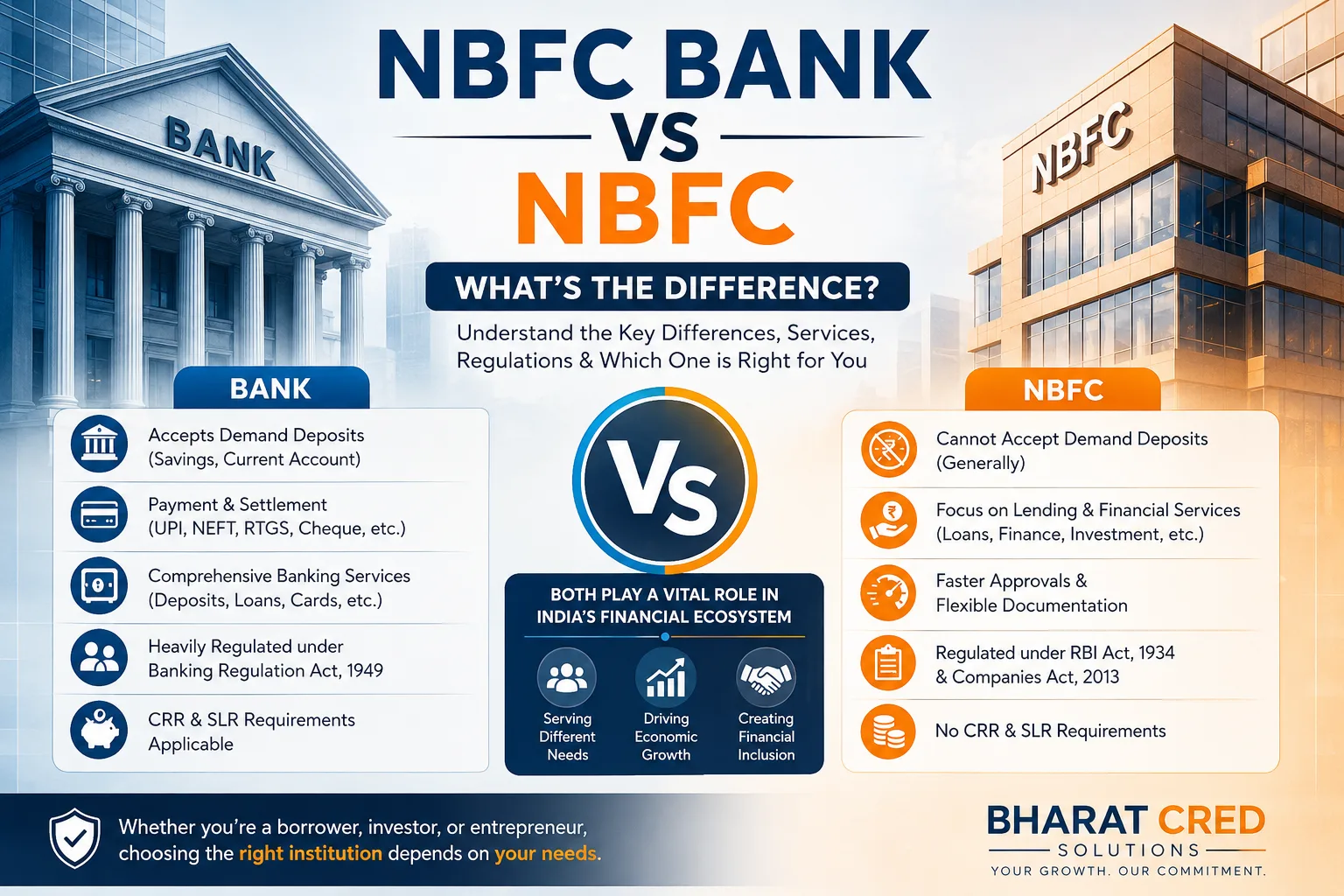
Bank vs NBFC: What's the Difference?
If you've ever searched for a loan, investment, or financial service, you've likely come across both banks and Non-Banking Financial Companies (NBFCs). At first glance, they may seem to offer similar services, such as loans, financing, and investment products. However, despite these similarities, NBFCs and banks operate under different regulatory frameworks and have distinct roles in India's financial ecosystem.
One of the most common questions people ask is:
Is an NBFC the same as a bank?
Can an NBFC accept deposits?
Which is better for loans—an NBFC or a bank?
Are NBFCs regulated by the RBI?
Why do businesses choose to establish an NBFC instead of a bank?
The answer lies in understanding the legal, operational, and regulatory differences between these two types of financial institutions.
In this comprehensive guide, we'll explain:
What is an NBFC?
What is a bank?
Major differences between NBFCs and banks
RBI regulations governing each
Services they provide
Advantages and disadvantages
Which institution is better for borrowers and businesses
How Bharat Cred Solutions helps entrepreneurs establish RBI-compliant NBFCs
Whether you're an entrepreneur planning to start a financial company, an investor exploring the sector, or someone looking for the right financing partner, this guide will help you make informed decisions.
What is a Bank?
A bank is a financial institution licensed by the Reserve Bank of India (RBI) under the Banking Regulation Act, 1949, to accept public deposits, provide loans, facilitate payments, and offer a wide range of financial services.
Banks form the backbone of India's financial system by accepting deposits from the public and using those funds to extend credit to individuals, businesses, and government entities.
Core Functions of a Bank
Banks perform several essential functions, including:
Accepting savings and current account deposits
Issuing fixed deposits and recurring deposits
Providing personal, business, home, education, and vehicle loans
Offering internet and mobile banking
Facilitating UPI, NEFT, RTGS, and IMPS transactions
Issuing debit cards, credit cards, and cheque books
Foreign exchange and remittance services
Investment and wealth management solutions
Locker facilities
Trade finance and corporate banking
Banks play a crucial role in maintaining financial stability and supporting economic growth.
What is an NBFC?
A Non-Banking Financial Company (NBFC) is a company registered under the Companies Act, 2013 and licensed by the Reserve Bank of India under the Reserve Bank of India Act, 1934 to carry on financial business.
Unlike banks, NBFCs cannot generally accept demand deposits (such as savings or current accounts). Instead, they specialize in providing loans, financing, leasing, investment activities, microfinance, infrastructure financing, housing finance, and other financial services.
NBFCs have become one of the fastest-growing segments of India's financial sector because they address credit needs that traditional banks may not efficiently serve.
Common Services Offered by NBFCs
NBFCs typically provide:
Business loans
Personal loans
MSME financing
Gold loans
Vehicle financing
Equipment financing
Loan against property
Invoice financing
Working capital loans
Project finance
Microfinance
Leasing and hire purchase
Investment advisory
Infrastructure finance
Housing finance (through eligible entities)
Many NBFCs focus on specific industries or customer segments, allowing them to deliver faster approvals, flexible documentation, and tailored financial solutions.
Why Do People Confuse NBFCs with Banks?
Many people assume NBFCs are banks because both offer loans and financial services. However, the similarity often ends there.
For example, if you take a vehicle loan from an NBFC or apply for a business loan from one, the experience may appear similar to borrowing from a bank. Yet the underlying legal structure, regulatory permissions, funding model, and operational scope are significantly different.
Both institutions are regulated by the Reserve Bank of India, but they are governed by different laws and are subject to different compliance requirements.
Understanding these differences is essential for borrowers, investors, entrepreneurs, and businesses planning to enter the financial services sector.
Why Does India Need Both Banks and NBFCs?
India's financial landscape is diverse, and no single type of institution can meet the needs of every customer.
Banks primarily focus on traditional banking services, deposit mobilization, payment systems, and broad-based lending. NBFCs complement this ecosystem by serving niche markets, underserved sectors, startups, MSMEs, rural borrowers, and specialized financing requirements.
Together, banks and NBFCs improve credit availability, promote financial inclusion, and support economic development across urban and rural India.
====================================================================================================================================================================================================================================================================================
Complete Comparison Between NBFC and Bank
One of the biggest reasons people search for "NBFC vs Bank" is to understand which institution is better suited for borrowing, investing, or starting a financial business.
Although both banks and NBFCs provide financial services, they differ significantly in terms of regulation, licensing, deposit acceptance, payment systems, funding, compliance requirements, and operational flexibility.
The following comparison explains these differences in detail.
1. Regulatory Framework
Banks are governed by the Banking Regulation Act, 1949, which provides a comprehensive legal framework for banking operations, deposit acceptance, payment systems, and financial stability.
NBFCs, on the other hand, are incorporated under the Companies Act, 2013 and regulated by the Reserve Bank of India Act, 1934. Depending on their business model, they must also comply with various RBI Master Directions and sector-specific guidelines.
Although both are regulated by the RBI, the regulatory obligations and operational permissions differ substantially.
2. Banking License vs NBFC Registration
A bank must obtain a banking license from the Reserve Bank of India before commencing operations.
Obtaining a banking license is considerably more stringent because banks are permitted to accept public deposits and operate the nation's payment infrastructure.
An NBFC does not receive a banking license. Instead, eligible companies obtain an NBFC Certificate of Registration (CoR) from the RBI after meeting prescribed eligibility norms, including Net Owned Fund (NOF) requirements, fit-and-proper criteria, and business planning.
3. Deposit Acceptance
This is perhaps the biggest difference between a bank and an NBFC.
Banks can accept:
Savings deposits
Current account deposits
Fixed deposits
Recurring deposits
Demand deposits
These deposits form the primary funding source for banks.
Most NBFCs cannot accept demand deposits from the public.
Only specific categories of RBI-authorized Deposit-Taking NBFCs (NBFC-D) may accept certain deposits under strict regulatory conditions.
Therefore, if a customer wants to open a savings account or current account, only a bank can legally provide this facility.
4. Payment System Participation
Banks are an integral part of India's payment ecosystem.
They participate directly in systems such as:
UPI
NEFT
RTGS
IMPS
Cheque Clearing
ATM Networks
Debit Cards
Credit Cards
NBFCs generally do not operate payment systems like banks. While many NBFCs partner with banks or fintech companies to offer digital payment solutions, they are not traditional payment system operators.
5. Lending Activities
Both banks and NBFCs provide loans.
However, their approach differs considerably.
Banks usually follow highly standardized lending procedures with detailed documentation, stringent eligibility checks, and longer approval timelines.
NBFCs often specialize in niche lending markets and are known for:
Faster approvals
Flexible underwriting
Customized financial products
Industry-specific financing
Higher risk appetite
This flexibility enables NBFCs to serve customer segments that banks may find difficult to finance.
6. Customer Segments
Banks cater to virtually every segment of society, including:
Individuals
Students
Salaried employees
Businesses
Government organizations
Corporate enterprises
Rural customers
NBFCs generally focus on specialized customer groups such as:
MSMEs
Startups
Entrepreneurs
Transport operators
Real estate developers
Equipment buyers
Microfinance borrowers
Infrastructure companies
High-net-worth individuals (HNIs)
Their specialization allows them to design products for industries with unique financing needs.
7. Loan Approval Process
Banks typically prioritize risk management, resulting in longer approval timelines and extensive documentation.
NBFCs emphasize operational efficiency and customer convenience.
As a result, borrowers often experience:
Faster approvals
Simplified documentation
Digital application processes
Customized repayment structures
Higher flexibility for non-traditional borrowers
This is one reason why NBFCs have experienced rapid growth in India's lending ecosystem.
8. Regulatory Compliance
Banks operate under one of the most rigorous compliance frameworks in the financial sector.
They must comply with:
CRR (Cash Reserve Ratio)
SLR (Statutory Liquidity Ratio)
Basel Norms
Banking Regulation Act
RBI Prudential Guidelines
Priority Sector Lending
KYC & AML Regulations
NBFCs also maintain strong compliance standards but follow a regulatory framework designed specifically for non-banking financial institutions.
Their compliance obligations include:
RBI Master Directions
Prudential Norms
Fair Practices Code
Corporate Governance Guidelines
KYC & AML Compliance
Risk Management Frameworks
9. Funding Sources
Banks primarily generate funds through customer deposits.
NBFCs rely on alternative funding channels, including:
Bank borrowings
Financial institutions
Bonds
Debentures
Commercial Papers
Equity investment
Private capital
Institutional investors
This funding structure influences how NBFCs price their loan products.
10. Risk Appetite
Banks generally maintain conservative lending policies because they safeguard public deposits.
NBFCs often have a greater willingness to finance:
New businesses
Emerging industries
First-time borrowers
Specialized sectors
Higher-risk commercial activities
While this flexibility benefits borrowers, it also requires robust risk management practices.
11. Technology Adoption
Over the past decade, NBFCs have become pioneers in digital lending.
Many leading NBFCs leverage:
AI-powered credit assessment
Automated underwriting
Digital KYC
Instant loan approvals
API integrations
Paperless onboarding
Although banks have significantly improved their digital offerings, NBFCs often move faster due to their operational flexibility.
12. Financial Inclusion
NBFCs play a critical role in expanding financial access across India.
They actively finance:
Rural entrepreneurs
Small businesses
Self-employed professionals
Agriculture
Vehicle owners
First-generation entrepreneurs
This complements the banking sector and strengthens India's overall financial ecosystem.
Advantages of Banks vs NBFCs – Which One Should You Choose?
Choosing between a bank and a Non-Banking Financial Company (NBFC) depends entirely on your financial objectives, business requirements, eligibility, and the type of services you need.
Many people assume banks are always the better choice because they have existed for decades. However, India's rapidly growing financial ecosystem has shown that NBFCs often provide faster, more flexible, and customer-centric financial solutions, especially for businesses and entrepreneurs.
Let's understand the advantages of each.
Advantages of Banks
Banks are considered the backbone of India's financial system because they provide a complete range of banking and financial services under one roof.
Some of the biggest advantages include:
1. Safe Deposit Facility
Banks are authorized to accept public deposits such as:
Savings Accounts
Current Accounts
Fixed Deposits
Recurring Deposits
Customer deposits are regulated by the Reserve Bank of India, making banks one of the safest institutions for storing money.
2. Complete Banking Services
Banks provide multiple financial services including:
Personal Banking
Corporate Banking
Retail Banking
Trade Finance
Foreign Exchange
Wealth Management
Investment Services
Locker Facilities
Internet Banking
Mobile Banking
Credit Cards
Debit Cards
Customers rarely need another financial institution for day-to-day banking.
3. Lower Interest Rates
Since banks primarily use customer deposits as their funding source, their cost of funds is relatively lower.
As a result:
Home loans
Education loans
Business loans
Vehicle loans
are often offered at competitive interest rates.
4. Strong Public Confidence
Banks enjoy a very high level of public trust because they are heavily regulated and monitored by the RBI.
For depositors, banks generally remain the preferred choice for wealth preservation.
5. National Payment Infrastructure
Banks operate India's payment ecosystem through:
UPI
RTGS
NEFT
IMPS
Cheque Clearing
ATM Network
NBFCs generally cannot offer these services independently.
Limitations of Banks
Despite their strengths, banks have certain limitations.
Borrowers often experience:
Lengthy approval processes
Extensive documentation
Strict eligibility criteria
Lower flexibility
Limited customized financing
Startups and new entrepreneurs may find it difficult to secure funding from traditional banks.
Advantages of NBFCs
NBFCs have transformed India's lending landscape by making finance faster, more accessible, and tailored to customer needs.
1. Faster Loan Approvals
One of the biggest reasons borrowers prefer NBFCs is speed.
Many NBFCs provide:
Same-day approvals
Digital onboarding
Paperless verification
Quick loan disbursement
For businesses requiring urgent working capital, this can be a significant advantage.
2. Flexible Documentation
Unlike banks, NBFCs often accept alternative financial documentation.
This benefits:
Startups
Self-employed professionals
Small businesses
First-time entrepreneurs
MSMEs
who may not satisfy traditional banking requirements.
3. Customized Financial Products
NBFCs usually specialize in particular industries.
Examples include:
Vehicle Finance
Equipment Finance
Gold Loans
MSME Loans
Infrastructure Finance
Housing Finance
Supply Chain Finance
Invoice Discounting
Loan Against Property
This specialization enables them to design products for specific business needs.
4. Better Support for MSMEs
India's MSME sector contributes significantly to employment and GDP.
Many small businesses struggle to obtain funding from banks due to:
Limited financial history
Insufficient collateral
New business models
NBFCs help bridge this financing gap.
5. Innovation & Digital Experience
Leading NBFCs invest heavily in technology.
Modern NBFCs frequently offer:
AI-based underwriting
Instant eligibility checks
Online documentation
Automated verification
Digital loan processing
Mobile-first customer experience
This improves both customer convenience and operational efficiency.
6. Higher Risk Appetite
Banks usually avoid financing high-risk industries.
NBFCs often finance:
New businesses
Emerging sectors
Growing startups
Innovative business models
This flexibility supports entrepreneurship and economic growth.
Limitations of NBFCs
Like every financial institution, NBFCs also have limitations.
Most NBFCs:
Cannot accept savings accounts
Cannot offer current accounts
Cannot issue cheque books
Cannot independently operate payment systems
Usually have a higher cost of funds compared to banks
As a result, loan interest rates may sometimes be slightly higher depending on the borrower profile.
Which One is Better?
There is no universal answer.
The right choice depends on your objective.
Choose a Bank if You Need:
✅ Savings Account
✅ Current Account
✅ Salary Account
✅ Fixed Deposit
✅ Payment Services
✅ Lower Interest Rates
✅ Long-Term Banking Relationship
Choose an NBFC if You Need:
✅ Faster Loan Processing
✅ Flexible Documentation
✅ Business Financing
✅ MSME Loans
✅ Startup Funding
✅ Equipment Finance
✅ Specialized Financial Solutions
✅ Customized Lending
Real-Life Example
Imagine two entrepreneurs planning to expand their businesses.
Example 1
Rahul owns an established manufacturing company with audited financial statements, collateral, and a strong credit history.
A commercial bank may provide him with a business loan at a competitive interest rate because he meets all lending criteria.
Example 2
Priya is launching a fintech startup with innovative ideas but limited operating history.
Although her business has strong potential, traditional banks may hesitate due to higher perceived risk.
An NBFC specializing in startup financing is more likely to evaluate her business model holistically and provide customized financial assistance.
Can an NBFC Become a Bank?
Yes—but not automatically.
If an NBFC wishes to operate as a bank, it must obtain a banking license from the Reserve Bank of India and comply with all applicable banking regulations.
This involves significantly higher capital requirements, governance standards, regulatory obligations, and compliance responsibilities.
Many large NBFCs have successfully transitioned into banks over the years after fulfilling RBI requirements.
Why Entrepreneurs Prefer Starting an NBFC
For entrepreneurs looking to enter the financial services industry, establishing an NBFC is often more practical than applying for a banking license.
An RBI-registered NBFC enables businesses to:
Provide lending services
Finance MSMEs
Offer leasing and hire purchase
Support startups
Serve niche financial markets
Build scalable financial institutions
With the right business model and regulatory guidance, an NBFC can become a highly profitable and sustainable financial enterprise.
How Bharat Cred Solutions Helps
Starting an NBFC involves much more than company incorporation. RBI approval requires careful planning, documentation, compliance, and regulatory expertise.
Bharat Cred Solutions provides end-to-end assistance for entrepreneurs, investors, and financial businesses looking to establish RBI-compliant NBFCs.
Our services include:
Eligibility Assessment
Business Structure Planning
Company Incorporation
Net Owned Fund (NOF) Guidance
RBI Documentation
Business Plan Preparation
Financial Projections
Compliance Framework Design
RBI Application Filing
Post-Registration Compliance Support
Corporate Governance Advisory
Ongoing Regulatory Consultation
With a team of experienced legal, compliance, and financial professionals, we simplify the complex RBI registration process so you can focus on building and growing your financial business.
Frequently Asked Questions (FAQs), Common Myths & Conclusion
A comprehensive FAQ section helps answer users' questions while improving the chances of appearing in Google's "People Also Ask" (PAA) results. The following FAQs are optimized around high-volume search queries related to NBFC vs Bank.
Frequently Asked Questions (FAQs)
1. Is an NBFC a Bank?
No.
An NBFC (Non-Banking Financial Company) is not a bank. While both provide loans and financial services, NBFCs generally cannot accept demand deposits such as savings or current accounts, issue cheque books, or independently operate payment systems like banks.
NBFCs are regulated by the Reserve Bank of India (RBI) but operate under a different regulatory framework.
2. Which is Better: NBFC or Bank?
Neither is universally better—the right choice depends on your needs.
Choose a Bank if you need:
Savings Account
Current Account
Fixed Deposits
Payment Services
Lower Interest Loans
Choose an NBFC if you need:
Faster Loan Approval
Flexible Documentation
MSME Financing
Startup Funding
Specialized Financial Solutions
Business Expansion Finance
3. Are NBFCs Safe?
Yes.
RBI-registered NBFCs operate under strict regulatory supervision and must comply with prudential norms, governance standards, KYC regulations, anti-money laundering requirements, and periodic reporting obligations.
Before dealing with any NBFC, always verify that it is registered with the Reserve Bank of India.
4. Can NBFCs Accept Deposits?
Most NBFCs cannot.
Only RBI-authorized Deposit-Taking NBFCs (NBFC-D) are permitted to accept specific deposits under prescribed conditions.
The majority of NBFCs in India are Non-Deposit Taking NBFCs (NBFC-ND).
5. Why Do NBFCs Charge Higher Interest Rates?
NBFCs generally borrow funds from banks, financial institutions, or capital markets instead of accepting public deposits.
Since their cost of funds is often higher, loan interest rates may also be slightly higher.
However, borrowers frequently choose NBFCs because of:
Faster approvals
Flexible underwriting
Easier documentation
Better customer experience
6. Who Regulates NBFCs in India?
NBFCs are regulated by the Reserve Bank of India (RBI) under the provisions of the Reserve Bank of India Act, 1934.
The RBI monitors licensing, governance, prudential norms, compliance, and financial stability for all registered NBFCs.
7. Can an NBFC Issue Cheque Books?
No.
NBFCs cannot issue cheque books because they do not maintain savings or current accounts like banks.
8. Can an NBFC Offer UPI Services?
Not independently.
UPI services are generally provided through banks or payment system participants authorized by the National Payments Corporation of India (NPCI).
Some NBFCs integrate UPI features through banking partnerships.
9. Can an NBFC Become a Bank?
Yes.
If an NBFC fulfills RBI's eligibility requirements, including capital adequacy, governance standards, compliance obligations, and licensing conditions, it may apply for a banking license.
However, obtaining a banking license is a complex and highly regulated process.
10. Why Should Entrepreneurs Start an NBFC?
An NBFC offers an excellent opportunity for entrepreneurs who wish to enter India's growing financial services sector.
Advantages include:
Lending business opportunities
MSME financing
Startup financing
Equipment leasing
Loan Against Property
Infrastructure financing
High-growth business potential
With increasing demand for specialized financial services, the NBFC sector continues to be one of India's fastest-growing industries.
Common Myths About NBFCs
Myth 1: NBFCs Are Illegal
Reality: Every genuine NBFC is registered and regulated by the Reserve Bank of India.
Myth 2: NBFCs Are Not Safe
Reality: RBI-registered NBFCs operate under strict regulatory and compliance standards.
Myth 3: Banks and NBFCs Are the Same
Reality: Banks and NBFCs have different legal structures, regulatory frameworks, operational permissions, and business models.
Myth 4: NBFCs Can Open Savings Accounts
Reality: Only banks can open savings and current accounts.
Myth 5: Banks Always Provide Better Loans
Reality: Banks may offer lower interest rates, but NBFCs often provide faster approvals, flexible documentation, and customized financing solutions, making them a preferred choice for many businesses.
Final Thoughts
Both banks and NBFCs play vital roles in India's financial ecosystem.
Banks are designed to provide comprehensive banking services, safeguard public deposits, and support payment infrastructure. NBFCs complement this ecosystem by offering specialized financial solutions, faster lending, and greater flexibility for businesses, entrepreneurs, and underserved sectors.
Rather than viewing one as better than the other, it's important to understand that each serves a unique purpose. Choosing the right institution depends on your financial goals, business stage, and financing requirements.
For entrepreneurs planning to establish a financial services company, registering an RBI-approved NBFC can open the door to significant growth opportunities in lending, investment, leasing, and financial advisory.
Why Choose Bharat Cred Solutions?
Setting up an NBFC requires expert guidance, detailed documentation, and strict compliance with RBI regulations. Even small mistakes can delay approval or lead to rejection.
At Bharat Cred Solutions, we simplify the entire process with end-to-end support.
Our NBFC Services Include:
RBI NBFC Registration
Plug & Play NBFC Solutions
Existing NBFC Acquisition Assistance
NBFC Compliance & Regulatory Support
RBI Licensing Consultation
Business Structuring
Financial Projections & DPR Preparation
Net Owned Fund (NOF) Guidance
Corporate Governance Advisory
Annual RBI Compliance
Legal & Secretarial Services
End-to-End Post-Registration Support
Whether you're an entrepreneur, investor, fintech founder, or financial consultant, our experienced team helps you establish and grow an RBI-compliant NBFC with confidence.
Ready to Start Your NBFC Journey?
If you're planning to register an NBFC or need expert guidance on RBI licensing, compliance, or financial business structuring, Bharat Cred Solutions is here to help.
Book a consultation today and let our experts guide you from business planning to RBI approval and beyond.
Services
Have a specific question about this?
Talk it through with our team on a strategy call.