
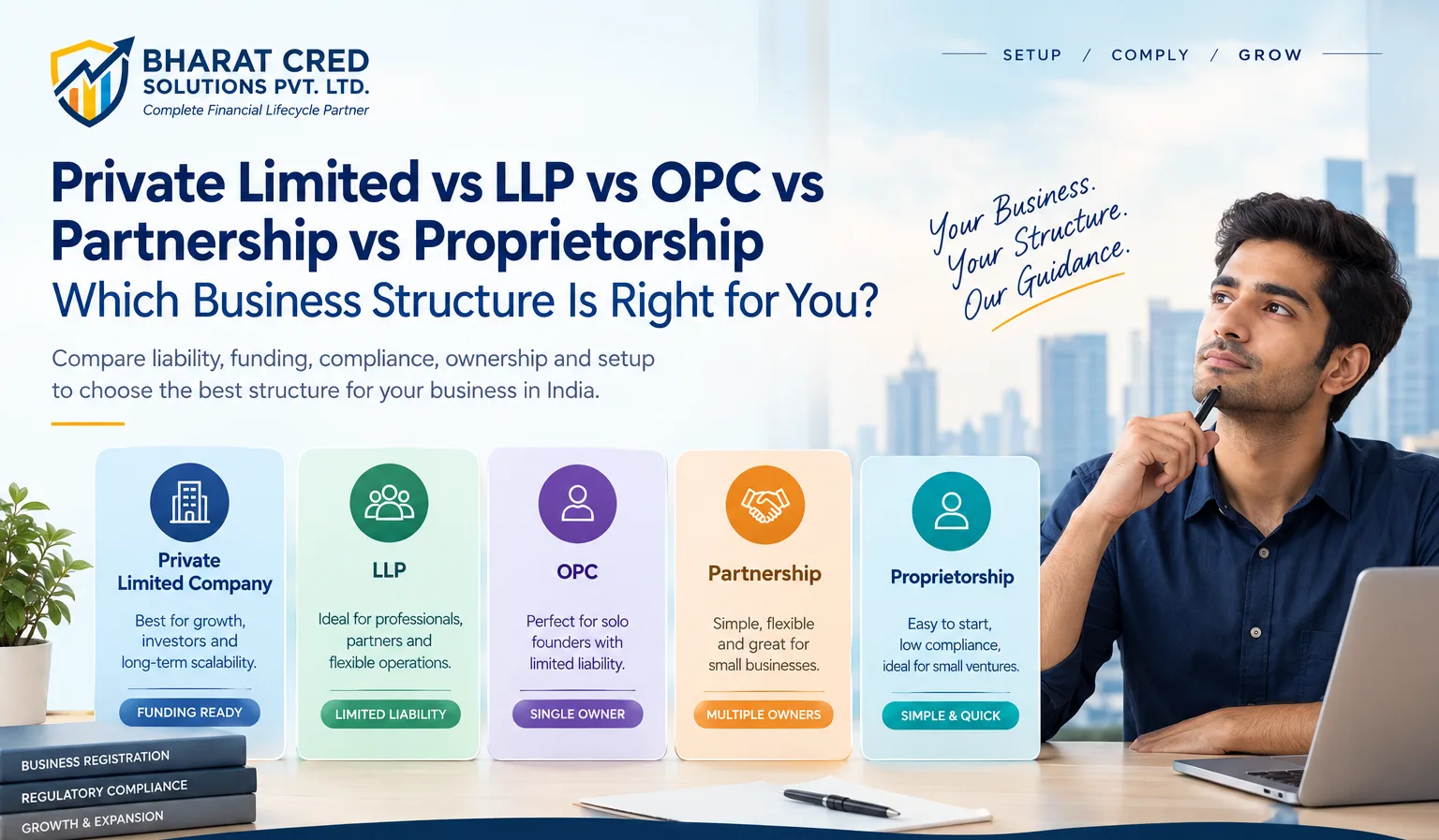
Planning to start a business in India?
Before you register a company, there is a more important question:
What should you actually register?
A Private Limited Company, LLP, OPC, Partnership Firm and Sole Proprietorship are not interchangeable. The right structure depends on who is starting the business, whether you need investors, how much liability you are willing to accept, how you plan to operate, and where you want the business to go in the next 3–5 years.
For foreign founders and overseas companies, there are additional considerations around foreign investment, directors, documentation, banking, taxation and sector-specific regulations.
This guide explains the practical process of setting up a business in India — from choosing the entity to incorporation and post-registration compliance.
Quick Answer: What Is the Best Business Structure in India?
There is no single structure that is best for every business.
Private Limited Company
Usually considered when the business is designed for growth, multiple shareholders, external investment, formal corporate governance or future fundraising.
LLP
Often considered by professional services businesses, consulting firms and businesses where partners want limited liability with a partnership-style operating structure.
OPC
Designed for an individual entrepreneur who wants a corporate structure with limited liability while remaining the sole shareholder.
Partnership Firm
A traditional structure for two or more partners. Its simplicity can be attractive for certain small businesses, but partners generally have unlimited liability.
Sole Proprietorship
A simple structure for an individual operating a small business, but there is no separate legal personality between the owner and the business.
The structure you choose affects liability, governance, funding options, compliance and future flexibility. Startup India similarly identifies these factors as important when selecting a business structure.
1. First Decide What You Are Building
Don't start with:
"How do I register a company?"
Start with:
"What do I want this business to become?"
Ask yourself:
Will I remain the only owner?
Will I have co-founders?
Will I raise angel or venture capital?
Will I have foreign shareholders?
Will I hire employees?
Will I sign large corporate contracts?
Will I apply for government registrations or licences?
Will I operate in a regulated industry?
Will I need a business bank account?
Will I expand into multiple states?
Will I eventually sell the company?
Will I bring in new shareholders?
These questions can change the appropriate structure.
For example, a founder planning to raise equity investment may have very different structural requirements from a consultant running a small professional practice.
2. Private Limited Company vs LLP vs OPC vs Partnership
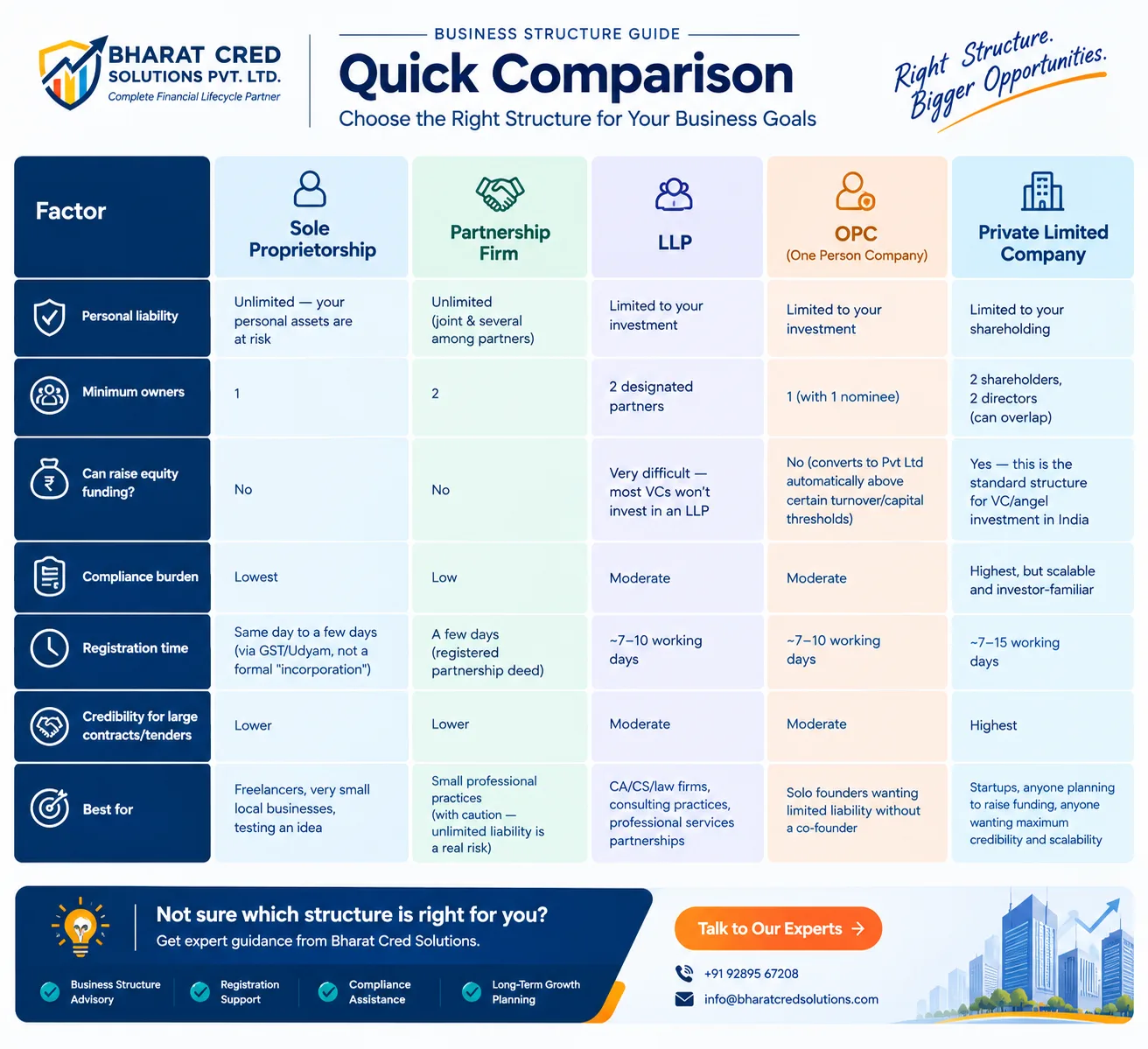
Important: this table is a practical comparison, not a substitute for entity-specific legal or tax advice.
3. Why Private Limited Is Commonly Chosen by Growth-Focused Startups
If you are building a company that may eventually have:
angel investors,
venture capital,
multiple shareholders,
ESOPs,
institutional investment,
strategic investors,
a larger management team,
a Private Limited Company is often the structure founders investigate first.
Startup India specifically highlights Private Limited Companies for businesses that expect outside funding because the structure allows investors to become shareholders.
It also provides limited liability to shareholders, subject to the applicable law and circumstances.
But there is a trade-off:
More flexibility and investor compatibility generally come with more formal compliance.
4. When Does an LLP Make More Sense?
An LLP can be attractive when the business is primarily partner-driven rather than investor-driven.
Examples can include:
consulting firms,
professional services,
advisory businesses,
certain agencies,
partner-led practices.
An LLP combines limited liability with a partnership-style structure. Startup India describes LLPs as a structure that can be suitable for businesses that do not expect to require conventional equity funding.
Before choosing an LLP, consider:
Do you expect outside investors to become shareholders?
If yes, discuss the ownership structure with a professional before incorporation.
5. What If You Are a Solo Founder?
You essentially have two important directions to examine:
Sole Proprietorship
Simple and relatively lightweight, but the owner and business are not separate legal persons and liability is generally unlimited.
OPC
An OPC allows an individual to operate through a company structure with limited liability.
The choice should depend on:
expected revenue,
risk exposure,
funding plans,
contracts,
employees,
expansion plans,
compliance expectations.
Don't choose an entity simply because it is "cheaper to register."
Choose the structure that fits the business you are actually building.
6. Can a Foreigner Start a Company in India?
Yes, foreign individuals and overseas businesses can explore establishing a presence in India, but the route and requirements depend on the proposed activity, ownership, sector and applicable foreign investment rules.
The structure may involve:
an Indian subsidiary,
a joint venture,
a branch office,
a liaison office,
a project office,
or another permitted structure.
The correct route should be evaluated before incorporation.
For a foreign founder, the question is therefore not simply:
"Can I register an Indian company?"
The better question is:
"Which India-entry structure is legally and commercially appropriate for my business?"
This distinction is particularly important for regulated sectors and activities where foreign investment restrictions or approvals may apply.
7. How to Set Up a Company in India: Step-by-Step
Step 1: Decide the Business Activity
Clearly define:
what the company will sell,
who the customers are,
where the customers are located,
how revenue will be generated,
whether the business is regulated.
Your business activity affects the structure, registrations and licences you may need.
Step 2: Choose the Legal Structure
Evaluate:
Ownership + liability + funding + compliance + future plans
before deciding between:
Private Limited Company
LLP
OPC
Partnership
Proprietorship
Step 3: Decide the Company Name
Your proposed name needs to satisfy applicable naming requirements and should not create conflicts with existing entities or trademarks.
Don't build your entire brand around a name before checking availability.
Step 4: Prepare Founder & Director Documentation
Depending on the structure and circumstances, documents may include:
identity proof,
address proof,
photographs,
PAN,
digital signatures,
registered-office documentation,
declarations and incorporation documents.
Foreign nationals may require additional documentation and authentication/notarisation depending on the circumstances.
8. Company Incorporation Through MCA
For company incorporation, the Ministry of Corporate Affairs provides the SPICe+ system and linked services.
MCA describes SPICe+ as an integrated web form covering multiple incorporation-related services, including company registration, DIN, PAN/TAN and optional GSTIN application.
The broad process involves:
Name → Documentation → Digital Signatures → Incorporation Application → Government Review → Incorporation
But incorporation is not the end of the process.
It is the beginning.
9. What Happens After Company Incorporation?
This is where many new founders make a mistake.
Getting a Certificate of Incorporation does not automatically mean the business is ready for every activity.
Depending on the business, you may need:
PAN/TAN,
GST registration,
business bank account,
accounting setup,
payroll registrations,
Shops & Establishments registration,
professional tax registration where applicable,
sector-specific licences,
import-export registration,
intellectual property protection,
labour-related registrations,
annual MCA compliance,
tax filings.
The exact requirements depend on the company's activity, location, employees and applicable laws.
Startup India's regulatory checklist similarly treats incorporation as only one part of establishing a compliant business.
10. Company Registration Is Not the Same as Business Licensing
This distinction is extremely important.
Suppose you establish a company to operate in:
financial services,
lending,
import-export,
food,
healthcare,
education,
manufacturing,
fintech,
insurance,
payment services,
you may require additional licences, registrations, approvals or regulatory compliance.
Company incorporation creates the legal entity.
Business-specific registrations allow the entity to conduct particular regulated activities where required.
This is why founders should evaluate regulatory requirements before launching the business rather than after.
11. How Much Does It Cost to Register a Company in India?
There is no single universal price.
The total cost can depend on:
entity type,
state,
authorised capital,
number of directors/partners,
stamp duty,
government filing fees,
DSC requirements,
professional fees,
foreign documentation,
GST requirements,
sector-specific registrations.
Instead of relying on a generic "company registration price," ask for a complete cost breakdown.
A proper quotation should distinguish:
Government / statutory charges
from
Professional / advisory charges
and
Optional registrations or services.
This makes the actual cost easier to understand.
12. How Long Does Company Registration Take?
The timeline depends on:
document readiness,
name availability,
application accuracy,
government processing,
resubmissions,
foreign-document requirements,
complexity of the proposed structure.
Therefore, a fixed "company registration in X hours" promise can be misleading.
A better approach is to prepare the documentation correctly before filing and identify potential issues early.
13. What Is the Minimum Number of Directors?
Under the Companies Act, a private company requires at least two directors, while an OPC requires at least one director. The law also provides a resident-director requirement, subject to the applicable provisions.
This is one reason entity selection should happen before you start collecting incorporation documents.
14. What Should Foreign Founders Know Before Setting Up in India?
If you are based in:
USA
UK
UAE
Singapore
Germany
Japan
Australia
Canada
Europe
and are exploring India, don't treat incorporation as the first and only step.
Your India-entry checklist may involve:
Market entry
Is India the right market for your product or service?
Entity selection
Should you establish a subsidiary, JV, branch or another permitted presence?
Foreign investment
Does the proposed ownership and activity comply with applicable FDI rules?
Documentation
Are your overseas documents correctly prepared and authenticated?
Banking
How will capital enter India and how will the business operate financially?
Tax
What Indian tax obligations could apply?
Employment
How will employees and payroll be structured?
Licences
Does the sector require additional permissions?
Ongoing compliance
Who will manage filings after incorporation?
This is where an India-entry advisory partner can reduce friction.
15. Common Mistakes Founders Make
Mistake 1: Choosing an entity only because it is cheap
The cheapest structure today may become expensive to change later.
Mistake 2: Registering before checking the business activity
Some sectors have additional regulatory requirements.
Mistake 3: Ignoring future investors
Changing ownership structure after investors enter can create unnecessary complications.
Mistake 4: Treating incorporation as the finish line
Your company may be incorporated but still require registrations before beginning particular activities.
Mistake 5: Using generic templates for complex businesses
Foreign shareholders, regulated industries, multiple founders and specialised activities require more careful planning.
Mistake 6: Forgetting post-incorporation compliance
A company must continue meeting applicable statutory and tax obligations after incorporation.
16. Private Limited vs LLP: The Question You Should Actually Ask
Instead of asking:
"Which one is better?"
Ask:
If I need investors:
Private Limited may deserve closer consideration.
If I am building a partner-led professional practice:
LLP may be worth evaluating.
If I am a solo founder:
Compare OPC and other structures against your growth and liability plans.
If I am testing a very small business:
A proprietorship may be relevant depending on risk and business requirements.
The correct answer depends on your specific circumstances.
17. What Does Bharat Cred Solutions Help With?
At Bharat Cred Solutions, our objective is to help businesses move from idea → incorporation → regulatory readiness → ongoing compliance.
Our assistance can include:
Business Setup
Private Limited Company setup assistance
LLP setup assistance
OPC setup assistance
Partnership setup assistance
Business structure advisory
India Entry Support
Foreign company India-entry assistance
Indian subsidiary setup coordination
Business establishment advisory
Documentation coordination
Regulatory & Compliance Support
GST-related assistance
Import-export registrations
Sector-specific registrations
Regulatory compliance advisory
Ongoing compliance support
Financial & Regulatory Services
NBFC registration assistance
RBI regulatory advisory
NBFC compliance
NBFC acquisition & exit advisory
Recovery and lending compliance advisory
18. Why Talk to Bharat Cred Before You Register?
Because the biggest mistake is often made before the incorporation form is submitted.
If you choose the wrong structure, misunderstand your regulatory requirements or overlook a necessary registration, correcting the problem later can take more time and money.
A short consultation can help identify:
What are you building?
↓
Who will own it?
↓
Where will the money come from?
↓
Do you need investors?
↓
Is the activity regulated?
↓
Which structure fits?
↓
Which registrations are required?
↓
What needs to happen after incorporation?
19. Frequently Asked Questions
Can a foreigner register a company in India?
Foreign individuals and overseas businesses can establish a presence in India subject to applicable laws, sectoral rules, foreign investment requirements and documentation requirements. The appropriate India-entry structure depends on the proposed activity and ownership.
Can one person start a company in India?
Yes. An individual can explore structures such as an OPC, while a proprietorship is another option depending on the business model and requirements.
Is a Private Limited Company better than an LLP?
Neither is universally better. A Private Limited Company is generally more compatible with conventional equity investment and multiple shareholders, while an LLP can be suitable for partner-led businesses that do not require conventional equity funding.
How many directors are required for a Private Limited Company?
A private company requires at least two directors under the Companies Act.
Can I change my business structure later?
Some structures can be converted or reorganised subject to applicable legal requirements. However, it is generally better to consider the intended growth path before incorporation.
Do I need GST immediately after incorporation?
Not every company automatically needs GST registration merely because it has been incorporated. GST applicability depends on the nature and scale of the business and applicable rules.
Is company incorporation enough to start a business?
Not necessarily. Depending on the activity, additional registrations, licences, approvals and compliance processes may be required.
Can a foreign company open a business in India?
Yes, subject to applicable foreign investment, sectoral and regulatory requirements. The appropriate structure should be evaluated before proceeding.
20. Your Next Step
If you are still deciding between Private Limited, LLP, OPC, Partnership or another structure, don't start by filling out the incorporation form.
Start with the business model.
Tell us:
What does your business do?
Who owns it?
Where are you based?
Will you have Indian or foreign shareholders?
Do you plan to raise funding?
Do you need any sector-specific licence?
When do you want to start operations?
Our team can help you identify the relevant setup and compliance requirements before you proceed.
Talk to Bharat Cred Solutions
Planning to start a business in India?
Get a consultation before you register.
[Get Free Business Setup Consultation]
[Talk to an India Entry Expert]
Related Guides
Continue your research:
Business Setup
Private Limited Company Registration in India
LLP Registration in India
OPC Registration in India
Partnership Firm Registration in India
Sole Proprietorship vs Private Limited Company
Private Limited vs LLP
How to Choose a Business Structure in India
Foreign Founders
How Foreigners Can Start a Company in India
How to Set Up an Indian Subsidiary
India Entry Strategy for Foreign Companies
FDI in India: What Foreign Founders Need to Know
Branch Office vs Subsidiary in India
Joint Venture vs Wholly Owned Subsidiary in India
How to Set Up a GCC in India
Regulatory Setup
GST Registration for New Businesses
Import Export Code Registration
RBI Compliance Advisory
NBFC Registration Assistance
NBFC Compliance Services
RBI PRAVAAH Portal Assistance
Digital Lending Compliance for NBFCs
Final Takeaway
Registering a company in India is easy to describe. Building the right business structure is the difficult part.
The decision affects your ownership, liability, funding options, compliance obligations and ability to scale.
So don't ask only:
"How quickly can I register my company?"
Ask:
"What structure will still make sense when my business grows?"
That is the decision worth getting right before you incorporate.
About Bharat Cred Solutions
Bharat Cred Solutions provides business setup, regulatory advisory and compliance assistance for businesses operating in India and international businesses exploring the Indian market.
Our team supports businesses across company setup, regulatory registrations, financial-services advisory, NBFC consulting, compliance and India-entry requirements.
Need help setting up your business in India?
Talk to Bharat Cred Solutions before you register.
Have a specific question about this?
Talk it through with our team on a strategy call.