
RBI Cancels 192 NBFC CoRs in 2026: Why NBFCs Are Losing Registration, How to Surrender CoR & Complete Exit Guide
Last Updated: August 2026
The Reserve Bank of India (RBI) has taken significant regulatory action against the Non-Banking Financial Company (NBFC) sector in 2026.
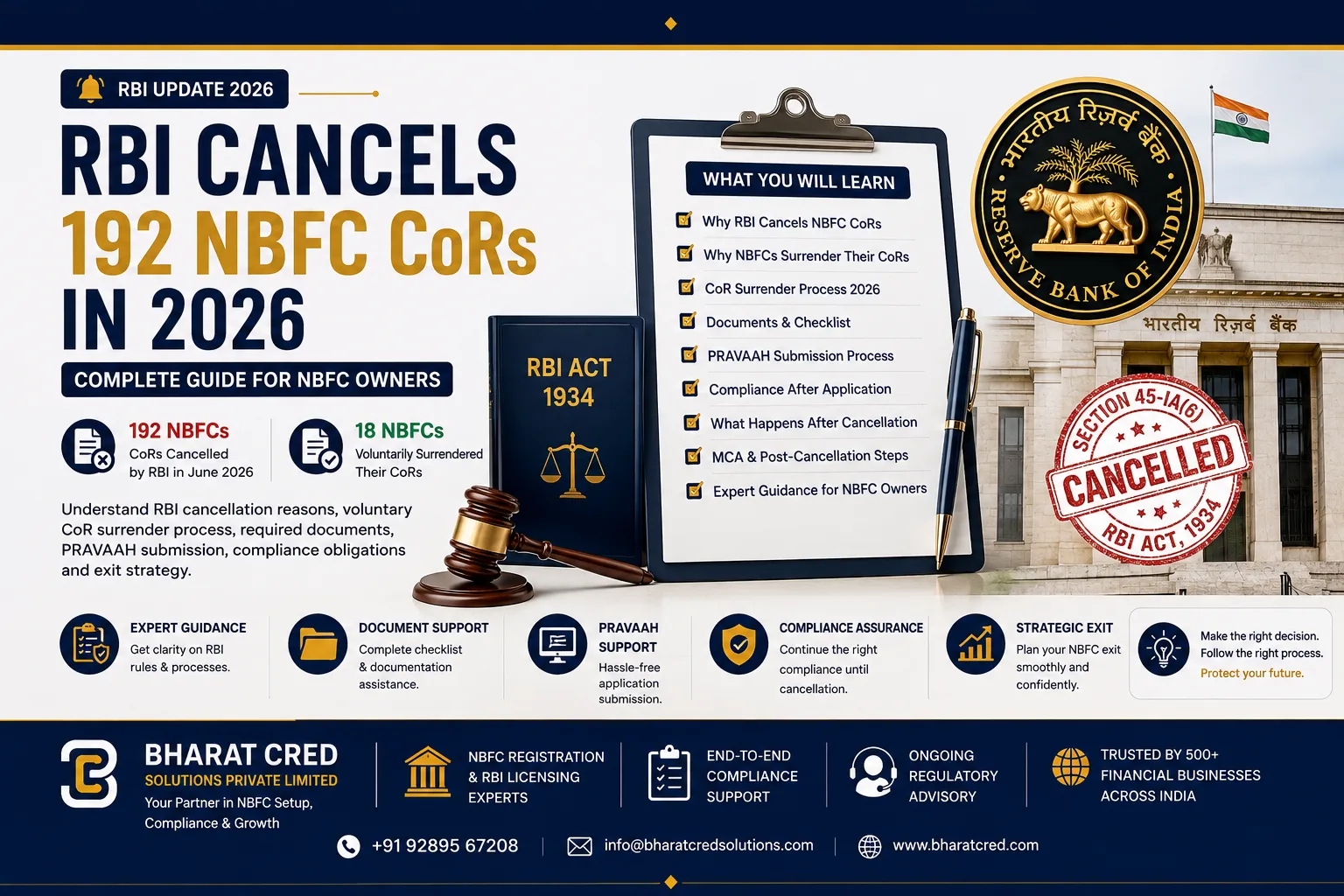
In June 2026, RBI cancelled the Certificates of Registration (CoRs) of 192 NBFCs under Section 45-IA(6) of the Reserve Bank of India Act, 1934. Around the same regulatory period, 18 NBFCs voluntarily surrendered their Certificates of Registration, after which RBI cancelled their CoRs.
This development has created an important question for NBFC promoters, directors, shareholders and businesses:
What happens if an NBFC no longer wants to continue its NBFC business?
An NBFC may need to understand whether it should continue operations, restructure its business, seek regulatory advice, or explore the voluntary surrender of its Certificate of Registration.
RBI has also revised the application form and indicative checklist for voluntary surrender of CoR by NBFCs and HFCs. The revised application process is linked to the current regulatory framework and requires submission through the PRAVAAH portal.
This comprehensive guide explains the 2026 RBI NBFC CoR cancellation developments, voluntary surrender process, reasons for cancellation, documents, compliance requirements, PRAVAAH submission, post-cancellation requirements and the questions NBFC promoters should consider before deciding their next step.
Important: This article is for general informational purposes. NBFC-specific regulatory decisions should be taken after reviewing the company's individual financial, legal, regulatory and operational position with qualified professionals.
What Happened to NBFC Registrations in 2026?
The RBI's 2026 regulatory action has attracted significant attention because of the scale of CoR cancellations.
According to reports covering RBI's June 2026 cancellation orders, 192 NBFC Certificates of Registration were cancelled under Section 45-IA(6) of the RBI Act. Following cancellation, those entities are no longer permitted to carry on the business of a Non-Banking Financial Institution.
At the same time, 18 NBFCs voluntarily surrendered their CoRs. The surrender cases included entities exiting the NBFI business, entities meeting criteria for an unregistered Core Investment Company, and entities that ceased to exist because of amalgamation, merger, dissolution or voluntary strike-off.
This distinction is extremely important.
RBI Cancellation vs Voluntary CoR Surrender
These two situations are often confused in Google searches.
RBI Cancellation
In an RBI cancellation case, the Reserve Bank takes regulatory action and cancels the NBFC's Certificate of Registration.
The reasons can include regulatory or statutory non-compliance and other circumstances covered by the RBI Act and applicable directions.
Voluntary Surrender
In a voluntary surrender case, the NBFC itself seeks cancellation of its Certificate of Registration because it no longer wishes or needs to continue the relevant NBFC business or falls within a situation where registration is no longer required.
RBI's published process specifically covers voluntary surrender of CoR by NBFCs, including HFCs.
Simple Difference
RBI cancellation:
RBI initiates the regulatory cancellation.
Voluntary surrender:
The company applies to RBI for cancellation of its CoR.
Both ultimately result in cancellation of the Certificate of Registration, but the underlying circumstances and process are different.
Why Is RBI Cancelling NBFC Certificates of Registration?
There is no single reason behind every CoR cancellation.
Depending on the individual case, RBI cancellation actions can relate to regulatory non-compliance, failure to meet applicable requirements, or changes in the legal or business status of the entity.
RBI has statutory powers under Section 45-IA(6) of the RBI Act to cancel the Certificate of Registration of an NBFC.
Historical RBI cancellation releases also show different categories of cancellation, including:
Exit from the NBFI business
Voluntary surrender
Amalgamation or merger
Dissolution
Voluntary strike-off
Conversion or qualification as an unregistered Core Investment Company
Other circumstances resulting in the entity no longer requiring or being entitled to the registration
Therefore, an NBFC should not assume that every cancellation has the same cause.
Why Would an NBFC Voluntarily Surrender Its CoR?
An NBFC may consider voluntary surrender for several legitimate business or regulatory reasons.
RBI's framework has historically recognised circumstances including cessation of NBFI/HFI business, conversion into an unregistered Core Investment Company and amalgamation or merger with another entity.
Common business situations may include:
1. The company wants to exit the NBFC business
The promoters may decide that continuing the NBFC business is no longer commercially viable or aligned with their long-term strategy.
2. The company has stopped NBFC activities
An entity that has ceased the relevant financial business may need to determine whether surrender of its CoR is appropriate.
3. Business restructuring
The company may be restructuring its business model and no longer require NBFC registration.
4. Merger or amalgamation
An NBFC may cease to exist as a separate legal entity after a merger or amalgamation.
5. Voluntary strike-off or dissolution
Where the legal existence of the company changes, its regulatory status also needs to be addressed appropriately.
6. Unregistered Type I NBFC circumstances
The 2026 regulatory framework introduced/updated the treatment of Type I NBFCs and Unregistered Type I NBFCs. The April 29, 2026 amendment directions defined an "Unregistered Type I NBFC" as an NBFC meeting specified conditions and exempt from Section 45-IA requirements as detailed in the directions.
This is one reason the voluntary-surrender application and checklist were revised in June 2026.
RBI NBFC CoR Surrender Process 2026
If an NBFC is considering voluntary surrender, the process should not be treated as simply sending a letter to RBI.
RBI has prescribed an application form and indicative checklist for voluntary surrender.
The latest 2026 process requires eligible applicants to submit the completed application with the required documents through the PRAVAAH portal.
Step 1: Evaluate the NBFC's Current Position
Before preparing the application, review:
Current NBFC activity
Financial assets
Total assets
Financial income
Existing loans or financial exposures
Public deposits, where applicable
Regulatory returns
Outstanding RBI/NHB matters
Pending regulatory correspondence
Existing liabilities
Legal status of the company
Proposed business after surrender
This preliminary assessment is important because the surrender application should accurately reflect the company's actual position.
Step 2: Determine the Reason for Surrender
The company should clearly identify why it wants to surrender its CoR.
Potential situations may include:
Exit from NBFI business
Business restructuring
Merger
Amalgamation
Conversion into an eligible unregistered CIC/Type I structure
Dissolution
Other circumstances recognised under the applicable RBI framework
The reason should be supported by appropriate corporate and financial documentation.
Step 3: Review RBI Compliance Before Applying
One of the biggest mistakes an NBFC can make is assuming that submitting the surrender application immediately ends its compliance responsibilities.
It does not.
RBI has specifically clarified that submission of the voluntary-surrender application and supporting documents should not be treated as cancellation of the CoR.
The NBFC/HFC must continue complying with applicable RBI/NHB/other regulatory requirements and filing applicable regulatory or supervisory returns until RBI formally cancels the CoR and communicates the decision.
This means:
Application submitted ≠ CoR cancelled
The formal RBI decision matters.
Step 4: Prepare the Required Documents
The exact documentation depends on the entity and its circumstances.
The RBI's application form and indicative checklist should be treated as the primary reference for the current application.
Depending on the case, documentation may involve information relating to:
Company details
Certificate of Registration
Board approval
Audited financial statements
Auditor certifications
Financial position
NBFC activities
Public deposits, where applicable
Outstanding liabilities
Regulatory compliance
Proposed post-cancellation business
Corporate restructuring
Legal status
Other supporting declarations
Do not use an old checklist blindly.
The RBI revised the application form and indicative checklist on June 30, 2026 following the 2026 regulatory amendments.
Step 5: Board-Level Approval
The company's internal corporate approvals should be properly documented.
A voluntary surrender application is not simply a marketing or administrative request.
The company should ensure that the appropriate Board and authorised personnel have approved the proposed action and that the supporting corporate records are consistent with the application.
Step 6: Submit Through PRAVAAH
The current revised process provides for submission through RBI's PRAVAAH portal.
The application should be complete and supported by the documents prescribed in the applicable RBI checklist.
An incomplete or inconsistent submission can create unnecessary correspondence and delay.
Step 7: Continue Compliance Until RBI Communicates Cancellation
This is one of the most important points in the entire process.
An NBFC should not assume that its regulatory obligations have ended simply because its application has been submitted.
RBI has expressly stated that applicable compliance and regulatory/supervisory returns should continue until cancellation is approved and communicated.
Step 8: Receive RBI's Decision
Once RBI reviews the application and supporting information, the company must wait for the formal decision.
Only after the CoR has actually been cancelled and the decision communicated should the company treat the RBI registration as cancelled.
What Happens After NBFC CoR Cancellation?
Cancellation of an NBFC CoR has important consequences.
An entity whose CoR has been cancelled cannot continue carrying on the business of a Non-Banking Financial Institution.
The RBI has repeatedly stated this consequence in its CoR cancellation releases.
The company's next steps may depend on the reason for cancellation and its intended future business.
Potential post-cancellation considerations can include:
Corporate restructuring
Change of business activity
Changes to constitutional documents
MCA/ROC-related requirements
Financial reporting
Regulatory record keeping
Settlement of outstanding matters
Future regulatory registrations, if another regulated activity is proposed
These should be evaluated according to the company's individual circumstances.
Can an NBFC Simply Stop Filing Returns After Applying for Surrender?
No.
Submitting a surrender application does not itself cancel the CoR.
RBI's current guidance expressly states that the entity should continue applicable regulatory/supervisory compliance and returns until cancellation is formally approved and communicated.
This is one of the most important points for directors and compliance teams.
Can an NBFC Continue Business After Its CoR Is Cancelled?
No.
Once the CoR is cancelled, the entity cannot continue carrying on the business of a Non-Banking Financial Institution.
RBI cancellation releases explicitly state this consequence.
Therefore, companies should carefully plan the transition before treating cancellation as a routine administrative exercise.
NBFC CoR Cancellation vs Company Closure
These are not necessarily the same thing.
Cancelling an NBFC Certificate of Registration and closing a company under corporate law are separate regulatory/corporate matters.
An NBFC may surrender its CoR while continuing as a corporate entity for another permissible business activity.
Conversely, a company that ceases to exist through merger, dissolution or strike-off may also have its NBFC CoR cancelled.
Therefore:
NBFC registration cancellation ≠ automatic company closure
The correct route depends on the company's structure, activities and intended future business.
NBFC CoR Surrender Due to Merger or Amalgamation
A merger or amalgamation can result in the NBFC ceasing to exist as a separate legal entity.
RBI cancellation releases have included cases where NBFCs ceased to be legal entities because of amalgamation, merger, dissolution or voluntary strike-off.
In such cases, the regulatory and corporate steps should be coordinated rather than treated independently.
NBFC CoR Surrender for Conversion / Unregistered CIC
Another important search category is the relationship between NBFC registration and an unregistered Core Investment Company.
RBI's voluntary-surrender framework has recognised cases where entities meet the criteria for an unregistered CIC that does not require NBFC registration.
However, eligibility should be assessed against the current RBI framework, rather than relying on an older article or checklist.
The 2026 amendments specifically address Type I NBFCs and Unregistered Type I NBFCs.
RBI NBFC CoR Surrender Checklist
Before submitting an application, an NBFC should review the following areas:
Corporate Information
Company name
CIN
Registered office
Directors
Authorised signatories
CoR details
Regulatory Information
NBFC category
RBI registration details
Current regulatory status
Pending RBI correspondence
Applicable returns
Compliance status
Financial Information
Latest audited financial statements
Financial assets
Total assets
Financial income
Existing liabilities
Public deposits, if applicable
Business Information
Current NBFC activities
Date of cessation, where applicable
Reason for surrender
Proposed future business
Business restructuring plans
Corporate Approvals
Board resolution
Authorisation
Relevant declarations
Supporting corporate documents
Application
Latest RBI application form
Current indicative checklist
Required supporting documents
PRAVAAH submission
Always verify the latest RBI checklist before filing because requirements can change.
Common Reasons an NBFC Should Seek Professional Review Before Surrender
A surrender decision may look simple from the outside, but the underlying situation can be complex.
Professional review becomes particularly important when the company has:
Existing borrowers
Existing lenders
Public deposits
Regulatory notices
Pending returns
Compliance deficiencies
Outstanding liabilities
Multiple group entities
Merger plans
Proposed restructuring
A change in business model
Questions regarding Type I/Type II status
Questions regarding unregistered CIC eligibility
A proper review can help identify issues before they become problems during the RBI application process.
Common Mistakes in NBFC CoR Surrender
Mistake 1: Using an old RBI checklist
The 2026 application/checklist has been revised.
Use the latest applicable RBI documents.
Mistake 2: Assuming application means cancellation
It does not.
RBI must formally cancel the CoR and communicate the decision.
Mistake 3: Stopping compliance immediately
Compliance obligations may continue while the application is pending.
Mistake 4: Treating NBFC cancellation as company closure
These are different regulatory/corporate actions.
Mistake 5: Ignoring existing financial exposure
Loans, liabilities, deposits and other financial obligations must be properly reviewed.
Mistake 6: Providing inconsistent information
The application, financial statements, Board documents and supporting certificates should tell a consistent story.
Mistake 7: Treating PRAVAAH submission as the final step
Submission is part of the process—not proof that RBI has approved cancellation.
What Should NBFC Promoters Do If RBI Has Cancelled Their CoR?
If an NBFC discovers that its CoR has been cancelled, the first step should be to understand:
Why was the CoR cancelled?
What RBI order or notification applies?
Is the company still conducting any NBFC activity?
What financial liabilities remain?
Are there pending regulatory obligations?
What is the company's intended future business?
Are MCA/ROC actions required?
Does the company need another regulatory registration?
Is any corrective or legal action available in the specific circumstances?
The answer will differ from company to company.
2026 RBI NBFC CoR Cancellation: What Businesses Should Know
The 2026 developments demonstrate that NBFC regulatory status should not be treated as a one-time registration exercise.
RBI continues to monitor compliance, regulatory eligibility and the business activities of registered entities.
At the same time, the revised voluntary-surrender mechanism provides a defined route for eligible NBFCs that genuinely intend to exit the relevant business or fall within circumstances where registration is no longer required.
For NBFC promoters, the important question is therefore not simply:
"How do I cancel my NBFC licence?"
The better question is:
"What is the correct regulatory exit route for my company's specific situation?"
Frequently Asked Questions
What is NBFC CoR surrender?
NBFC CoR surrender is the process through which an NBFC voluntarily applies to the RBI for cancellation of its Certificate of Registration.
How can an NBFC surrender its RBI licence?
An eligible NBFC can apply for voluntary surrender using the applicable RBI application process and supporting checklist. The revised 2026 process uses the PRAVAAH portal.
Can NBFC CoR surrender be done online?
The current revised application process provides for submission through RBI's PRAVAAH portal.
What is PRAVAAH in NBFC CoR surrender?
PRAVAAH is the RBI platform through which the revised voluntary-surrender application and supporting documents are submitted.
Does submitting the application cancel the NBFC licence?
No.
Submission of the application does not itself cancel the CoR. RBI must formally cancel the CoR and communicate its decision.
Can an NBFC stop compliance after applying for surrender?
No. Applicable compliance and regulatory/supervisory returns should continue until the cancellation is formally approved and communicated.
Why does RBI cancel NBFC registrations?
RBI can cancel CoRs under its statutory powers and applicable regulatory framework. Cancellation circumstances vary by entity.
What happened to 192 NBFCs in 2026?
RBI cancelled the CoRs of 192 NBFCs through cancellation orders issued during June 2026.
Did NBFCs voluntarily surrender their CoRs in 2026?
Yes. Reports covering the 2026 RBI action state that 18 NBFCs voluntarily surrendered their CoRs.
What is the difference between RBI cancellation and voluntary surrender?
RBI cancellation is a regulatory action by the Reserve Bank. Voluntary surrender begins with the NBFC's request to surrender its CoR.
Can an NBFC surrender its CoR if it has stopped its business?
Potentially, depending on its circumstances and satisfaction of applicable RBI requirements. The company should evaluate its status and supporting documentation before applying.
Can an NBFC surrender its CoR after a merger?
Certain RBI cancellation cases involve entities that ceased to exist because of merger or amalgamation. The appropriate regulatory and corporate route depends on the specific transaction.
What documents are required for NBFC CoR surrender?
The documents depend on the current RBI application and indicative checklist and the applicant's circumstances. The latest RBI checklist should always be checked before submission.
How long does NBFC CoR surrender take?
There is no universal timeline that should be promised for every case. Processing can depend on the completeness of the application, regulatory review, documentation and the company's individual circumstances.
Can a cancelled NBFC continue lending?
An entity whose CoR has been cancelled cannot continue carrying on the business of a Non-Banking Financial Institution.
Does NBFC CoR cancellation automatically close the company?
No. NBFC regulatory cancellation and corporate closure are separate matters.
What should an NBFC do after CoR cancellation?
The company should review the RBI cancellation order, stop activities that require the cancelled registration, address outstanding regulatory/corporate matters and determine the appropriate next business or restructuring steps.
Need Help With NBFC CoR Surrender or Regulatory Exit?
For an NBFC considering voluntary surrender of its Certificate of Registration, the most important step is to understand the company's current regulatory and financial position before submitting the application.
At Bharat Cred Solutions, our NBFC-focused advisory approach can help businesses assess their regulatory situation, documentation requirements and appropriate next steps.
We can assist with areas such as:
NBFC CoR surrender advisory
RBI regulatory documentation
NBFC compliance review
NBFC exit planning
Voluntary surrender application support
PRAVAAH submission preparation
NBFC restructuring guidance
RBI correspondence support
NBFC registration and regulatory advisory
Post-cancellation compliance coordination
Not sure whether surrender is the right option?
Don't submit an incomplete application or rely on an outdated checklist.
Speak with our team first and understand the appropriate route for your NBFC.
Get an NBFC Regulatory Consultation
Request a CoR Surrender Assessment
Talk to a Bharat Cred Solutions Expert
Why Bharat Cred Solutions?
Bharat Cred Solutions focuses on regulatory and business requirements related to NBFCs and financial services.
Our approach is built around understanding the company's actual situation before recommending the next step.
Instead of treating every NBFC cancellation or surrender case the same way, we look at:
Company → RBI Status → Compliance → Financial Position → Reason for Exit → Documentation → Application → Regulatory Decision → Post-Cancellation Requirements
This helps create a more structured approach to NBFC regulatory matters.
Important RBI Sources
For the latest official requirements, always verify the current RBI documentation before filing.
The RBI's official website currently lists the revised "Voluntary Surrender of Certificate of Registration by NBFCs (including HFCs) for Cancellation – Application Form and Indicative Checklist."
The RBI's earlier framework also explains that merely submitting a voluntary-surrender application does not constitute cancellation and that applicable compliance continues until RBI communicates the cancellation decision.
Final Takeaway
The 2026 RBI action involving 192 cancelled NBFC CoRs and 18 voluntary surrenders is an important regulatory development for NBFC promoters and directors.
However, the headline numbers are only one part of the story.
For an NBFC that wants to exit the business, the key issue is choosing the correct route and preparing the company properly before submitting its application.
The revised 2026 voluntary-surrender framework, PRAVAAH submission process, documentation requirements and continuing compliance obligations make it important to approach the process systematically.
If your NBFC is considering surrendering its CoR, has received an RBI cancellation order, or is unsure about its current regulatory status, obtain a case-specific review before taking action.
Have a specific question about this?
Talk it through with our team on a strategy call.