
RBI NBFC Credit Facilities Amendment 2026: What NBFCs Need to Know
The Reserve Bank of India has issued a Draft Reserve Bank of India (Non-Banking Financial Companies – Credit Facilities) Amendment Directions, 2026, proposing changes to the regulatory framework governing credit facilities offered by NBFCs. The document is expressly marked "Draft for Comments", meaning it should be treated as a proposed regulatory change rather than a final amendment.
One of the most important proposed changes concerns revolving credit facilities.
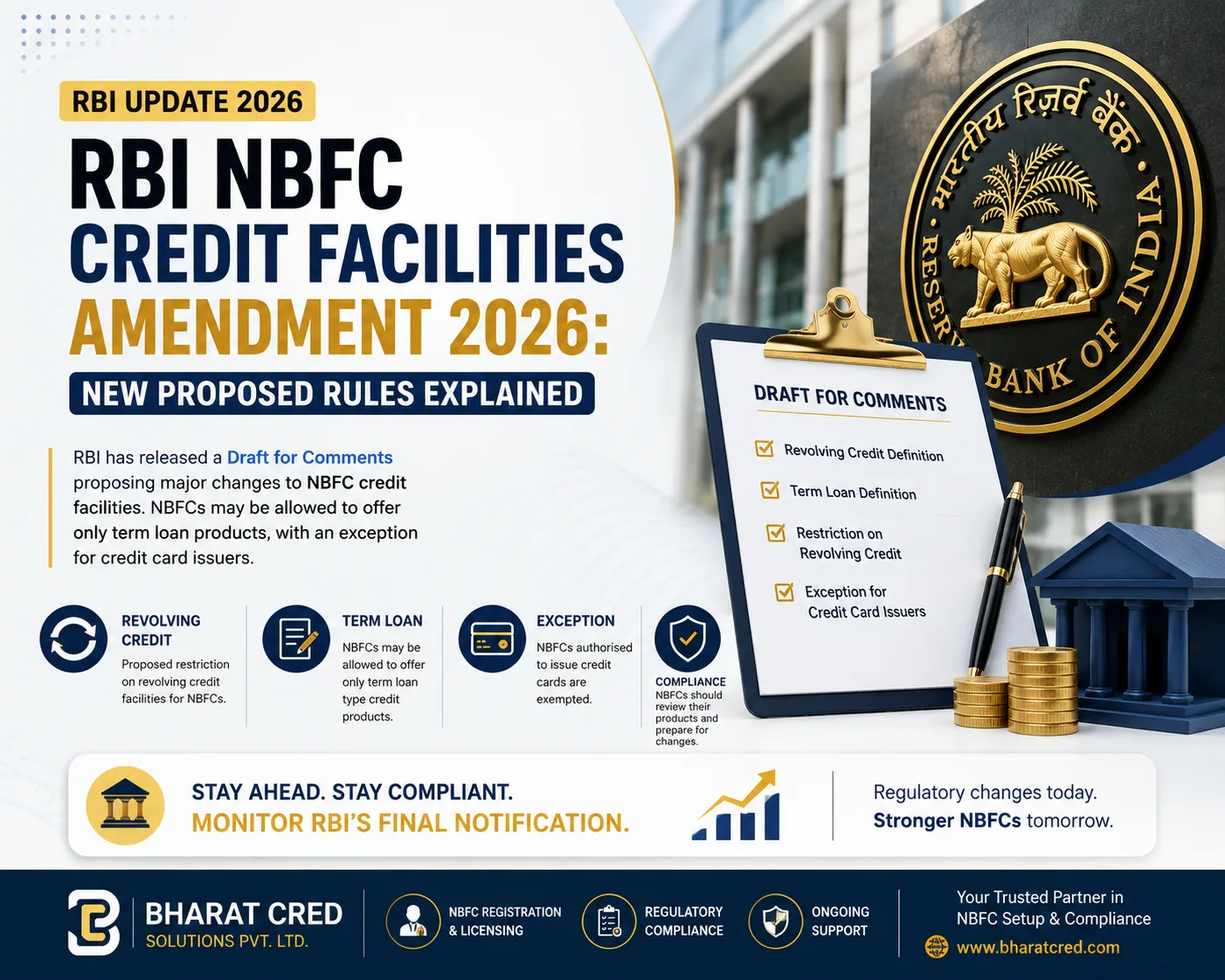
The draft proposes that NBFCs should offer credit products that are in the nature of term loans and should not offer revolving credit products, subject to a specific exception for NBFCs authorised by RBI to issue credit cards.
For NBFCs, lenders, fintech businesses and professionals involved in regulatory compliance, this proposed change deserves close attention.
What Is the RBI Proposing?
The draft amendment proposes the introduction of definitions for two important concepts:
1. Revolving Credit
The draft defines revolving credit as a fund-based credit facility that does not meet the definition of a term loan.
2. Term Loan
A term loan is proposed to mean a fund-based credit facility involving a fixed principal amount made available by an NBFC to a borrower.
The proposed characteristics include:
The sanctioned amount may be disbursed in one or more instalments.
Repayment follows a predetermined amortisation schedule.
Repayment may occur through periodic instalments or as a bullet payment on specified due dates.
Once the amount is repaid, the sanctioned limit cannot be restored or replenished.
This distinction is important because it separates a conventional term-loan structure from a revolving facility where the borrower can repeatedly draw and repay within an approved limit.
Proposed Restriction on Revolving Credit Facilities
The key proposed provision appears under the section concerning restrictions on revolving credit facilities.
The draft states that an NBFC shall only offer credit products which are in the nature of term loans and shall not offer revolving credit products.
If implemented in its proposed form, this could have implications for the way certain NBFC credit products are structured, marketed and administered.
NBFCs should therefore review their existing and proposed product structures against the final regulatory position once the amendment process is completed.
Important Exception: Credit Cards
The proposed restriction contains an important exception.
The restriction on revolving credit would not apply to an NBFC authorised by RBI to issue credit cards.
Therefore, the proposed rule should not be interpreted as a blanket prohibition on every form of revolving credit in the financial system.
The specific regulatory status and authorisation of the NBFC would need to be considered.
Why This Draft Matters for NBFCs
The proposed amendment could affect several areas of NBFC operations, including:
Product Design
NBFCs may need to examine whether their credit products fit within the proposed term-loan framework.
Compliance
Compliance teams should monitor the final version of the amendment and assess its impact on existing lending structures.
Documentation
Loan agreements, product documentation and repayment structures may need review depending on the final regulatory requirements.
Technology Systems
Where credit products are supported by automated lending platforms, the product logic and repayment/replenishment functionality may need to be reviewed.
Regulatory Strategy
NBFCs planning new lending products should keep the proposed regulatory direction in consideration while designing their product architecture.
Is This Rule Already Final?
No.
This distinction is extremely important.
The document uploaded from RBI is explicitly labelled "Draft for Comments." Therefore, businesses should not treat every provision in this document as an already-final regulatory requirement.
The draft states that the amendments would come into force immediately, but that statement appears within the draft text itself. The final legal position should therefore be determined from the subsequently issued final notification/directions.
What Should NBFCs Do Now?
NBFCs should take a proactive compliance approach rather than waiting until the final regulatory position is published.
A practical review can include:
Identify all existing credit products.
Classify products as term loans or revolving facilities.
Review repayment and replenishment mechanisms.
Identify products potentially affected by the proposed restriction.
Review whether any credit-card authorisation exception applies.
Monitor RBI's final notification.
Prepare an internal regulatory impact assessment.
Update product documentation if required after the final amendment.
RBI NBFC Compliance: Why Regulatory Monitoring Matters
NBFC regulation is continuously evolving.
A regulatory change affecting lending products can have implications beyond the legal department. Product, technology, risk, compliance, operations and business teams may all need to coordinate.
For this reason, NBFCs should maintain a structured regulatory-monitoring process and assess RBI notifications before launching or modifying financial products.
Frequently Asked Questions
Is RBI banning all revolving credit facilities for NBFCs?
The 2026 document is a draft proposing that NBFCs generally offer only term-loan-type credit products and not revolving credit products, with an exception for NBFCs authorised by RBI to issue credit cards.
Is the RBI NBFC Credit Facilities Amendment 2026 final?
The document provided is marked Draft for Comments, so it should not be treated as the final amendment.
What is a term loan under the proposed amendment?
The proposed definition describes a fixed-principal fund-based facility with predetermined repayment and no restoration or replenishment of the sanctioned amount after repayment.
Does the proposed restriction apply to credit-card issuing NBFCs?
The draft specifically provides an exception for an NBFC authorised by RBI to issue credit cards.
What should NBFCs do now?
NBFCs should review their existing lending products, monitor the final RBI notification and assess whether product structures, documentation or technology systems may require changes.
Final Takeaway
The proposed RBI amendment could represent an important shift in how certain NBFC credit products are structured.
However, because the document is a Draft for Comments, businesses should avoid treating it as the final regulatory position.
NBFCs should monitor the final RBI notification and conduct a product-level compliance review once the final requirements are issued.
Need help with NBFC registration, RBI licensing, regulatory compliance or NBFC setup?
Bharat Cred Solutions helps businesses navigate NBFC-related regulatory and compliance requirements with structured professional assistance.
Have a specific question about this?
Talk it through with our team on a strategy call.