
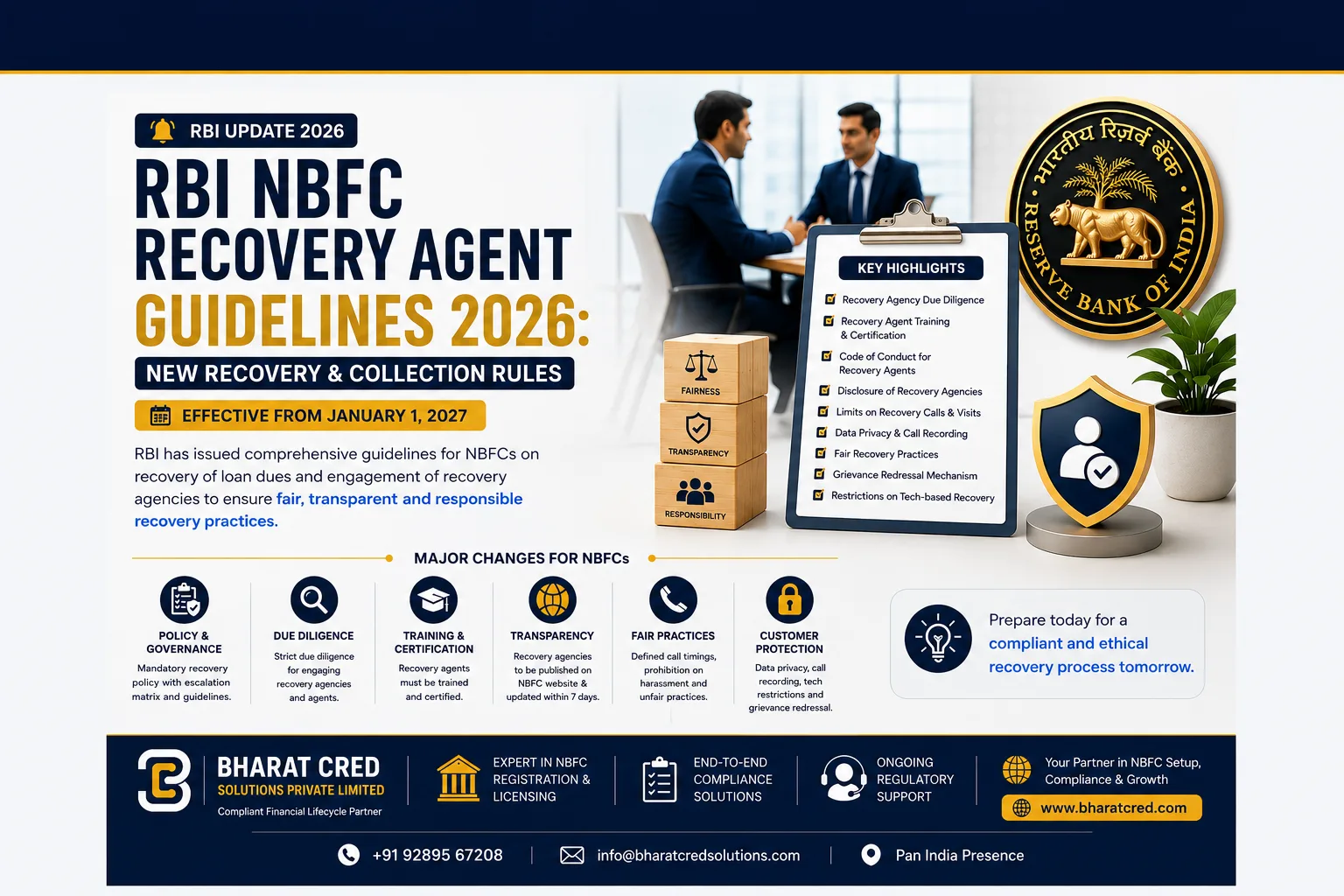
RBI NBFC Recovery Agent Guidelines 2026: What Has Changed?
The Reserve Bank of India has issued the Reserve Bank of India (Non-Banking Financial Companies – Responsible Business Conduct) Third Amendment Directions, 2026, introducing comprehensive instructions relating to the recovery of loan dues and engagement of recovery agencies by NBFCs.
The new directions are scheduled to come into effect from January 1, 2027.
The framework covers areas including:
Recovery agency engagement
Due diligence
Recovery-agent training
Codes of conduct
Disclosure of recovery agencies
Borrower treatment
Recovery calls and visits
Technology-based recovery mechanisms
Grievance redressal
Monitoring and control
For NBFCs, this makes recovery and collection compliance an important area of preparation ahead of 2027.
Who Do These Directions Apply To?
The directions apply to NBFCs in relation to recovery of loan dues and engagement of recovery agencies.
However, the notification specifically excludes certain categories, including:
Mortgage Guarantee Companies
Core Investment Companies
NBFC-Account Aggregators
Standalone Primary Dealers
Non-Operating Financial Holding Companies
NBFCs without customer interface.
NBFCs should therefore first determine whether the framework applies to their business model.
1. NBFCs Must Have a Recovery Policy
One of the significant requirements is that an NBFC must establish a policy covering the collection and recovery of loan dues.
The policy should address matters such as:
Triggers for starting recovery proceedings
Escalation mechanisms
Code of conduct
Recovery in cases involving the death of a borrower
Handling financial distress
Pre-escalation engagement
Available resolution options.
This means recovery should not simply be treated as an operational function.
It needs to operate within a documented governance framework.
2. Recovery Agencies Must Go Through Due Diligence
Where an NBFC engages a recovery agency, it must establish a due-diligence process for the engagement.
The directions also require verification of the antecedents of recovery agents before engagement and periodically thereafter according to the NBFC's policy.
This creates a stronger compliance responsibility around third-party recovery agencies.
3. Recovery Agents Need Training and Certification
The directions require recovery agencies to engage agents who have obtained the prescribed certificate from the Indian Institute of Banking and Finance (IIBF) after completing the Debt Recovery Agents training programme, or through an institute having an appropriate tie-up arrangement with IIBF.
Existing agents without the required certificate are given a period of one year from the effective date to obtain it.
With the directions taking effect on January 1, 2027, NBFCs and recovery agencies should plan their training and certification process well in advance.
4. NBFCs Need a Code of Conduct
NBFCs are required to establish a code of conduct for recovery agents and their own employees involved in recovery activities.
Where a recovery agency is engaged, the NBFC must obtain an undertaking from the agency that its recovery agents will comply with the code.
This creates an important governance link between the NBFC and its outsourced recovery function.
5. Recovery Agencies Must Be Disclosed on the NBFC Website
One of the notable transparency requirements is that an NBFC must publish an up-to-date list of recovery agencies engaged or empanelled by it on its website.
The list must include relevant information such as:
Name of the recovery agency
Type of agency
Correspondence address
Period of engagement
Purpose of engagement
The NBFC must update the list within seven calendar days of any modification. Termination of an agency must also be promptly reflected.
This means recovery-agency information becomes an important part of an NBFC's public-facing compliance infrastructure.
6. Borrowers Must Be Informed Before Recovery Visits
Where a case is forwarded to a recovery agency for an in-person recovery visit, the NBFC must provide the borrower or guarantor with details of the recovery agency at least one day before the first visit.
If the recovery agency changes during an ongoing recovery process, the borrower must be informed immediately.
Similarly, if an agency's agreement is terminated, affected borrowers or guarantors must be informed.
7. Customer Information Must Be Protected
The directions require NBFCs to ensure that borrower or guarantor information shared with employees or recovery agencies is limited to what is required to perform recovery duties.
NBFCs must also establish safeguards against misuse of customer information.
This makes data governance an important part of recovery-agent compliance.
8. Recovery Calls Must Be Recorded and Documented
NBFCs are required to document the time and number of calls made by employees or recovery agents.
The directions also require recording of the content or text of calls made by recovery personnel and calls made by borrowers to the number communicated by the NBFC, with prescribed preservation requirements.
NBFCs should therefore review their telephony, recording, storage and monitoring systems before the effective date.
9. Restrictions on Technology-Based Recovery
The directions introduce specific requirements for technology-based mechanisms used to restrict or disable functionalities of a borrower's mobile device.
Such mechanisms generally cannot be used as a recovery tool unless the financed device itself is the subject of the financing and the prescribed conditions are met.
Even where such a mechanism is permitted, restrictions cannot be imposed immediately after default.
The directions specify that restrictions should not begin until the associated loan becomes 30 days past due and the borrower has failed to pay despite receiving the required notices.
Full restrictions may become effective only after the loan becomes 60 days past due, subject to the other requirements.
10. Essential Device Functions Cannot Be Blocked
Where permitted device-restriction technology is used, NBFCs must adopt a gradual approach.
The directions specifically protect essential functionalities such as:
Incoming calls
SMS
Emergency SOS features
The restrictions should also not prevent the borrower from carrying out work or employment activities.
11. Compensation for Wrongful Device Restrictions
An important consumer-protection provision concerns wrongful restrictions or delays in restoring device functionality.
Where the delay is attributable to the NBFC, the lender must compensate the borrower at ₹250 per hour until the wrongful action is remedied, subject to the overall cap specified in the directions.
NBFCs using such technology should therefore have appropriate monitoring, escalation and restoration mechanisms.
12. Recovery Agents Must Follow Specific Conduct Standards
The directions require recovery agents and NBFC employees involved in recovery to follow specific conduct requirements.
Among other things, they must:
Identify themselves properly.
Carry appropriate authorisation.
Interact with borrowers respectfully.
Contact borrowers within prescribed hours.
Avoid inappropriate circumstances for recovery contact.
Provide proper acknowledgement or receipts for payments.
The prescribed ordinary contact window is 8:00 AM to 7:00 PM, subject to the conditions specified in the directions.
13. Harsh Recovery Practices Are Prohibited
The directions explicitly identify several practices as harsh recovery methods.
These include:
Abusive or threatening language
Public humiliation
Misuse of social media
Inappropriate messages
Excessive calls or messages
Threatening or anonymous calls
Harassment or intimidation
False or misleading representations about debt or consequences of non-payment.
This is an important area for NBFCs to incorporate into employee and recovery-agency training.
14. NBFCs Need a Dedicated Grievance Mechanism
The directions require NBFCs to establish a dedicated mechanism for recovery-related grievances.
Relevant grievance-redressal details must be provided to borrowers, including through loan documentation and communications concerning recovery agencies.
This means recovery compliance should connect directly with the NBFC's customer grievance and escalation framework.
NBFC Recovery Compliance Checklist for 2027
NBFCs can begin preparing with the following internal checklist:
Review applicability of the amended directions.
Update recovery and collection policy.
Establish recovery-agent due-diligence procedures.
Verify recovery-agent credentials and training.
Implement required certification processes.
Update recovery-agent code of conduct.
Review recovery-agency agreements.
Create a process for publishing recovery-agency details.
Establish the seven-day update process.
Review customer-data access controls.
Audit call recording and retention systems.
Review field-visit communication procedures.
Review technology-based recovery mechanisms.
Establish grievance escalation procedures.
Train internal recovery teams.
Train outsourced recovery agencies.
When Do These RBI Recovery Rules Become Effective?
The Third Amendment Directions, 2026 state that they will come into effect from January 1, 2027.
NBFCs should therefore treat the period before January 2027 as an implementation and readiness window rather than waiting until the effective date.
Frequently Asked Questions
When will the new RBI NBFC recovery-agent rules come into effect?
The Third Amendment Directions, 2026 are scheduled to take effect on January 1, 2027.
Do NBFCs need a recovery policy?
Yes. The directions require NBFCs to establish a policy covering collection and recovery of loan dues, including relevant governance and escalation mechanisms.
Do recovery agents need certification?
The directions require recovery agencies to engage agents who have obtained the prescribed IIBF-related certification, with a transition period for existing agents who do not yet hold it.
Can NBFCs use technology to restrict a borrower's phone?
Only in the specific circumstances and subject to the conditions provided by the directions, including requirements concerning the financed device, contractual permission, notices and overdue periods.
Can recovery agents call borrowers at any time?
The directions provide that employees and recovery agents should ordinarily contact borrowers or guarantors between 8:00 AM and 7:00 PM, subject to the specified exception where the borrower expressly requests or authorises contact outside those hours.
Final Takeaway
The RBI's 2026 Third Amendment introduces a significantly more structured framework for NBFC loan recovery and engagement of recovery agencies.
The changes place greater emphasis on:
Governance + Due Diligence + Training + Transparency + Data Protection + Fair Recovery + Technology Controls + Grievance Redressal
With the directions scheduled to become effective on January 1, 2027, NBFCs should begin reviewing their policies, recovery-agency arrangements, technology systems and employee training well before the effective date.
Need professional assistance with NBFC registration, RBI compliance, lending setup or regulatory requirements?
Bharat Cred Solutions can help businesses understand and navigate NBFC regulatory and compliance requirements.
Have a specific question about this?
Talk it through with our team on a strategy call.