
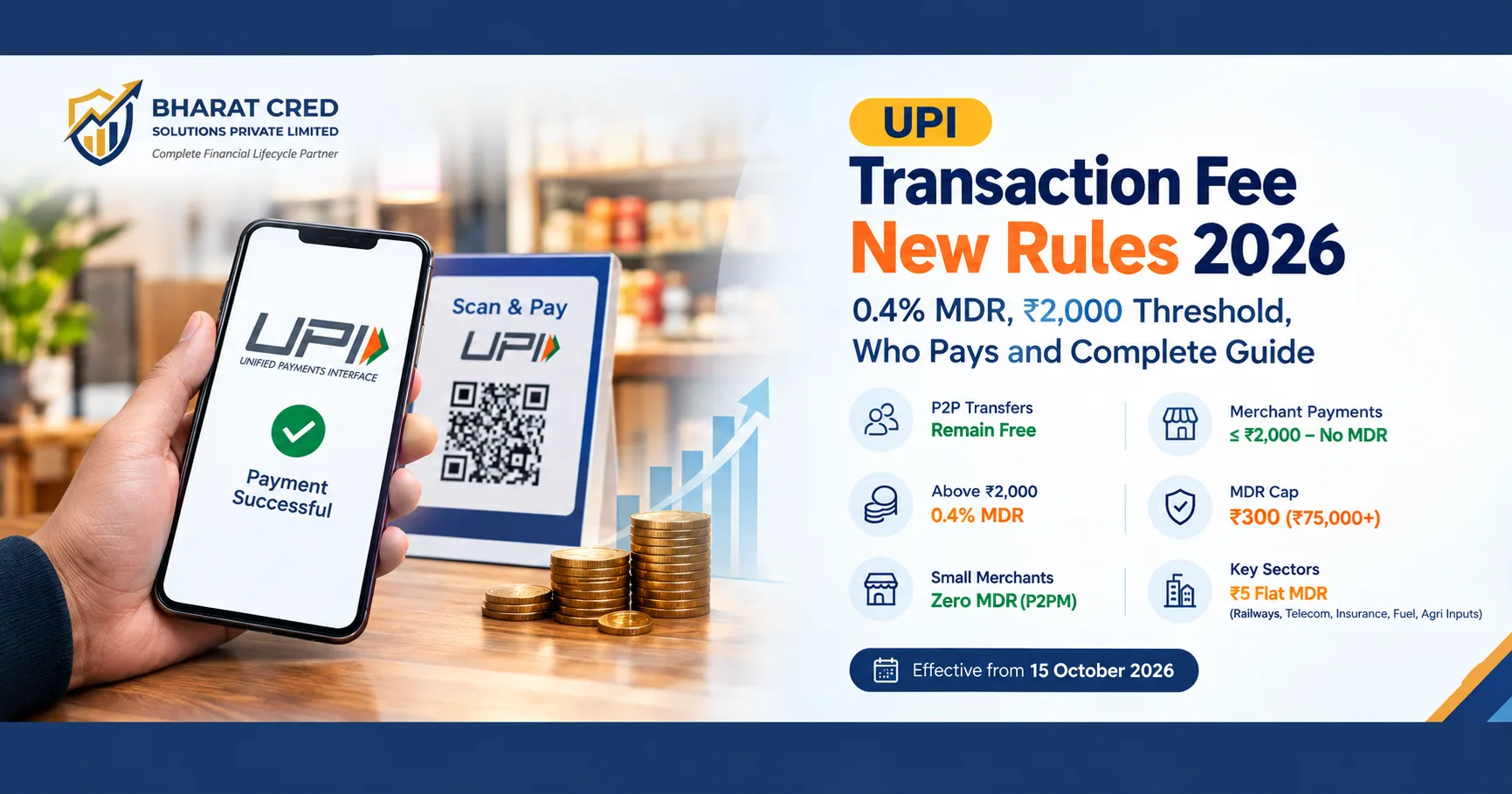
New UPI rules are coming into effect from 15 October 2026, introducing a Merchant Discount Rate, or MDR, on specified high-value UPI merchant transactions.
But there is an important distinction that every UPI user and business should understand.
UPI is not becoming a paid service for ordinary users.
Person-to-person UPI transactions will remain completely free, while merchant payments up to ₹2,000 will also remain free of MDR. Eligible small merchants under the zero-MDR P2PM framework will continue to receive zero MDR on their qualifying transactions.
For specified merchant transactions above ₹2,000, a 0.4% MDR will apply, with a maximum MDR of ₹300 per transaction for payments of ₹75,000 or more.
UPI NEW RULES 2026: QUICK ANSWER
Will customers have to pay a UPI transaction fee from 15 October 2026?
No.
The new MDR is a merchant-side payment ecosystem charge. Customers are not required to pay MDR when making covered UPI payments.
Person-to-person UPI transactions remain free regardless of transaction amount.
Merchant payments up to ₹2,000 remain free of MDR.
Eligible small merchants receiving up to ₹1 lakh per month through UPI QR under the P2PM category continue to receive zero MDR.
Specified P2M transactions above ₹2,000 will attract 0.4% MDR.
For applicable transactions of ₹75,000 or more, the MDR is capped at ₹300 per transaction.
The Ministry of Finance has also stated that UPI app providers cannot impose platform or hidden charges on customers for these UPI payments.
WHAT IS THE NEW UPI RULE FROM 15 OCTOBER 2026?
From 15 October 2026, a 0.4% Merchant Discount Rate will apply to specified Person-to-Merchant, or P2M, UPI transactions above ₹2,000.
The MDR is paid within the merchant payment ecosystem and is not a direct transaction fee charged to the customer.
There is also a ₹300 maximum MDR for applicable transactions of ₹75,000 or more.
For example:
A ₹3,000 applicable merchant payment results in ₹12 MDR.
A ₹5,000 applicable merchant payment results in ₹20 MDR.
A ₹10,000 applicable merchant payment results in ₹40 MDR.
A ₹50,000 applicable merchant payment results in ₹200 MDR.
A ₹75,000 applicable merchant payment reaches the ₹300 cap.
A ₹1,00,000 applicable merchant payment is also capped at ₹300 rather than 0.4% of the full amount.
WHAT IS MDR IN UPI?
MDR stands for Merchant Discount Rate.
It is a charge associated with processing a merchant payment and is distributed among participants in the payment ecosystem.
The Ministry of Finance has clarified that MDR is not a tax and is not a fee collected by the Government or NPCI.
Instead, the amount is distributed among payment ecosystem participants, including banks and payment application providers, to support the operation and continued expansion of the UPI ecosystem.
WHO PAYS THE NEW UPI MDR?
The MDR applies within the merchant payment ecosystem.
It is not a customer transaction fee.
This means that a customer making an applicable UPI payment should not be asked to pay an additional MDR simply because the payment was made through UPI.
Banks have been advised to ensure that merchants do not pass the MDR cost on to customers.
UPI application providers are also prohibited from imposing platform fees or hidden charges on customers under the stated framework.
IS UPI STILL FREE FOR CUSTOMERS?
Yes.
The new framework does not introduce a general fee for people using UPI.
Person-to-person payments remain completely free regardless of the amount transferred.
The Ministry of Finance has also stated that individuals will continue to have unlimited free UPI usage without monthly quotas, volume restrictions or tiered caps on free UPI transactions.
Daily transaction limits set by banks or NPCI are security and risk-management measures. They should not be confused with a charging threshold.
IS P2P UPI STILL FREE?
Yes.
P2P means Person-to-Person.
Examples include:
• Sending ₹500 to a friend
• Sending ₹5,000 to a family member
• Transferring ₹50,000 to another individual
• Paying another person through their UPI ID
These transactions remain outside the MDR framework.
The amount of the P2P transaction does not change this basic treatment.
WHAT IS P2M IN UPI?
P2M means Person-to-Merchant.
It refers to payments made by an individual to a business or merchant.
Examples include:
• Paying a restaurant
• Paying a retail store
• Paying an online seller
• Paying a service provider
• Paying a business through a UPI QR code
The new MDR framework specifically concerns specified P2M transactions above ₹2,000.
WHAT IS P2PM?
P2PM refers to the Person-to-Person-Merchant category used for eligible small merchants.
Under the current framework, small merchants receiving up to ₹1 lakh per month through UPI QR under the P2PM category continue to receive zero MDR on their transactions.
This provision is intended to protect small businesses such as street vendors, neighbourhood shops and other eligible small merchants from additional payment costs.
WHAT IS THE UPI CHARGE ON ₹3,000?
For a standard applicable P2M transaction:
₹3,000 × 0.4% = ₹12
Therefore, the MDR calculation at the standard rate is ₹12.
The MDR is a merchant-side charge within the payment ecosystem, not a separate UPI fee that the customer should be asked to pay.
WHAT IS THE UPI CHARGE ON ₹5,000?
For a standard applicable P2M transaction:
₹5,000 × 0.4% = ₹20
Therefore, the applicable MDR at the standard rate is ₹20.
Certain specified sectors have a different flat MDR structure, so the standard 0.4% calculation does not apply universally.
WHAT IS THE UPI CHARGE ON ₹10,000?
For a standard applicable P2M transaction:
₹10,000 × 0.4% = ₹40
Therefore, the standard MDR calculation is ₹40.
WHAT IS THE UPI CHARGE ON ₹25,000?
For a standard applicable P2M transaction:
₹25,000 × 0.4% = ₹100
Therefore, the standard MDR calculation is ₹100.
WHAT IS THE UPI CHARGE ON ₹50,000?
For a standard applicable P2M transaction:
₹50,000 × 0.4% = ₹200
Therefore, the standard MDR calculation is ₹200.
WHAT HAPPENS TO A ₹75,000 UPI PAYMENT?
At ₹75,000:
₹75,000 × 0.4% = ₹300
This reaches the MDR cap.
For applicable transactions of ₹75,000 or more, the MDR is capped at ₹300 per transaction.
WHAT IS THE UPI MDR ON ₹1 LAKH?
A simple 0.4% calculation on ₹1 lakh would produce ₹400.
However, the applicable MDR is capped at ₹300 for transactions of ₹75,000 and above.
Therefore, the MDR at the stated cap is ₹300.
The cap becomes particularly important for businesses receiving higher-value UPI merchant payments.
WHICH UPI TRANSACTIONS REMAIN FREE?
The following categories remain outside the standard MDR charge under the announced framework:
• Person-to-person UPI transactions
• Merchant payments up to ₹2,000
• Eligible small merchants under the P2PM zero-MDR framework
The Ministry of Finance estimates that approximately 96% of P2M transactions will remain unaffected.
WHICH SECTORS HAVE A ₹5 FLAT MDR?
The Ministry has specified a flat ₹5 MDR for applicable transactions above ₹2,000 in certain essential and thin-margin sectors.
These include:
• Railways
• Telecommunications
• Insurance
• Fuel
• Agricultural inputs
This means the standard 0.4% MDR is not the applicable rate for these specified categories.
WHAT IS THE UPI MDR FOR CAPITAL MARKET TRANSACTIONS?
Payments relating to capital-market categories such as mutual funds, securities, stockbrokers and dealers will attract an MDR of 0.02%, capped at ₹300 per transaction.
The Ministry has stated that the lower rate is intended to support continued retail participation in formal financial markets.
CAN A MERCHANT CHARGE CUSTOMERS EXTRA FOR USING UPI?
The announced framework does not permit merchants to simply pass the MDR cost to customers as a separate UPI charge.
Banks have been advised to ensure that merchants do not pass MDR charges on to customers.
Therefore, customers should be careful if a merchant suddenly adds a separate "UPI charge" or "UPI MDR" to the displayed price.
If this happens, customers can:
• Check the final amount before entering their UPI PIN.
• Ask the merchant for the listed price.
• Keep the bill and payment record.
• Raise the issue through the relevant bank or payment app grievance channel if necessary.
WILL GOOGLE PAY CHARGE USERS FOR UPI?
The announced framework does not introduce a general UPI transaction fee for customers using Google Pay.
The Ministry of Finance has stated that UPI application providers are prohibited from imposing platform fees or hidden charges on customers under this framework.
The same principle applies to the customer-side treatment of UPI payments generally.
WILL PHONEPE CHARGE USERS FOR UPI?
The new MDR framework does not introduce a general customer-side UPI transaction charge.
The Ministry has specifically stated that UPI application providers cannot impose platform fees or hidden charges on customers under the announced framework.
Customers should nevertheless distinguish between the UPI transaction itself and any separate service or product fee that may be governed by another arrangement.
DO SMALL SHOPKEEPERS HAVE TO PAY UPI MDR?
Eligible small merchants under the P2PM framework continue to receive zero MDR on qualifying transactions.
The Ministry has specifically stated that small merchants receiving up to ₹1 lakh per month through UPI QR under the P2PM category will continue to enjoy zero MDR.
This is particularly relevant for street vendors, neighbourhood shops and other eligible small businesses.
WILL E-COMMERCE BUSINESSES BE AFFECTED BY THE NEW UPI RULES?
E-commerce businesses accepting UPI as a payment method should review how their transactions are classified and processed.
Businesses receiving higher-value P2M payments may need to account for MDR within their payment costs and settlement calculations.
The actual impact will depend on factors such as transaction value, merchant classification, sector and payment arrangement.
Businesses should therefore review their payment-provider documentation before the effective date.
WHAT DOES THE NEW UPI MDR MEAN FOR FINTECHS AND NBFCs?
The new framework is particularly relevant for businesses that use UPI for collections, repayment flows and merchant or customer payments.
Fintechs and NBFCs should review:
• Payment collection architecture
• Merchant classification
• Transaction values
• Settlement calculations
• Reconciliation processes
• Payment-provider agreements
• Cost per transaction
• Customer communication
• Accounting treatment
• Reporting and monitoring
For regulated financial businesses, payment infrastructure and compliance workflows should be reviewed before the new framework becomes effective.
WHAT SHOULD BUSINESSES DO BEFORE 15 OCTOBER 2026?
Businesses accepting UPI payments should prepare for the new framework instead of waiting until the effective date.
Step 1: Identify your UPI transaction categories.
Separate P2P, P2M and eligible P2PM transactions.
Step 2: Review transaction values.
Identify how many merchant transactions are above ₹2,000.
Step 3: Check your merchant classification.
Confirm whether your business falls under a specific sector or zero-MDR category.
Step 4: Review your payment provider agreement.
Speak with your acquiring bank, payment service provider or payment aggregator about how MDR will appear in settlement reports.
Step 5: Review reconciliation.
Make sure finance and accounting teams understand how the new payment cost will appear in settlement and reconciliation data.
Step 6: Review customer communication.
Do not automatically add a separate UPI surcharge to customer invoices.
Step 7: Review your payment economics.
Businesses with high-value UPI transactions should assess the impact of the MDR on payment processing costs and margins.
WHY HAS THE GOVERNMENT INTRODUCED THE MDR FRAMEWORK?
The Ministry of Finance has explained the framework in terms of the long-term sustainability and continued expansion of the UPI ecosystem.
UPI operates at very large scale, and the framework creates a mechanism through which specified merchant transactions can contribute to the payment ecosystem while protecting individuals and small merchants from additional charges.
The Ministry has also stated that MDR is distributed among ecosystem participants such as banks and payment application providers.
IS UPI MDR A TAX?
No.
MDR is not a tax.
The Ministry of Finance has explicitly clarified that MDR is neither a tax nor a charge collected by the Government or NPCI.
It is a payment ecosystem charge distributed among participating entities.
This distinction is important because online discussions sometimes incorrectly describe MDR as a new UPI tax.
IS THERE GST ON UPI TRANSACTIONS ABOVE ₹2,000?
The ₹2,000 threshold should not be described as a new GST threshold.
The Ministry's current 2026 clarification describes the new charge as MDR on specified P2M transactions above ₹2,000.
MDR itself is different from GST.
Businesses should rely on applicable tax and payment-provider guidance for their specific circumstances rather than assuming that every UPI transaction above ₹2,000 attracts GST simply because of the new MDR framework.
HOW MANY UPI TRANSACTIONS WILL BE AFFECTED?
According to the Ministry of Finance, MDR will apply to approximately 4% of merchant transactions.
Approximately 96% of merchant transactions are expected to remain unaffected because they are either at or below ₹2,000 or covered by the zero-MDR framework for small merchants.
COMMON MISUNDERSTANDINGS ABOUT THE NEW UPI RULES
Misunderstanding 1: "UPI will become paid for everyone."
Reality: P2P UPI remains free, and customers are not being charged MDR for making covered UPI payments.
Misunderstanding 2: "Every UPI transaction above ₹2,000 will cost the customer 0.4%."
Reality: The 0.4% MDR applies to specified merchant transactions and is a merchant-side payment ecosystem charge.
Misunderstanding 3: "₹300 will be charged on every UPI transaction."
Reality: ₹300 is the MDR cap for applicable transactions of ₹75,000 and above.
Misunderstanding 4: "Small shopkeepers will automatically pay MDR on every UPI transaction."
Reality: Eligible small merchants under the P2PM framework continue to receive zero MDR on qualifying transactions.
Misunderstanding 5: "MDR is a new UPI tax."
Reality: The Ministry of Finance has explicitly stated that MDR is not a tax.
Misunderstanding 6: "Daily UPI limits are the same as charging limits."
Reality: Daily limits set by banks and NPCI are security and risk-management measures and should not be confused with charging thresholds.
FREQUENTLY ASKED QUESTIONS ABOUT UPI CHARGES 2026
Q: Is UPI still free for sending money to friends and family?
Yes. Person-to-person UPI transactions remain completely free regardless of the amount transferred.
Q: Will customers pay the new 0.4% UPI MDR?
No. MDR is a merchant payment ecosystem charge and is not a customer transaction fee under the announced framework.
Q: What is the UPI charge on ₹3,000?
For a standard applicable P2M transaction, 0.4% of ₹3,000 is ₹12.
Q: What is the UPI charge on ₹5,000?
For a standard applicable P2M transaction, 0.4% of ₹5,000 is ₹20.
Q: What is the UPI charge on ₹50,000?
For a standard applicable P2M transaction, 0.4% of ₹50,000 is ₹200.
Q: What is the maximum UPI MDR?
For applicable transactions of ₹75,000 or more, the MDR is capped at ₹300 per transaction.
Q: Is P2P UPI free?
Yes. P2P UPI transactions remain completely free.
Q: Are UPI payments up to ₹2,000 free?
Yes. P2M transactions up to ₹2,000 remain free of MDR.
Q: Will small shopkeepers pay UPI MDR?
Eligible small merchants under the P2PM framework receiving up to ₹1 lakh per month through UPI QR continue to receive zero MDR.
Q: Can a merchant add a separate UPI fee to my bill?
The announced framework bars merchants from passing MDR directly to customers as a separate UPI charge. Banks have been advised to ensure that merchants do not pass MDR costs to customers.
Q: Is MDR a government tax?
No. The Ministry of Finance has explicitly stated that MDR is not a tax and is not a charge collected by the Government or NPCI.
Q: When will the new UPI MDR rules take effect?
The new framework is scheduled to take effect from 15 October 2026.
Q: Does the new framework affect P2P transactions?
No. P2P transactions remain outside the MDR framework.
Q: Which sectors have a flat ₹5 MDR?
Specified transactions above ₹2,000 in sectors including railways, telecommunications, insurance, fuel and agricultural inputs have a flat ₹5 MDR under the announced framework.
Q: What is the MDR for capital-market transactions?
Payments relating to mutual funds, securities, stockbrokers and dealers will attract 0.02% MDR, capped at ₹300 per transaction.
KEY TAKEAWAYS
The most important points about the new UPI transaction rules are:
• UPI is not becoming a paid service for ordinary users.
• P2P UPI transactions remain free.
• Merchant payments up to ₹2,000 remain free of MDR.
• Eligible small P2PM merchants continue to receive zero MDR.
• Specified P2M transactions above ₹2,000 attract 0.4% MDR.
• The MDR is capped at ₹300 for applicable transactions of ₹75,000 and above.
• Certain essential sectors have a flat ₹5 MDR.
• Capital-market transactions have a 0.02% MDR capped at ₹300.
• MDR is not a government tax.
• Customers should not be charged a separate UPI MDR by merchants.
• Approximately 96% of P2M transactions are expected to remain unaffected.
WHAT DOES THIS MEAN FOR YOUR BUSINESS?
For businesses, the most important issue is not simply the 0.4% rate.
The actual impact depends on your transaction size, merchant classification, sector, payment provider and monthly payment volume.
Businesses that receive significant high-value UPI payments should review their payment infrastructure, settlement reports, reconciliation process and transaction economics before 15 October 2026.
Fintechs, NBFCs and other financial businesses should also review how the new MDR framework interacts with their collection systems and payment workflows.
NEED HELP WITH FINANCIAL BUSINESS AND COMPLIANCE?
Bharat Cred Solutions works with fintechs, NBFCs and financial businesses across financial consulting, regulatory compliance, lending operations and payment-related business requirements.
If your business is evaluating the impact of the new UPI MDR framework, merchant payment costs, collection infrastructure or financial compliance requirements, our team can help you understand the relevant requirements and plan the next steps.
Talk to a Bharat Cred expert for a consultation.
Phone: +91 92895 67208
Website: bharatcredsolutions.com
FINAL WORD
The new UPI framework does not mean that customers will suddenly start paying a fee every time they use UPI.
The key distinction is between customer payments and merchant-side payment processing.
P2P UPI remains free. Merchant payments up to ₹2,000 remain free of MDR. Eligible small merchants continue to receive zero MDR under the applicable P2PM framework.
For specified merchant transactions above ₹2,000, a 0.4% MDR will apply from 15 October 2026, with a ₹300 cap for transactions of ₹75,000 and above.
Businesses should therefore focus on understanding their own transaction category, merchant classification and payment-provider arrangement rather than relying on social-media claims about "UPI charges."
For the latest regulatory information, businesses and consumers should rely on official updates from the Ministry of Finance, RBI and NPCI.
SOURCE AND EDITORIAL NOTE
This article is based on the Ministry of Finance clarification issued on 15 September 2026 regarding the UPI MDR framework and related official government information.
UPI payment rules and implementation details can change through subsequent official notifications or NPCI circulars. Businesses should verify the latest applicable requirements before making compliance or financial decisions.
Have a specific question about this?
Talk it through with our team on a strategy call.