

Quick answer: Setting up a Global Capability Center in India typically takes 8–24 weeks and costs $25,000–$80,000 per engineer per year fully loaded — 40–60% below equivalent US or European costs. Most successful GCC launches don't do a "big bang" captive build on day one; they sequence through a pilot (EOR or managed model), a Build-Operate-Transfer phase, and then transfer to a fully owned captive entity as the center matures. This guide covers model selection, city choice, the step-by-step setup process, and realistic costs.
If you haven't yet decided on your legal entity structure, start with our companion guide on [how to set up a company in India] — everything below assumes you've settled on (or are actively deciding between) a wholly owned subsidiary and a managed/BOT path.
What Is a GCC, and Why Are Companies Building Them at This Pace?
A Global Capability Center (also called a captive center, Global In-house Center, or GIC) is a dedicated offshore or nearshore unit that a company owns and operates itself in India — as opposed to outsourcing work to a third-party vendor. The defining feature: you own the team, the IP, and the roadmap. The people working in your GCC work exclusively for you, not across multiple client accounts.
India now hosts 2,117+ GCCs employing roughly 2.36 million professionals and generating close to $98–100 billion in annual revenue — and the pace is accelerating, not slowing. India added 111 new GCCs in just the first eight months of 2026, already surpassing the full-year pace of 2025. Nearly 90% of India GCCs now operate as multi-functional hubs spanning R&D, analytics, product engineering, and digital transformation — not narrow cost centers. This is why GCCs have earned the label "GCC 3.0": today's centers frequently own entire global product lines, not just support functions.
The reasons companies build here rather than elsewhere: 40–60% cost savings across engineering, data, and product functions compared to Western markets; access to roughly 45% of the world's GCC-relevant talent base; and an increasingly mature ecosystem of Grade A infrastructure, specialized service providers, and government incentives purpose-built for this model.
💡 Want to know the exact cost of registering your company?
Get a transparent fee quote with zero hidden charges.
[Contact Your Registration Expert ]
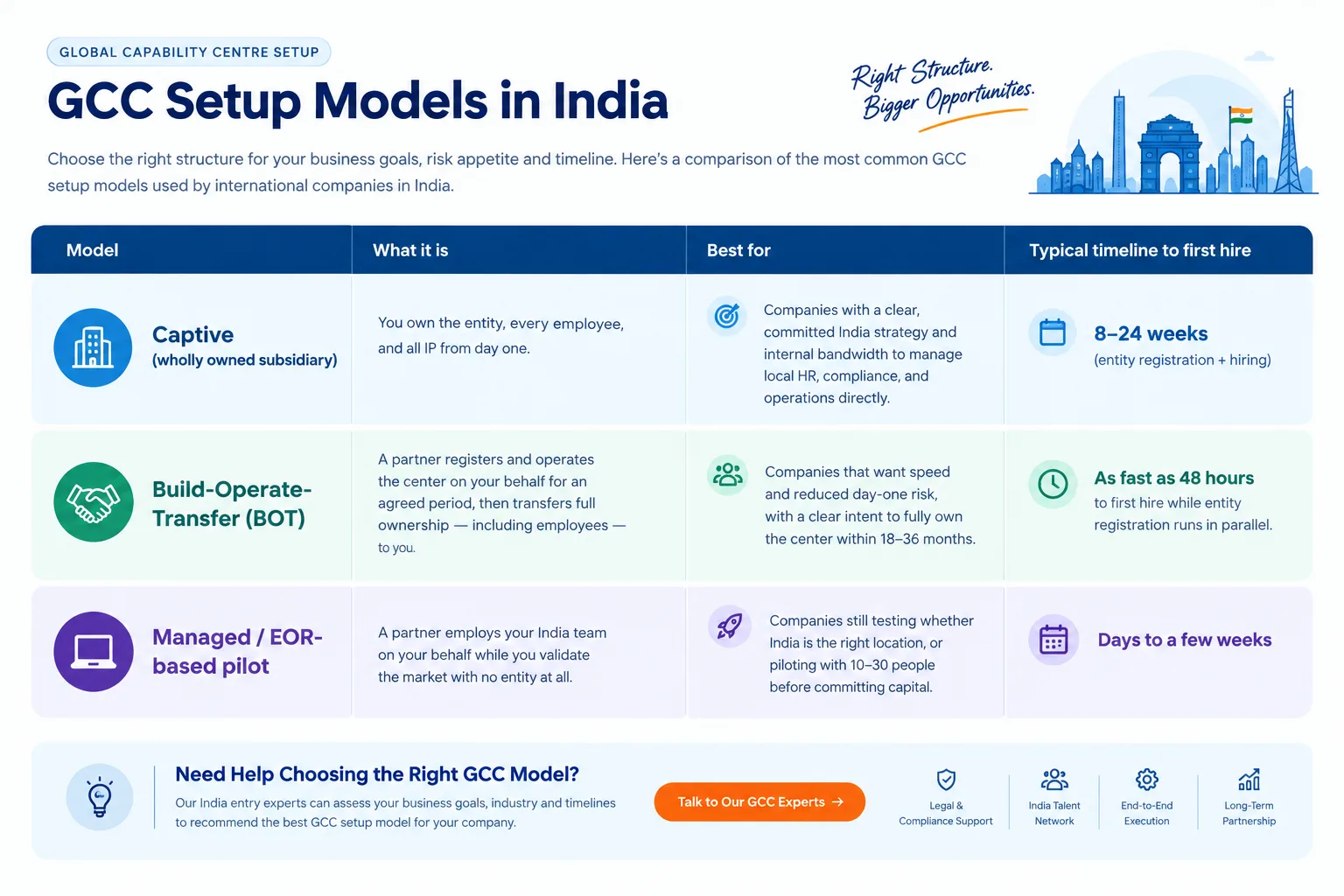
The pattern most successful mid-market GCC launches now follow is sequential, not all-at-once:
Months 0–6: Pilot with an EOR or managed model — 10–30 FTEs, validate the talent market and delivery quality before committing capital.
Months 6–18: Move to a BOT engagement — scale to 50–150 FTEs on partner infrastructure while your entity registration and governance setup run in parallel.
Months 18–36: Transfer to a fully owned captive — your own payroll, your own culture and brand, typically scaling to 150–300+ FTEs at this stage.
The BOT model in particular has become common precisely because it removes the "wait for the entity" bottleneck: companies can start hiring against a real India delivery plan almost immediately, while incorporation, FEMA/RBI filings, and infrastructure setup proceed in the background — then convert to full ownership once the model is proven. The main legal complexity to plan for at the transfer stage is a clean employee novation that complies with India's Industrial Relations Code and applicable state labor legislation — build this into your BOT contract from day one, not as an afterthought at transfer time.
Which City Should You Choose?
Location choice now reflects specialist talent availability, ecosystem maturity, and state-specific incentives — not just headline cost.
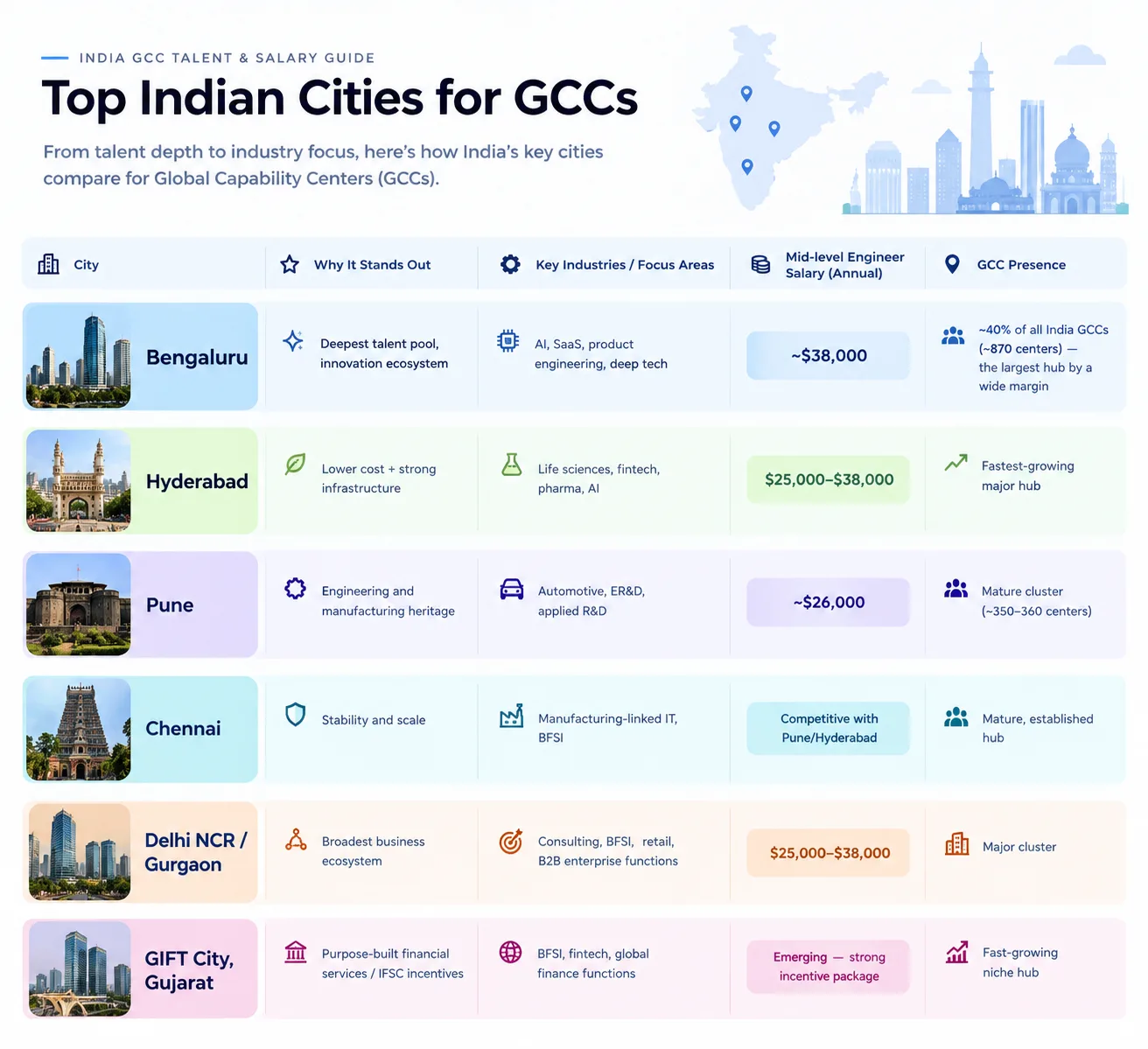
Tier-2 alternatives (Coimbatore, Ahmedabad, Jaipur, Indore, and similar cities) are increasingly viable for specific functions: they typically run 15–35% lower operating costs than Tier-1 cities, with 20–30% lower attrition rates and meaningful state-level incentives — worth serious consideration if your function doesn't require the absolute deepest specialist talent pool that only Bengaluru or Hyderabad can offer.
Practical guidance: most enterprise GCCs end up multi-city within 2–3 years (e.g., Bengaluru for core product/AI talent, plus a Tier-2 city for scaled operations functions) — so choose your first city based on where your hardest-to-hire skill set is deepest, not purely on cost.
Step-by-Step: How to Set Up a GCC in India
Define scope and function mix. Decide what the center will actually own — pure cost-center support work, or genuine product/engineering ownership (the 2026 trend strongly favors the latter for competitive talent attraction).
Choose your model and city using the frameworks above.
Begin entity registration in parallel with hiring (via SPICe+ — see our [company setup guide] for the full process) — don't let entity timelines block your first hires if you're using a BOT or managed pilot approach.
Complete FEMA and RBI filings for inbound capital once your entity is live.
Set up infrastructure: office site selection (Grade A office space now accounts for 38% of leasing activity in top cities, driven substantially by GCC demand), IT and network infrastructure, and security architecture.
Appoint your India leadership ("India Head") early — this hire disproportionately determines whether the center scales smoothly or stalls; treat it as a top-priority search, not a backfill.
Design governance and reporting lines between the India center and global HQ from day one — ambiguity here is one of the most common causes of GCC underperformance in year one.
Build your compliance framework, including DPDP Act 2023 data-residency and data-handling requirements — increasingly a board-level concern for GCCs handling customer or IP-sensitive data, and worth designing in from the start rather than retrofitting.
Realistic timeline
8–24 weeks depending on model and scale — the low end applies to an EOR/managed pilot getting your first hires working within days to weeks; the higher end applies to a full captive buildout with real estate, infrastructure, and a larger initial team.
Realistic cost
Per-employee cost: $25,000–$80,000 fully loaded annually per engineer/professional, depending on city and seniority — still 40–70% below equivalent US costs even at the top of that range.
EOR/pilot-stage cost: as low as roughly $99 per employee per month in service fees on top of salary, with zero upfront capital commitment — the cheapest way to validate before you build.
Infrastructure: Grade A office rents range from roughly $0.80–$1.80+ per sq ft/month depending on city, plus IT/security buildout costs that scale with headcount and function sensitivity.
The Most Common Reasons GCC Launches Fail or Stall
Blocking the first hire on entity registration — the single most avoidable failure mode; a BOT or EOR pilot removes this bottleneck entirely.
Multi-state compliance gaps as centers scale beyond their original city — labor law, professional tax, and shops & establishment rules vary by state and are easy to miss when scaling fast.
Attrition mismanagement — choosing a city or comp structure without benchmarking local attrition (which can run materially higher in oversaturated micro-markets) frequently stalls delivery just as a center is ramping.
Treating the India team as a cost center rather than a genuine capability owner — this is now a talent-retention issue, not just a strategic preference; the strongest India talent increasingly chooses employers that hand over real product ownership.
Underinvesting in the India Head role and governance design at the outset, leading to unclear reporting lines and slow decision-making between HQ and the center.
Frequently Asked Questions
How long does it take to set up a GCC in India? Typically 8–24 weeks depending on the model: an EOR or managed pilot can have your first hires working within days to a few weeks, while a full captive buildout with real estate and larger initial headcount takes several months.
What's the difference between a GCC and outsourcing to a vendor? In a GCC, you own the entity (or a BOT partner operates it on your behalf, en route to full ownership), the employees work exclusively for you, and you retain the IP. Outsourcing means a third-party vendor's employees work across multiple client accounts and the vendor retains operational control.
Which city is best for a GCC in India? Bengaluru remains the largest and deepest hub, particularly for AI, SaaS, and product engineering talent, hosting roughly 40% of all India GCCs. Hyderabad, Pune, and Chennai offer strong alternatives with meaningfully lower costs, and Tier-2 cities are increasingly viable for specific, less specialist-dependent functions.
Do I need to set up a legal entity before I can hire in India for my GCC? No. An Employer of Record or a Build-Operate-Transfer partner can legally employ your India team while your entity registration proceeds in parallel — this is now the standard approach for companies that don't want entity timelines to delay their first hires.
How much does it cost to run a GCC in India? Fully loaded cost per employee typically runs $25,000–$80,000 annually depending on role, seniority, and city — generally 40–70% below equivalent roles in the US or Western Europe, even before infrastructure and real estate savings.
Ready to Scope Your GCC?
Every GCC's right model and city depend on your function mix, timeline, and how much operational risk you want to take on in year one. Download our GCC Setup Timeline Template to map your own path from pilot to captive — or book a free 20-minute feasibility call to get a model and city recommendation specific to your function and headcount plan.
This guide reflects India's GCC landscape, cost benchmarks, and regulatory environment as of September 2026. City-level cost and talent data shift as the market matures — verify current benchmarks for your specific function, or talk to our team for a current assessment.
Have a specific question about this?
Talk it through with our team on a strategy call.