
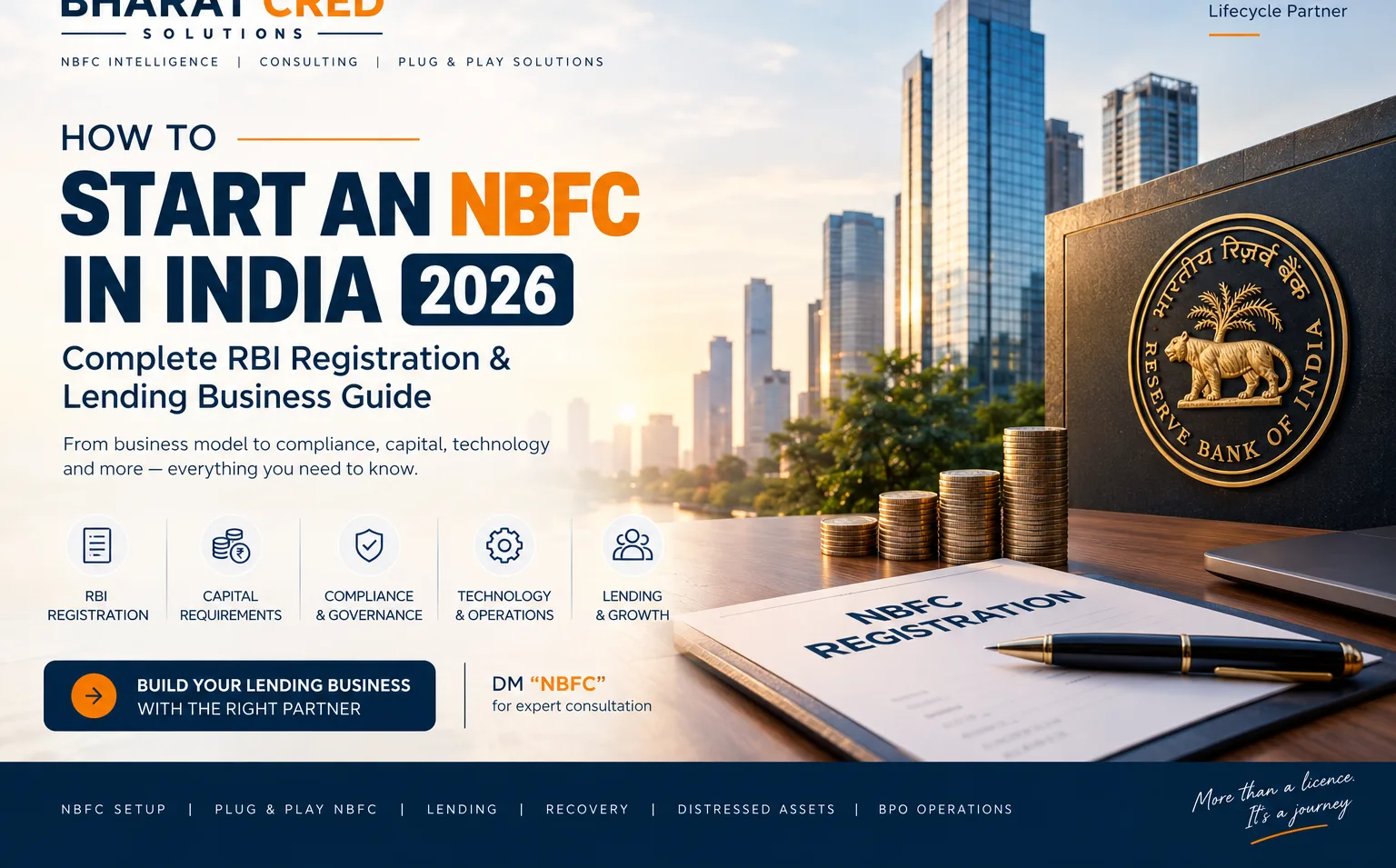
How to Start a Finance Company or NBFC in India in 2026? Complete RBI Registration & Lending Business Guide
Starting a finance company or lending business in India in 2026 is an opportunity—but it is not simply a company registration exercise.
If you are searching for how to start an NBFC in India, how to start a finance company, NBFC registration process, RBI NBFC licence requirements, minimum capital for an NBFC, or how to start a lending business, you need to understand the complete ecosystem before investing capital or choosing a business structure.
An NBFC business involves regulatory requirements, capital, governance, business planning, documentation, technology, underwriting, compliance, operations and collections.
This complete guide explains the major considerations for entrepreneurs, investors, fintech founders and businesses planning to enter India's lending and financial-services ecosystem in 2026.
Quick Answer: How Do You Start an NBFC in India?
The broad process involves:
Define your lending business model.
Determine whether an NBFC structure is actually required.
Select and structure the appropriate company.
Meet the applicable RBI capital and regulatory requirements.
Prepare the business plan and financial projections.
Establish appropriate governance and management structures.
Prepare the required documentation.
Submit the application through the applicable RBI process, including PRAVAAH where applicable.
Respond to regulatory queries and complete the approval process.
Prepare the business for post-registration operations.
Establish lending, underwriting, technology, compliance and collection systems.
Maintain ongoing RBI and other applicable regulatory compliance.
However, the correct route depends heavily on the proposed business model.
Starting an NBFC is therefore a business-structuring decision before it becomes a registration decision.
What Is an NBFC?
An NBFC, or Non-Banking Financial Company, is a company engaged in specified financial activities such as lending, investment and other regulated financial activities, subject to the applicable RBI framework.
An NBFC is different from a bank.
It operates within the regulatory framework applicable to non-banking financial companies and must comply with the requirements relevant to its category and activities.
For an entrepreneur, the important question is not simply:
"How do I register an NBFC?"
The better question is:
"What financial business am I trying to build, and what regulatory structure is appropriate for that business?"
That distinction can prevent expensive mistakes.
Why Are Entrepreneurs Exploring NBFC and Lending Businesses in 2026?
India's lending ecosystem continues to evolve across retail lending, business lending, fintech, digital lending, MSME finance and specialised credit.
Recent RBI data also indicates continued credit expansion among NBFCs. According to reporting based on RBI data, NBFC credit grew 14.4% year-on-year in June 2026, while retail lending growth accelerated to 20.3%.
This creates opportunities for:
Financial entrepreneurs
Fintech founders
Investors
Existing businesses
Lending platforms
Digital financial-services companies
Businesses looking to build credit products
But growth also comes with increased regulatory expectations.
That means a new lending business needs to think about regulation and operations together.
How to Start a Finance Company in India in 2026
Before applying for any licence, define your business model.
Ask:
What type of customers will you serve?
For example:
Individuals
MSMEs
Corporates
Self-employed professionals
Consumers
Specific industry segments
What type of loans will you provide?
Examples may include:
Business loans
Personal loans
MSME finance
Secured lending
Unsecured lending
Working capital finance
Asset-backed lending
Specialised lending products
How will customers be acquired?
Possible channels include:
Direct acquisition
Digital channels
Partnerships
Fintech platforms
Channel partners
Referral networks
Co-lending arrangements
How will loans be underwritten?
You need to consider:
Credit assessment
Risk policies
Documentation
Eligibility
Credit scoring
Fraud prevention
Loan approval workflows
How will collections happen?
A lending business needs a structured approach to:
Repayment monitoring
Customer communication
Collections
Field operations where applicable
Legal recovery
Portfolio monitoring
These questions should be answered before building the registration strategy.
Do You Actually Need an NBFC?
This is one of the most important questions.
Not every business involved in financial services should automatically begin by applying for an NBFC Certificate of Registration.
Depending on the business model, a company may explore different structures or partnerships.
Possible models can include:
NBFC
Fintech/LSP model
Lending partnership model
Co-lending arrangement
Channel/DSA model
Other permitted financial-services structures
The correct structure depends on what the business actually intends to do.
Do not choose an NBFC structure simply because you want to enter financial services.
First determine:
Who lends the money?
Who owns the loan book?
Who takes the credit risk?
Who deals with the customer?
Who performs underwriting?
Who handles collections?
Who is regulated for the activity?
These questions can materially change the appropriate business structure.
NBFC Registration Requirements in India
For businesses that do require NBFC registration, the RBI framework becomes central to the process.
The requirements can involve areas such as:
Company structure
The proposed business must have an appropriate corporate structure for the intended regulated activity.
Capital
The applicable Net Owned Fund and other financial requirements must be examined carefully.
Management
The experience, suitability and governance structure of the proposed management and directors can become important considerations.
Business model
The RBI needs to understand what the company intends to do and how the business will operate.
Financial projections
The business plan should demonstrate realistic financial assumptions and a sustainable operating model.
Governance
The company needs appropriate systems for decision-making, oversight and compliance.
Documentation
The application requires supporting documentation relevant to the proposed structure and business.
How Much Capital Is Required to Start an NBFC?
This is one of the most searched questions:
"How much money is required to start an NBFC in India?"
The answer should not be reduced to one number without considering the applicable category and current RBI framework.
For many conventional NBFC structures, the applicable Net Owned Fund requirement is a critical consideration.
However, founders should distinguish between:
Regulatory capital / Net Owned Fund
and
Total business capital required to actually build and operate the lending company.
Your total financial requirement may also include:
Technology
Employees
Compliance
Legal
Office and infrastructure
Loan origination systems
Loan management systems
Customer acquisition
Underwriting
Collections
Working capital
Operational reserves
Therefore:
Meeting a regulatory capital requirement does not automatically mean the business is financially ready to operate.
Important 2026 RBI Change: Certain Type I NBFCs and Deregistration
One of the important regulatory developments in 2026 concerns NBFCs that do not avail public funds and do not have customer interface.
Under the amended framework, qualifying NBFCs below the applicable ₹1,000 crore asset threshold can fall within an exemption from mandatory registration requirements, subject to the conditions prescribed by RBI.
Existing entities that meet the specified conditions may have a route to seek deregistration within the prescribed period.
This is particularly important for businesses that already hold a Type I NBFC registration but may no longer require it under the updated framework.
Therefore, in 2026, the question is not always:
"How do I obtain an NBFC licence?"
For some businesses, the relevant question may instead be:
"Does my company still require an NBFC Certificate of Registration under the current framework?"
This is an area where professional regulatory assessment is extremely important.
How to Apply for NBFC Registration
The registration process should be treated as a structured project rather than simply completing an online form.
A typical preparation process includes:
Step 1: Business Model Assessment
Define:
Lending products
Target customers
Geography
Funding model
Risk model
Customer acquisition
Technology
Collections
Step 2: Corporate Structuring
Review:
Shareholding
Directors
Capital
Objects
Group structure
Existing businesses
Step 3: Regulatory Assessment
Determine:
Applicable RBI category
Registration requirements
Capital requirements
Regulatory obligations
Whether an alternative model is more appropriate
Step 4: Business Plan
Prepare a detailed business plan covering:
Business objectives
Target market
Lending products
Credit policy
Risk management
Operations
Technology
Management
Financial projections
Step 5: Documentation
Prepare and verify the required supporting documents.
Step 6: RBI Application
Submit the application through the applicable RBI process, including the PRAVAAH portal where required.
Step 7: Regulatory Review
The application may involve further examination, clarifications and regulatory communication.
Step 8: Post-Approval Preparation
Once approval is obtained, the business still needs to establish its operating infrastructure.
Documents Required for NBFC Registration
The exact documentation depends on the business and applicable category.
Common areas of documentation may include:
Certificate of Incorporation
Constitutional documents
PAN and corporate information
Shareholding information
Director information
KYC documentation
Capital-related documents
Bank statements
Financial statements where applicable
Business plan
Financial projections
Board resolutions
Management profiles
Source-of-funds documentation
Organisational structure
Compliance policies
Operational information
The important point is:
Do not rely on a generic NBFC registration document checklist without checking the current RBI requirements applicable to your case.
What Should an NBFC Business Plan Contain?
A weak business plan can make an otherwise promising application look unprepared.
A strong business plan should clearly explain:
1. Business Model
What exactly will the NBFC do?
2. Target Market
Who will borrow?
3. Loan Products
What products will be offered?
4. Credit Policy
How will borrowers be evaluated?
5. Risk Management
How will credit, operational and other risks be managed?
6. Funding Strategy
Where will the company's funds come from?
7. Technology
How will applications, underwriting, servicing and reporting operate?
8. Collections
How will repayment and overdue accounts be managed?
9. Management
Who will operate the company?
10. Financial Projections
The projections should be realistic and aligned with the proposed business model.
NBFC Technology Setup: More Than Just a Website
A modern lending business needs technology that supports the complete lending lifecycle.
Depending on the business model, this can include:
Loan Origination System — LOS
For:
Lead capture
Application
Documentation
Verification
Credit assessment
Approval workflow
Loan Management System — LMS
For:
Loan accounts
Repayments
Interest
Schedules
Outstanding amounts
Portfolio monitoring
Underwriting System
For:
Credit assessment
Risk scoring
Decisioning
Policy implementation
Customer Portal / App
For:
Applications
Loan status
Documents
Repayments
Customer communication
Collection Technology
For:
Collection allocation
Follow-up
Payment tracking
Field operations
Reporting
APIs and Integrations
For:
KYC
Banking
Credit data
Payments
Communication
Internal systems
This is why launching an NBFC is not merely a licensing project.
It is an operating-system project for a financial business.
What Is an NBFC Plug & Play Model?
For entrepreneurs who don't want to build every component from zero, a Plug & Play NBFC approach can be explored.
The concept is to bring multiple components of the lending ecosystem together instead of building them independently.
Depending on the proposed structure and requirements, this can involve:
NBFC acquisition or fresh setup
Licensing and documentation
Business structuring
Lending partnerships
Technology
LMS
Underwriting
Applications
APIs
Operations
SOPs
CRM
Hiring
Collections
Legal recovery infrastructure
Bharat Cred Solutions positions its NBFC setup offering around this integrated approach, including greenfield or acquisition structuring, technology, underwriting, operations and collections.
Why does this matter?
Because entrepreneurs often try to solve each problem separately:
Consultant → registration
Developer → technology
Recruiter → employees
Agency → customer acquisition
Collection agency → recovery
That creates fragmented execution.
A Plug & Play approach aims to bring the relevant components together under one coordinated strategy.
NBFC Acquisition vs Fresh NBFC Setup
Entrepreneurs may also evaluate whether to:
Build a fresh NBFC
or
Explore acquisition of an existing NBFC
Neither option should automatically be considered better.
The right choice depends on factors such as:
Regulatory status
Business category
Financial history
Compliance history
Assets and liabilities
Shareholding
Existing operations
Business objectives
Due diligence findings
An acquisition also requires careful legal, financial and regulatory due diligence.
Never purchase an existing NBFC simply because it already has a Certificate of Registration.
The company's history and regulatory position matter.
Can a Fintech Start Lending Without Becoming an NBFC?
This is another major search question.
The answer depends on the actual role the fintech plays.
A technology company may participate in lending through permitted arrangements with regulated entities, but the structure must be designed carefully.
Questions include:
Who is the regulated lender?
Who provides the funds?
Who makes the credit decision?
Who owns the loan?
Who interfaces with customers?
What technology role does the fintech perform?
What regulatory obligations apply?
This is why "fintech lending" and "becoming an NBFC" are not necessarily the same decision.
Common Mistakes When Starting an NBFC
Mistake 1: Treating NBFC registration like company registration
Incorporating a company and becoming an RBI-regulated NBFC are different matters.
Mistake 2: Starting with a generic business plan
The business model should drive the business plan.
Mistake 3: Ignoring technology
A licence alone doesn't create a functioning lending operation.
Mistake 4: Ignoring collections
Every lending business needs a realistic repayment and recovery strategy.
Mistake 5: Looking only at initial capital
Operational funding is also important.
Mistake 6: Choosing a structure before understanding the business
Start with the business model.
Then choose the structure.
Mistake 7: Assuming Plug & Play means "instant licence"
Plug & Play should not be confused with bypassing RBI requirements.
It is an execution and infrastructure approach—not a shortcut around regulation.
Mistake 8: Ignoring post-registration compliance
Obtaining registration is not the end of regulatory responsibility.
NBFC Compliance After Registration
Once an NBFC is operational, ongoing compliance becomes part of the business.
Depending on the applicable regulatory framework and business category, areas may include:
RBI returns
Financial reporting
Governance
Fair practices
Customer protection
Grievance handling
KYC/AML requirements
Credit reporting
Prudential requirements
Asset classification
Capital requirements
Digital lending requirements where applicable
This is why founders should build compliance into the operating model from day one.
Who Should Consider Starting an NBFC?
An NBFC structure may be worth exploring for:
Entrepreneurs
Who want to build a lending business.
Fintech Founders
Who want to move deeper into the lending ecosystem.
Investors
Who want exposure to financial services.
Existing Businesses
That have identified a financing opportunity within their industry.
Lending Platforms
That want to evaluate their own regulated lending structure.
Financial Services Entrepreneurs
Who want to build a scalable credit business.
However, suitability depends on the proposed business model, capital, governance, regulatory requirements and execution capability.
Who Should Consider an NBFC Plug & Play Approach?
A Plug & Play approach may be worth discussing when an entrepreneur wants to build a lending ecosystem but does not want to coordinate every component independently.
It can be particularly relevant for:
Fintech startups
Investors
Entrepreneurs
Existing NBFCs
Businesses entering lending
Companies exploring NBFC acquisition
Founders looking for technology + operations + regulatory coordination
The exact scope should be determined according to the business model.
How Bharat Cred Solutions Can Help
Building an NBFC or lending business requires more than filling out forms.
Bharat Cred Solutions works across the financial-services lifecycle.
NBFC Setup
Support around:
Fresh NBFC setup
Acquisition structuring
Licensing
Documentation
Business planning
Plug & Play NBFC
Integrated support around:
Technology
LMS
Underwriting
App
APIs
Operations
SOPs
CRM
Hiring
Collections
Lending Support
Including:
Customer acquisition
Lender matchmaking
Eligibility support
Channel partnerships
Recovery & Collections
Including:
Soft collection
Field recovery
Legal support
Tracing
Portfolio support
Distressed Assets
Including:
NPA acquisition support
OTS execution
Debt resolution
Investor-led opportunities
Bharat Cred's current service architecture is built around connecting NBFC setup, lending, recovery, distressed assets and outsourced operations rather than treating each function as an isolated service.
Why Choose an Integrated NBFC Setup Partner?
If you are building a lending business, you may need multiple specialists.
But coordination itself becomes a problem.
An integrated approach can help bring together:
Regulatory understanding
Business structuring
Technology
Operations
Underwriting
Collections
Compliance
The objective is simple:
Build the business as one system instead of assembling disconnected pieces.
Frequently Asked Questions About NBFC Registration
How can I start an NBFC in India?
You need to first determine the appropriate business model and regulatory category, then evaluate corporate structure, capital, management, documentation, business planning and the applicable RBI registration process.
How much capital is required for an NBFC?
The applicable Net Owned Fund requirement depends on the relevant regulatory framework and category. Founders should also budget separately for operational and technology requirements.
Can I start a lending business without an NBFC?
Potentially, depending on the business model and the role of the company. Partnership and fintech/LSP structures may be relevant in certain circumstances, but the regulatory structure must be evaluated carefully.
How long does NBFC registration take?
There is no universal guaranteed timeline. It depends on the quality of preparation, regulatory review, queries and the specific application.
What documents are required for NBFC registration?
Documents can include corporate records, capital information, director and shareholder details, business plans, financial projections and other supporting documents depending on the application.
What is PRAVAAH?
PRAVAAH is RBI's platform used for various regulatory applications and submissions. The applicable application route should be confirmed for the specific regulatory matter.
What is an NBFC Certificate of Registration?
It is the RBI registration authorising an eligible entity to undertake the relevant NBFC activities subject to applicable law and regulation.
Can an NBFC surrender its Certificate of Registration?
Yes, RBI has a process for voluntary surrender/cancellation of CoR, subject to the prescribed application, documentation and regulatory process.
What is NBFC Plug & Play?
It is an integrated approach to building an NBFC/lending ecosystem where relevant components such as setup, technology, underwriting, operations and collections can be coordinated rather than developed independently.
Is buying an existing NBFC better than starting a new one?
Not necessarily. Existing NBFC acquisition requires detailed legal, financial and regulatory due diligence. The better route depends on the specific opportunity.
Final Checklist Before Starting an NBFC
Before investing significant capital, ask yourself:
Business
☐ What exactly will we lend?
☐ Who are our customers?
☐ What is our competitive advantage?
Regulation
☐ Do we actually require an NBFC structure?
☐ Which regulatory category applies?
☐ What are the current capital requirements?
Management
☐ Do we have appropriate management capability?
☐ Is the governance structure suitable?
Capital
☐ Is the required capital available?
☐ Have we planned operating capital separately?
Technology
☐ How will we originate loans?
☐ How will we underwrite?
☐ How will we manage loans?
☐ How will customers interact with us?
Operations
☐ Who will run the business?
☐ What SOPs are required?
☐ How will compliance be managed?
Recovery
☐ How will overdue accounts be handled?
☐ Do we have an appropriate collections infrastructure?
Growth
☐ How will we acquire customers?
☐ What partnerships will we need?
☐ What will our lending economics look like?
If these questions do not have clear answers, the business is probably not ready for registration.
Conclusion: Starting an NBFC Is a Business Decision, Not Just a Licence
The biggest mistake an entrepreneur can make is thinking:
"Once I get the NBFC licence, the business will start."
The licence is only one part of the journey.
A successful lending business requires:
Regulatory structure
→ Capital
→ Business model
→ Technology
→ Underwriting
→ Operations
→ Customer acquisition
→ Collections
→ Compliance
→ Continuous management
That is why founders should evaluate the complete business ecosystem before choosing their route.
If you are planning to start an NBFC, launch a lending business, explore an NBFC acquisition, build a fintech lending model, or evaluate an NBFC Plug & Play solution, start with the business model—not the paperwork.
Planning to enter India's lending or NBFC ecosystem?
Talk to Bharat Cred Solutions about your proposed business model, NBFC setup, Plug & Play requirements, lending infrastructure and execution strategy.
Bharat Cred Solutions
Your Financial Lifecycle Partner
NBFC Setup | Plug & Play NBFC | Lending | Recovery | Distressed Assets | BPO Operations
Have a specific question about this?
Talk it through with our team on a strategy call.