
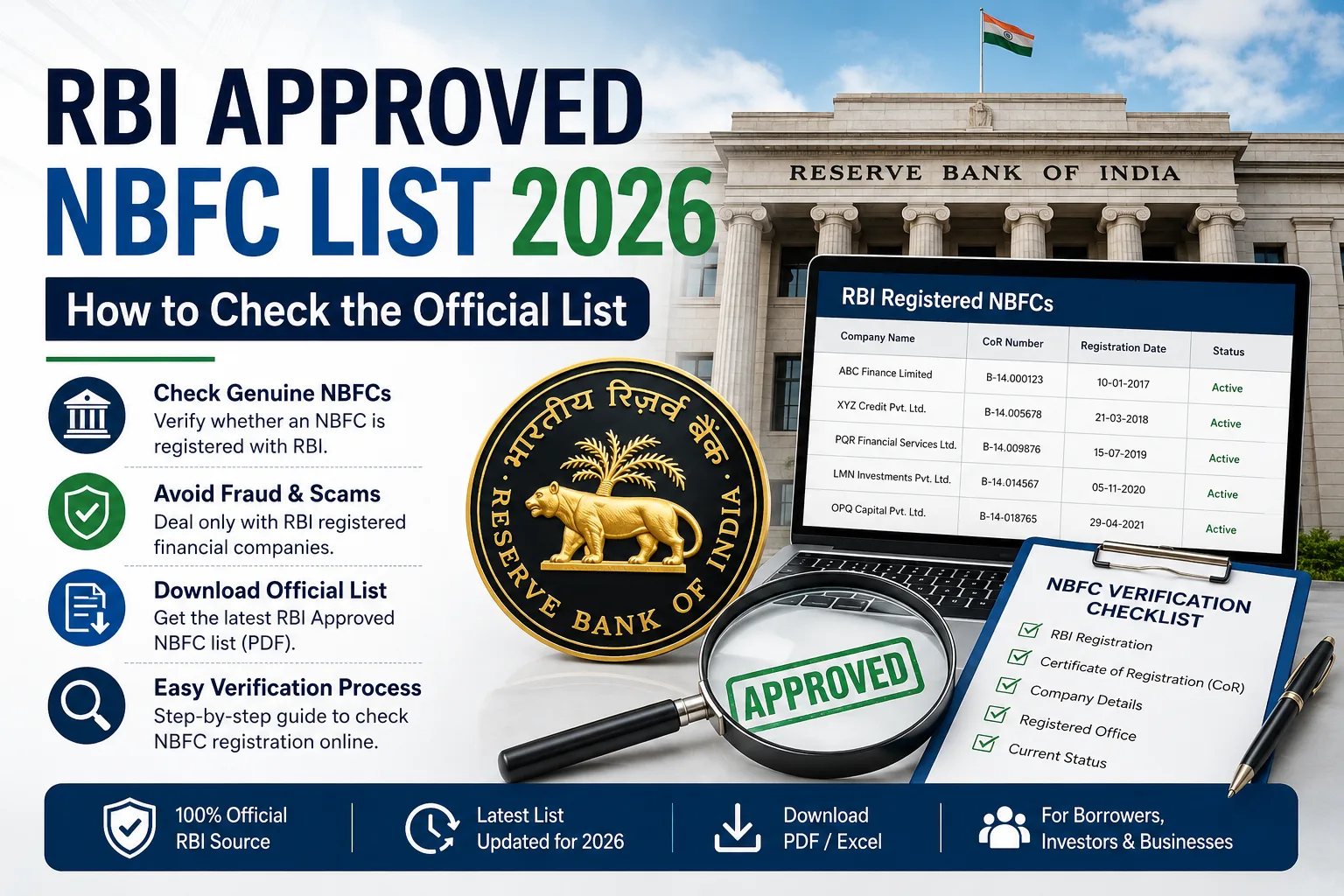
Looking for the RBI Approved NBFC List 2026 ?
You're not alone.
Thousands of entrepreneurs, investors, lenders, fintech startups, borrowers, and business owners search every month to verify whether an NBFC is genuinely registered with the Reserve Bank of India (RBI).
With the rapid rise of digital lending platforms and financial service providers, it has become increasingly important to distinguish between:
RBI Registered NBFCs
Fake NBFCs
Unauthorized Lending Apps
Companies falsely claiming RBI approval
Before applying for a loan, partnering with an NBFC, investing in a finance company, or purchasing an existing NBFC, you should always verify its registration status through the official RBI records.
Best Solution for NBFCs - Plug & Play NBFC
Click here to Download - rbi approved nbfc list 2026 pdf download
Click here to Download - list of nbfc licence cancelled by rbi 2026 pdf download
This comprehensive guide explains:
What the RBI Approved NBFC List is
How to verify an NBFC online
Where to find the official RBI database
Types of RBI registered NBFCs
How RBI grants approval
Why companies are removed from the list
Common mistakes people make while verifying an NBFC
Frequently Asked Questions
By the end of this guide, you'll know exactly how to confirm whether an NBFC is legally authorized to operate in India.
What is an RBI Approved NBFC?
An RBI Approved NBFC (Non-Banking Financial Company) is a company that has obtained a valid Certificate of Registration (CoR) from the Reserve Bank of India under the provisions of the Reserve Bank of India Act, 1934.
Only after receiving this approval can an NBFC legally commence regulated financial activities.
An RBI-approved NBFC may provide services such as:
Business Loans
MSME Loans
Personal Loans
Vehicle Finance
Gold Loans
Infrastructure Finance
Housing Finance (through applicable regulations)
Invoice Financing
Supply Chain Financing
Asset Financing
Microfinance
Leasing
Hire Purchase
Investment Activities
Not every finance company operating in India is an RBI-approved NBFC. Businesses offering financial services without RBI authorization may be operating illegally or under a different regulatory framework.
That is why checking the official RBI list is an essential step before engaging with any financial institution.
Why is the RBI Approved NBFC List Important?
The RBI Approved NBFC List serves as the official record of all licensed NBFCs authorized to operate in India.
Verifying an NBFC helps protect individuals and businesses from fraud while ensuring they deal only with legally registered financial institutions.
Key Benefits of Checking the RBI List
✔ Confirms whether the company holds a valid RBI Certificate of Registration.
✔ Helps identify fake or unauthorized lenders.
✔ Verifies the legal name of the NBFC.
✔ Shows the current operational status of the company.
✔ Helps investors conduct due diligence.
✔ Assists businesses planning strategic partnerships.
✔ Supports borrowers in choosing legitimate financial institutions.
✔ Reduces the risk of financial fraud.
Who Should Check the RBI Approved NBFC List?
The official RBI list is valuable for a wide range of stakeholders, including:
Entrepreneurs
Planning to establish or acquire an NBFC.
Investors
Conducting due diligence before investing in financial companies.
Loan Applicants
Verifying whether the lender is legally authorized.
Fintech Companies
Ensuring compliance while partnering with NBFCs.
Banks
Verifying financial partners and lending institutions.
Chartered Accountants (CAs)
Performing regulatory compliance checks.
Company Secretaries (CS)
Assisting clients with corporate due diligence.
Lawyers
Reviewing financial entities during legal transactions.
Business Owners
Selecting trustworthy lending partners.
What Information Does the RBI Approved NBFC List Contain?
The RBI database typically includes key information about each registered NBFC, such as:
Company Name
Certificate of Registration Status
Registered Office
RBI Registration Details
Category of NBFC
Operational Status
Regulatory Classification
Licensing Information
This enables users to confirm whether a company is officially recognized by the Reserve Bank of India.
Is the RBI Approved NBFC List Public?
Yes.
The Reserve Bank of India maintains a publicly accessible database of registered NBFCs, allowing anyone to verify the registration status of a financial company.
This public database is frequently updated to reflect changes such as:
New registrations
Licence cancellations
Company mergers
Name changes
Regulatory actions
Surrender of licences
Business closures
For this reason, users should always consult the latest available information before making any financial decisions.
How Does RBI Approve an NBFC?
Obtaining RBI approval is a rigorous process designed to ensure that only qualified and compliant entities enter the financial sector.
A company must satisfy several regulatory conditions before the RBI grants a Certificate of Registration.
These conditions generally include:
Incorporation
The company must be incorporated under the Companies Act.
Minimum Net Owned Funds (NOF)
The applicant must meet the RBI's prescribed minimum Net Owned Fund requirement.
Fit and Proper Management
Promoters and directors are assessed for integrity, financial soundness, and professional competence.
Business Plan
The proposed business model must demonstrate long-term sustainability and regulatory compliance.
Governance Structure
The company must establish appropriate governance policies, risk management systems, and internal controls.
Documentation
Applicants are required to submit extensive legal, financial, and operational documentation for RBI review.
Only after a comprehensive examination does the RBI issue a Certificate of Registration, authorizing the company to operate as an NBFC.
Different Types of RBI Registered NBFCs
The RBI regulates various categories of NBFCs based on the nature of their business activities.
Some common categories include:
Investment and Credit Companies (ICC)
These entities provide loans, financing, leasing, and investment-related services.
Infrastructure Finance Companies (IFC)
Specialize in financing large-scale infrastructure projects.
Micro Finance Institutions (NBFC-MFI)
Offer financial services to low-income individuals and underserved communities.
Housing Finance Companies (HFC)
Provide housing loans and mortgage-related financial products under the applicable regulatory framework.
Core Investment Companies (CIC)
Primarily invest in shares and securities of group companies.
Infrastructure Debt Funds
Facilitate long-term infrastructure financing.
Account Aggregators
Operate under RBI guidelines to enable secure financial data sharing with customer consent.
Peer-to-Peer Lending Platforms (NBFC-P2P)
Facilitate lending transactions between borrowers and individual lenders through regulated online platforms.
NBFC-Factor
Provide receivables financing and invoice discounting services for businesses.
====================================================================================================================================================================================================================================================================================
How to Check the RBI Approved NBFC List Online (Step-by-Step Guide)
One of the most common questions people ask is:
"How can I verify whether an NBFC is really registered with the RBI?"
The good news is that the Reserve Bank of India (RBI) provides an official database where anyone can verify the registration status of an NBFC. This database includes RBI-registered NBFCs and separate information about entities whose Certificates of Registration (CoR) have been cancelled.
Whether you're applying for a loan, investing in a finance company, planning a business partnership, or purchasing an existing NBFC, always verify the company's registration before proceeding.
Step-by-Step Process to Verify an RBI Registered NBFC
Step 1: Visit the Official RBI Website
Always begin your search using the official Reserve Bank of India website.
Avoid relying on third-party websites, blogs, or social media posts that may contain outdated or inaccurate information.
The RBI is the only authoritative source for verifying whether an NBFC is officially registered.
Step 2: Navigate to the NBFC Section
Within the RBI website, go to the Non-Banking Financial Companies (NBFCs) section.
Here you'll find resources including:
List of Registered NBFCs
List of Cancelled NBFCs
Notifications
Registration Forms
Regulatory Circulars
FAQs
The RBI periodically updates these records as companies receive new registrations, surrender licences, or have their Certificates of Registration cancelled.
Step 3: Search for the Company Name
Enter the exact legal name of the company.
Be careful not to search using:
Brand names
Trade names
Mobile app names
Abbreviations
Always verify the registered company name appearing in its incorporation documents or official website.
Step 4: Verify the Registration Status
If the company appears in the RBI database, review the available information carefully.
Typical details include:
Company Name
Registered Office
NBFC Category
Registration Status
Certificate of Registration information
If you cannot find the company, do not immediately assume it is fraudulent. There could be legitimate reasons, such as a recent name change or an application that is still under process. However, if a company claims to be RBI registered but does not appear in the official records, you should proceed with caution and verify directly through RBI resources.
Can You Download the RBI Approved NBFC List?
Yes.
The RBI publishes downloadable lists of registered NBFCs and separate lists of entities whose Certificates of Registration have been cancelled. These are updated periodically and made available through the RBI's NBFC section.
Because registrations, cancellations, mergers, and name changes occur over time, always refer to the latest version rather than relying on older copies.
What Information is Available in the RBI NBFC List?
The RBI list provides valuable information that helps users verify a company's regulatory status.
Depending on the category and publication, information may include:
Registered Company Name
Registered Office Address
NBFC Category
Certificate of Registration Status
Regulatory Classification
Operational Status
This information helps borrowers, investors, and businesses make informed decisions before entering into financial relationships.
Types of RBI Registered NBFCs
Many people assume that every NBFC performs the same function.
In reality, the RBI regulates multiple categories of NBFCs, each serving different financial purposes.
Investment and Credit Company (NBFC-ICC)
These are among the most common NBFCs in India.
They may provide:
Personal Loans
Business Loans
Vehicle Finance
Equipment Finance
Consumer Finance
Investment Activities
NBFC–Micro Finance Institution (NBFC-MFI)
These institutions focus on providing financial services to low-income households and underserved communities.
Typical services include:
Small Business Loans
Women's Entrepreneurship Loans
Rural Finance
Livelihood Support
NBFC–Peer-to-Peer Lending Platform (NBFC-P2P)
These entities operate regulated online platforms that connect borrowers with lenders.
They facilitate lending but do not function like traditional banks.
Account Aggregator (NBFC-AA)
Account Aggregators help customers securely share financial information between regulated financial institutions after obtaining customer consent.
They are an important part of India's digital financial ecosystem.
Core Investment Company (CIC)
These companies primarily hold investments in group companies rather than engaging in conventional lending activities.
Infrastructure Finance Company (IFC)
Infrastructure Finance Companies focus on financing large infrastructure projects such as roads, ports, power generation, transportation, and urban development.
NBFC-Factor
These NBFCs specialize in receivables financing and invoice discounting, helping businesses improve cash flow by financing outstanding invoices.
How to Identify Fake NBFCs
One of the biggest mistakes borrowers make is assuming that every company offering loans is RBI registered.
Unfortunately, fraudulent entities often misuse terms such as:
RBI Approved
RBI Authorized
Government Certified
Registered Finance Company
without actually holding a valid Certificate of Registration.
Before dealing with any lender, verify the following:
✔ Company appears in the official RBI records.
✔ The legal company name matches official documents.
✔ The website clearly displays corporate information.
✔ Contact details are genuine.
✔ The company does not make unrealistic promises such as "Guaranteed Loan Approval" or "Instant RBI Approved Loan."
Red Flags to Watch For
Be cautious if a finance company:
Claims RBI approval but cannot provide verifiable details.
Uses only a mobile number without a corporate address.
Demands large upfront fees before processing a loan.
Avoids sharing company registration information.
Operates exclusively through messaging apps.
Promises unrealistic returns or guaranteed approvals.
If you encounter an entity conducting NBFC activities without appearing in the RBI's list of authorised NBFCs, RBI advises informing the appropriate authorities.
Why Verifying an NBFC Matters
Whether you are:
Taking a loan,
Investing in a finance company,
Partnering with an NBFC,
Acquiring an NBFC,
Or conducting business due diligence,
verification is an essential first step.
It helps you:
Reduce fraud risk
Confirm regulatory compliance
Improve due diligence
Build confidence in financial transactions
Make informed business decisions
In the next section, we'll discuss why NBFCs may disappear from the RBI list, how RBI cancels Certificates of Registration, common compliance failures, and a practical checklist you can use before dealing with any finance company.
==============================================================================================================================================================================================================================================================================
Why an NBFC May Not Appear in the RBI Approved List
Finding that a finance company is missing from the RBI Approved NBFC List can be concerning. However, there isn't always a single explanation.
In some cases, the company may be operating legally under a different regulatory framework. In others, it could indicate that the business is not authorized to conduct NBFC activities.
Understanding the possible reasons can help you make informed decisions before entering into any financial transaction.
1. The Company is Not Registered as an NBFC
The most straightforward reason is that the company has never obtained a Certificate of Registration (CoR) from the Reserve Bank of India.
Some businesses provide financial advisory, consultancy, or technology services related to finance but do not operate as NBFCs. Such companies are not required to appear in the RBI's NBFC list if they are not undertaking regulated NBFC activities.
Always verify what services the company actually provides.
2. The Registration Process is Still Underway
A company may have applied for NBFC registration but has not yet received RBI approval.
Until the RBI grants the Certificate of Registration, the company should not represent itself as an RBI-registered NBFC.
If someone claims that their "approval is under process," ask for clarification and avoid assuming they already hold RBI authorization.
3. The Company Name Has Changed
Companies occasionally change their legal name due to:
Rebranding
Mergers
Corporate restructuring
Business acquisitions
If you cannot find the company under its current trading name, search using its legal corporate name.
4. The Certificate of Registration Has Been Cancelled
The RBI has the authority to cancel an NBFC's Certificate of Registration if the company fails to comply with regulatory requirements or no longer satisfies the conditions under which approval was granted.
For this reason, it is important to verify not only that a company appears in historical records, but that its registration remains valid.
5. The Company Has Voluntarily Surrendered its Licence
Some NBFCs choose to discontinue regulated financial activities and voluntarily surrender their Certificate of Registration.
In such cases, they will no longer be authorized to operate as NBFCs even though they may continue other lawful business activities.
Why Does RBI Cancel an NBFC Registration?
The Reserve Bank of India continuously supervises NBFCs to ensure the stability of India's financial system.
If an NBFC fails to comply with applicable regulations, the RBI may take supervisory or regulatory action, including cancellation of its Certificate of Registration where warranted.
Examples of situations that may lead to regulatory action include:
Failure to maintain prescribed regulatory requirements
Serious compliance deficiencies
Persistent non-compliance with RBI directions
Misrepresentation of information
Unsafe or unsound business practices
Failure to conduct the approved business activities
Voluntary discontinuation of NBFC operations
Every case is assessed on its own facts and applicable legal provisions.
How to Verify an NBFC Before Taking a Loan
Before applying for a loan or entering into a financial arrangement, perform a basic due diligence review.
Verification Checklist
Confirm RBI Registration
Verify the company's registration using the official RBI resources.
Verify Company Incorporation
Check whether the company is properly incorporated under the Companies Act.
Review the Official Website
A legitimate financial institution should generally have:
Corporate information
Registered office details
Contact information
Privacy policy
Terms and conditions
Regulatory disclosures
Verify Customer Support
Confirm that the company provides genuine business contact details rather than relying solely on messaging applications or personal mobile numbers.
Read Customer Reviews Carefully
Customer reviews can provide useful insights, but they should not replace official regulatory verification.
Look for consistent feedback regarding:
Transparency
Professionalism
Customer support
Complaint handling
Understand the Loan Terms
Never accept financial products without reviewing:
Interest rates
Processing charges
Repayment terms
Penalties
Applicable fees
RBI Compliance Requirements for NBFCs
Obtaining RBI registration is only the beginning.
Every registered NBFC must continue complying with ongoing regulatory obligations throughout its operations.
Compliance requirements vary depending on the category of NBFC and applicable regulations.
These may include areas such as:
Regulatory reporting
Governance
Financial reporting
Risk management
Internal controls
Customer due diligence
Record keeping
Statutory audits
Board oversight
Maintaining a strong compliance framework is essential for long-term operational stability.
Common Compliance Challenges
As NBFCs grow, compliance responsibilities become more complex.
Some common challenges include:
Managing regulatory updates
Preparing timely filings
Strengthening governance
Maintaining internal policies
Managing operational risks
Ensuring regulatory documentation remains current
Many NBFCs engage specialized consultants to support their ongoing compliance and regulatory obligations.
Planning to Start Your Own NBFC?
If you're considering entering India's financial services sector, understanding the RBI framework is only the first step.
Successfully establishing an NBFC requires careful planning, appropriate documentation, business structuring, compliance preparation, and long-term regulatory management.
At Bharat Cred Solutions, we provide comprehensive advisory services for entrepreneurs, startups, investors, and financial institutions.
Our services include:
Bharat Cred's Plug & Play NBFC Solution
Launching an NBFC involves more than obtaining regulatory approval.
Businesses also need operational infrastructure, technology, compliance systems, manpower, and lending processes.
To simplify this journey, Bharat Cred Solutions offers its NBFC Plug & Play System.
This integrated solution is designed to support eligible businesses with:
Operational Readiness
Lending Infrastructure
Compliance Guidance
Technology Advisory
Business Process Support
Strategic Consulting
Instead of building everything independently, entrepreneurs can establish their financial business with guidance from experienced professionals while remaining focused on growth and customer acquisition.
In the final section of this guide, we'll answer the most frequently asked questions about the RBI Approved NBFC List, provide expert recommendations, and explain how Bharat Cred Solutions can assist with NBFC registration and long-term regulatory compliance.
====================================================================================================================================================================================================================================================================================
Frequently Asked Questions (FAQs)
1. What is the RBI Approved NBFC List?
The RBI Approved NBFC List is the official database maintained by the Reserve Bank of India that contains details of Non-Banking Financial Companies (NBFCs) holding a valid Certificate of Registration (CoR). It helps borrowers, investors, and businesses verify whether an NBFC is legally authorized to operate.
2. How can I check if an NBFC is registered with the RBI?
You can verify an NBFC by visiting the official Reserve Bank of India website and searching the NBFC database using the company's legal name. Always rely on RBI's official records instead of third-party websites.
3. Is every finance company in India an NBFC?
No. Many finance-related businesses operate as consultants, fintech service providers, financial advisors, or software companies. Only companies that have received a Certificate of Registration from the RBI can legally operate as registered NBFCs.
4. Can I download the RBI Approved NBFC List?
Yes. The Reserve Bank of India periodically publishes updated lists of registered NBFCs and entities whose registrations have been cancelled. Always use the latest version available through RBI's official resources.
5. What is a Certificate of Registration (CoR)?
A Certificate of Registration (CoR) is the official approval issued by the Reserve Bank of India that authorizes an eligible company to operate as an NBFC under applicable regulations.
6. Why should I verify an NBFC before taking a loan?
Verification helps ensure that you are dealing with a legally registered financial institution. It reduces the risk of fraud, protects your financial interests, and confirms that the company operates under RBI's regulatory framework.
7. What happens if an NBFC is not listed on the RBI website?
There could be several reasons:
The company is not registered as an NBFC.
The registration process is still pending.
The company has changed its legal name.
The Certificate of Registration has been cancelled.
The company voluntarily surrendered its licence.
If an entity claims to be RBI approved but cannot be verified through official records, exercise caution.
8. Can RBI cancel an NBFC licence?
Yes. The RBI has the authority to cancel an NBFC's Certificate of Registration in accordance with applicable laws and regulations if regulatory requirements are not met or the company no longer satisfies licensing conditions.
9. How long does NBFC Registration take?
The timeline depends on several factors, including documentation quality, business preparedness, regulatory review, and the complexity of the proposed business model.
10. What is the minimum capital requirement for NBFC Registration?
Capital requirements are prescribed under the applicable regulatory framework and may change over time. Entrepreneurs should always refer to the latest RBI regulations or consult experienced professionals before planning their investment.
11. Can foreign investors establish an NBFC in India?
Foreign investment may be permitted in accordance with applicable FDI policies, RBI regulations, and other relevant laws. Professional regulatory guidance is recommended before proceeding.
12. Do all lending businesses require NBFC Registration?
Not necessarily. Whether registration is required depends on the business model and the nature of the proposed financial activities. Businesses should evaluate applicable regulatory requirements before commencing operations.
13. What are the main compliance responsibilities of an NBFC?
Compliance obligations vary depending on the category of NBFC but generally include regulatory reporting, governance, risk management, statutory audits, financial reporting, customer due diligence, and internal control systems.
14. Can I purchase an existing NBFC instead of registering a new one?
Yes. Subject to applicable legal and regulatory requirements, entrepreneurs may explore the acquisition of an existing NBFC. Proper legal, financial, and regulatory due diligence is essential before any transaction.
15. How can Bharat Cred Solutions help?
Bharat Cred Solutions provides end-to-end support for:
Why Choose Bharat Cred Solutions?
Establishing and operating an NBFC requires much more than submitting an application to the RBI.
It involves careful planning, business structuring, documentation, compliance management, operational readiness, and long-term regulatory support.
At Bharat Cred Solutions, we help entrepreneurs, startups, financial institutions, investors, and business owners build compliant and scalable financial businesses.
Our Expertise Includes:
Unlike traditional consultants who focus only on obtaining registration, we assist businesses throughout their growth journey.
Bharat Cred Plug & Play NBFC System
Launching an NBFC successfully requires multiple operational components beyond regulatory approval.
To simplify this process, Bharat Cred Solutions has developed its NBFC Plug & Play System.
Our integrated ecosystem helps eligible businesses accelerate operational readiness by supporting:
Business Planning
Operational Setup
Lending Infrastructure
Compliance Framework
Technology Advisory
Process Design
Business Growth Strategy
Long-Term Regulatory Support
Whether you're starting from scratch or expanding an existing financial business, our experts help you navigate each stage with confidence.
Final Thoughts
The RBI Approved NBFC List 2026 is one of the most valuable resources for anyone involved in India's financial services sector.
Whether you're a borrower, investor, entrepreneur, fintech founder, or business owner, verifying an NBFC before entering into any financial relationship is an essential step.
Working only with RBI-registered financial institutions helps reduce risk, improve transparency, and ensure regulatory compliance.
If you're planning to establish an NBFC or need guidance regarding RBI regulations, documentation, licensing, or ongoing compliance, seeking professional assistance can help you avoid costly mistakes and streamline the process.
Need Expert Guidance?
Bharat Cred Solutions provides comprehensive advisory services for entrepreneurs, fintech companies, investors, and financial institutions looking to establish or expand regulated financial businesses in India.
Our Services
📞 Book a Free Consultation Today
Our experts will help you understand your business model, evaluate regulatory requirements, and recommend the most suitable approach for your financial services venture.
Related Articles
Continue exploring our Knowledge Center:
NBFC Registration Online: Complete Process, Requirements & RBI Approval
How to Register an NBFC in India: Complete Step-by-Step Guide
Expert Tip: Always verify an NBFC through official RBI records before taking a loan, investing, or entering into a business partnership. A few minutes of verification today can help prevent significant financial and legal risks in the future.
Have a specific question about this?
Talk it through with our team on a strategy call.